- Thursday, 28 May 2026

Losers Want The Goal Post Changed
 P Kharel
P Kharel
P Kharel
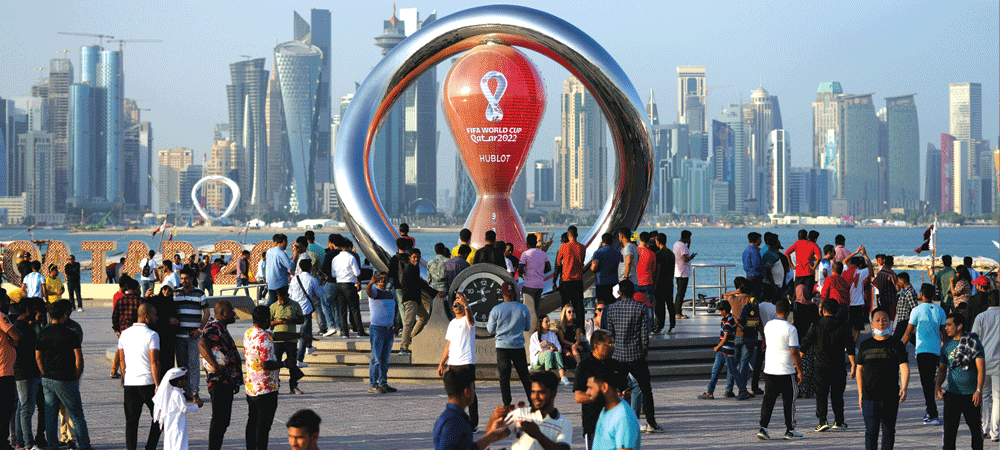
Hosted by the oil-rich tiny, but managerially one of the most successful sporting hosts, Qatar is drawing criticism from human rights groups and the Western press. One video channel concluded that the World Cup 2022 in Qatar is “the most corrupt sporting event ever”.
Really? Far from so.
With a very small population—the smallest for a World Cup host—the sheikhdom was the target of vile attacks from the time it was named for this year’s contest that also happens to be the first in the editions to be held in winter.
Intense prestige and national pride attached to holding aloft trophies and flashing medals in all their glitter and glory add to the competitions. Likewise, the privilege of playing venue to a spectacle such as soccer’s weighs in enormous value.
High stakes are involved because of the game’s politicisation in the name of national pride and fan euphoria, commercial interests (trade, tourism, advertisers and revenue seekers) and the general news media as well as sports-focused channels. Hence deep digging is done for scandals, imagined or otherwise.
Qatari outplay
Envious of being outbid by a micro state of less than 350,000 citizens, sour-grapes complaints began darting at the 2022 host from the very beginning. The controversy circulated by the wannabes that failed in winning the bidding made its round that bribery had played a gigantic role.
Suspicions alone don’t work in these matters. For many sports organisations have dubious distinctions of playing foul in many ways in the course of naming hosts, exerting pressure or going easy on an organiser, coordinating covertly with the hosts in drawing commercial sponsorships and other related revenues.
Those kind of charges do not stick strongly. For instance, many events that are decided on the basis of match points are plagued by accusations of unfair verdict. In boxing, countries that generally do not make it even to the quarter finals believe that their players will not win any match on points basis, unless a knockout is brought about.
Latin America, Africa, West Asia, South Asia and South East Asia are yet to host the soccer summit.
Qatar withstood the gauntlet thrown on it by Saudi Arabia, Egypt, the United Arab Emirates, Yemen, Bahrain and the Maldives, which snapped diplomatic relations with the world’s fourth
richest country and clamped economic sanctions
in June 2017. The Arab world’s richest state steered the course of the conflict with characteristic resolution but without resorting to venomous war of words.
Three and a half years later, the sanctions were lifted, but without Qatar ever buckling in any way. The borders were reopened, air and sea travel normalised, and trade ties revived to previous levels. Out of the crisis Qatar has emerged with an image larger than it had prior to the conflict, emerging successful in managing state affairs, planning development endeavours and building infrastructure with long term perspectives on a scale that is an envy of not only its Arab neighbours but also most other countries.
The world at large watches the events unfold, with silent appreciation of the sheikhdom that is showcasing its financial and managerial prowess to the avidly attracted global audiences on account of the euphorically awaited on-going four-week, 64-match fare with a 32-team lineup.
China hosted the 2021 Winter Olympics but not without vitriolic attacks from the West, ostensibly in protest against alleged human rights violations against Muslims in the Xinjiang region. That the Islamic Organisation has not issued any criticism concerning the Western allegations has supported Beijing’s denial.
China hosted the Games smoothly, with its superpower status firmly reiterated no matter what its competitors in the big power political play did to disparage its course—ideological, commercial and technological.
The Qatar World Cup is cast an infectious spell, with sports enthusiasts in general but football fans in particular glued to TV sets/cell phone screens, radio outlets and online portals, among other messaging instruments, for the world’s single biggest spectator sporting.
All continents and countries have a euphoric of people keenly following the blow-by-blow reports on their favourites. During a normally pulsating 60-minute battle—perhaps more for extended decider—which generates excitements, disappointments, thrills, chills and many other shades of emotions.
Record keepers will train close tab on the goings-on—goal getters, hat-tricks, corner kicks, free kicks, yellow cards, red cards, penalty hits and misses, which team scores the most, which the least, how 60-minute encounters go goalless. The news angling and audience curiosities are enormous. Who said what in which context and how and why are areas that cover the other reporting segments.
The small but stunningly rich country has under its desert natural gas enough to supply for 200 years at its existing rate. It managed its money meticulously for strategic interests, security, international image after its independence from the United Kingdom in 1972.
Qatar has been attacked by accusations of sports washing from guess who? This question would perhaps not have been raised on large scale if the soccer venue had been shifted to a European capital or the Americas.
Thrills galore
Meanwhile, the intensity of soccer interest increases as competing team-lineup advances to new rounds, while players will display hits, misses, discipline and bouts of triumphs and tears, shocks and surprises as well as rage and rancour. In the process, chants of cheers, jeers and bouts of fears will grip soccer crowds across the world.
Suspense packed entertainment covering eight venues will have cream of football talents in action 64 matches of action, including 16 in the knockout stage. The second segment will draw the cream of the cream of the single-biggest sporting competition. Nerve-wracking tussles, heart-pounding shots, thrilling dribbles, sea-saw passes, corner kicks and drab display.
Whereas the World Cup Trophy previously carried pure gold, the new version that was introduced in 1974 weighs 6.175 kg in 18 carat gold plus alloy. However, the sheer prestige and joy a triumph fetches far exceeds the gold the Trophy contains.
An unwelcome feature of major sporting events is the increasing politicisation by Western powers and their fronts disguised as various agencies with dubious funding roots. Tafi Mhaka, a Johannesburg-based political commentator, made a pertinent point: “I know what it’s like to dream for one’s region at the FIFA World Cup from a distance. Along with the Arab world, Africa will celebrate, too—no matter the racism and bigotry that the West throws at Qatar.”
(Kharel is former Editor-in-Chief of TRN)