- Thursday, 28 May 2026

Poll canvassing allowed from November 3-17

By A Staff Reporter
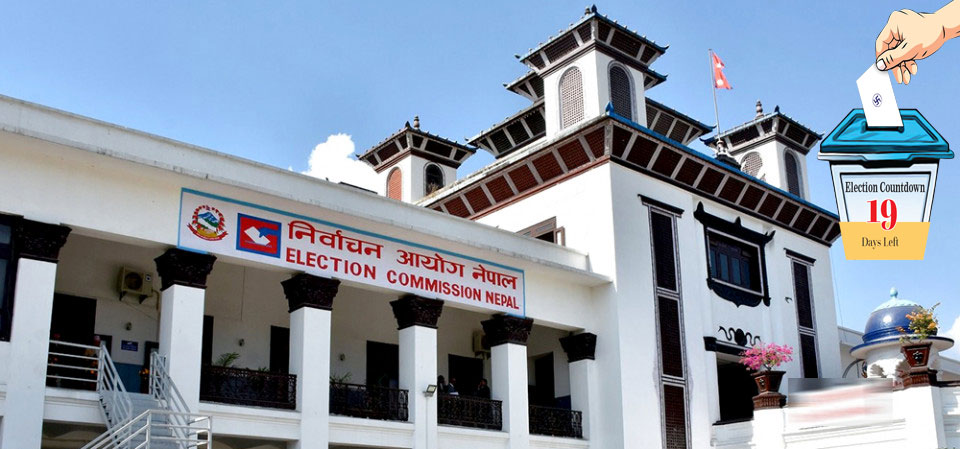
Kathmandu, Nov.1: As only 20 days are left until the election to the House of Representatives (HOR) and the Provincial Assemblies, the political parties and their candidates will be allowed to conduct election campaign from November 3-17.
Issuing a statement on Monday, Election Commission’s Shaligram Sharma Poudel said the parties and candidates can conduct marches, mass meeting, corner meetings, broadcasting or publishing any publicity materials in media and door-to-door campaign from November 3, as a part of election campaign.
Section 13 (Y) of the Election Code of Conduct, 2022 states that the candidates can start their acts of publicity 17 days prior to the polling day counting since the final list of the candidates is made public.
Even during the door-to-door campaign, the election code of conduct has restricted candidates from having more than 25 people accompanying them or use musical bands.
The code of conduct has been in force since September 28. Those violating the code can be fined Rs. 100,000 or face cancellation of the candidacy as per the Election Commission Act.
Stating that the EC had given continuity to the work of implementing the election code of conduct, EC’s Spokesperson Poudel said the EC had been issuing many show cause notices to alleged poll code violators.
The EC also asked political parties, candidates and concerned parties not to do any activities that are contrary to the election code of conduct.
Amid concerns that political leaders are spending a lot of money on the election campaign, the EC reduced the duration of electioneering to bring down spending by the candidates.
EC completes printing 70 million ballot papers The Election Commission (EC) has completed the printing of around 70 million ballot papers by Monday for the election to the HoR and provincial assemblies
Out of 80 million ballot papers required for the purpose of voting for the federal and provincial election, printing of around 85 per cent has been completed.
For the existing 17,988,570 voters, about 40 million ballots will be needed for the FPTP electoral system and about 40 million ballots for the proportional representative (PR) electoral system, the EC said.
According to EC, only 11.4 million ballot papers are to let to be printed. The printing of ballot papers towards the PR electoral system has already been completed while towards the FPTP system 28.68 million ballot papers have been printed.
Of the ballot papers printed for the FPTP, 12.95 million are meant for the provincial assemblies and 14.63 are meant for the HoR elections.
Ballot paper for PR transported to 75 districts so far The Election Commission (EC) has accelerated the transportation of ballot papers and election material for the upcoming elections.
The commission has completed the shipment of ballot papers towards proportional representation (PR) system in 75 districts. The task of transporting the ballot papers is still pending in Manang and Mustang districts.
Similarly, the shipment of 7.86 million ballot papers towards FPTP has been completed. Of them, 3.9 million ballot papers are for HoR and 3.9 million are for provincial assemblies, EC said.
According to the EC, till Monday, the supply of ballot papers towards FPTP has been completed in 16 districts including, Kailali, Kanchanpur, Achham, Doti, Dadeldhura, Bajhang, Baitadi, Darchula, Nawalparasi East, Nawalparasi West, Banke, Bardiya, Jajarkot, Kalikot, Dailekh and Surkhet.
Likewise, ballot papers meant for Humla, Jumla, Mugu and Bajura have been transported to Surkhet. The EC further informed that this time, the FPTP ballot paper is different from one electoral constituency to another because instead of printing election symbol of all political parties registered at the EC, the commission has printed the election symbols of only those political parties or candidates contesting in the election from the respective constituency.
Furthermore, there is uniformity in ballot papers towards PR electoral sys
tem for HoR across the country, while towards provincial assembly, different ballot papers are printed in accordance with the number of political parties in the province.