- Thursday, 28 May 2026

Jute cultivation in Sunsari declining every year


By Our Correspondent
Inaruwa, Sept 2 : ute cultivation has been declining every year over the decade in Sunsari district.
Due to the lack of advanced varieties of seeds, fertilizer, and irrigation during jute planting and water during the time of harvest, jute cultivation has decreased every year.
According to Chief of Agriculture Knowledge Centre, Sunsari Nil Kamal Singh, some farmers have stopped growing jute because they face a lack of advanced varieties of seeds, fertilizer, and irrigation when it is time to plant it. Even after that, there is a lack of water in ponds, rivers, and canals during the preparation phase.
The area of jute cultivation reached 4,000 hectares in the district in 2003/04, and now the area of jute cultivation has been limited to 1,352 hectares.
Singh said that due to the increase in the number of paddy crops and because the farmers are active in vegetable crops as well, the area of jute cultivation has dropped to 1,352 hectares of land at present.
According to him, farmers of the district are not encouraged towards jute cultivation due to the lack of incentives for the farmers of Sunsari and the inability to recover the investment.
Jute cultivation has been intensively carried out in the southern buffer area of Bhokraha Narsingh Rural Municipality, Gautampur, Ramnagar Bhutaha, Ghuski, and Basantpur of Harinagar Rural Municipality and Kushaha, Laukhi, Sripur and Haripur areas of Koshi Rural Municipality, has shrunk by 50 percent.
Similarly, the farmers of Kaptanganj, Madhyaharshahi, Rajganj Sinuwari, and Sahebganj of Dewangunj Rural Municipality, Babia and Jalpapur of Inaruwa Municipality have cultivated less than half of the jute that they had been planting this year.
Local farmer Birendra Yadav said that even though jute is cultivated in a small area, due to a lack of workers, jute is drying up in the fields. In this area, which was once considered fertile for jute cultivation, its cultivation has been decreasing in recent years, so there has been a reduction in jute export.
Yogendra Prasad Yadav, information officer of Agriculture Knowledge Centre, informed that jut farming, which is popular as a cash crop for farmers of Sunsari district, has been decreasing in recent years.
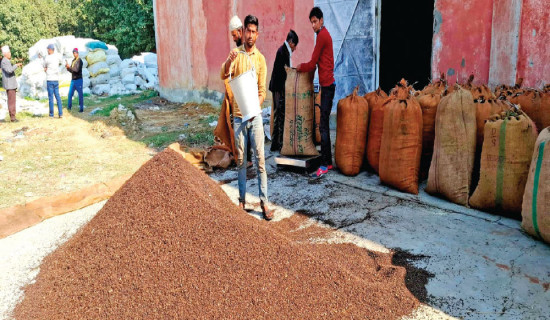
Yadav said that the jute produced by the jute farmers of Sunsari is 2,028 tonnes annually.
As jute cultivation started to decline in the district, there was an increase in dependence on the raw materials required for the jute industry.
Nepal, which has been exporting raw jute for a long time, has become dependent on raw jute at present.
As the interest of farmers in jute cultivation decreases every year, there is a shortage of raw jute for the jute industry of the Morang-Sunsari industrial corridor.
The jute industry of the Sunsari-Morang industrial corridor has been producing goods by importing raw jute from India and Bangladesh.
As the production of domestic raw materials is decreasing every year, even the industries with large investments and employing many workers are facing problems.