- Thursday, 28 May 2026

Go Green For Environment Protection

With the dawn of Shrawan, Nepal goes green. But is this green an exploitation of consumerised market-led economy and superstitious value system? Or the growing sustainable environmental concerns? Majority of the people in the rural parts of South Asian countries rely for their livelihood activities in agriculture, farming and forestry. The month of Shrawan, according to the lunar calendar, falls during mid-July to mid-August and is very important for the entire Indian sub-continent as it marks the onset of South-West Monsoons. The Shraban month derives its name from the “Shravan” Nakshatra which rules the skies during this month.
Rains being very important for farming and agricultural products, the onset of monsoon is a point for celebration by people. Due to the rains most of the dry areas suddenly become vegetated and green. Nepal with its predominantly Hindu population has been celebrating various Hindu religious and cultural festivals. During this period, mainly in the Kathmandu Valley, rice plantation is conducted with various singing, dancing and feasting activities as neighbours and family members share labour and go to do rice plantation on each other’s land.
Festivals
There are a series of festivals throughout the month of Shrawan, including Janai Purnima or Raksha Bandhan where married daughters and her families are invited for a feast at her parents’ house. On this day, germinated sprouted beans called Kwati or Biraula is served as the main dish especially in the Kathmandu Valley. Many Nepali cultural and religious practices follow the tradition of linking food with the incoming seasons. Similarly, mainly in the Terai belt, Raksha Bandhan is celebrated as a festival for siblings vouching the protection and care for each others.
Nag Panchami is another festival in Shrawan when several Hindu households worship snakes as it is related to the Samudra Manthan activity mentioned in the Hindu epic Mahabharat where Gods and snakes jointly churned out amrit to save the good on earth and separate poison which Lord Shiva volunteered to swallow to save the humans from being killed by the demons. During this month there are several religious activities associated with doing worship to lord Shiva, including performing rudris, which is a form of worship where milk and rice pudding or kheer is offered to the deity and eaten by family members and invitees. Then devotees are encouraged to fast every Monday during the month. Many devotees actually take a vegetarian meal throughout the month which actually might help in keeping the stomach light and healthy.
There are no mentions in any religious scriptures that only women need to fast, that too dressed and bejeweled in green. All devotees following the religion are encouraged to fast. However, due to the various episodes of Shiva Parvati romance stories spreading from one life time to another, whenever festivals related to Shiva are observed somehow the community moves towards women fasting so they get good husbands. Why do even educated and affluent women resort to fasting for “good” husbands? In our society daughters are still married off via arranged marriage and sent to their husband’s house.
Girls and women now want to continue their personal and professional dreams after marriage, too. Therefore, the belief that has been entrenched within them to observe fasting to get a good husband or for his long life seems to be more and more emphasised even in today’s Nepal. Moving out of parents’ home to be housed within their husband’s house and expected to maintain to be docile no matter their level of education is still a practice that probably drives girls and women to pray that they get a life partner who helps them to have a life they enjoy!.
On top of that, the market-led economy is very quick in capturing the social and cultural aspects of the communities they serve. Therefore, Shrawan has been painted as a month to capitalise on the psyche of longevity of husbands by selling commodities associated with marriage and a married women’s’ so called conceived beauty and jewelry like pote- the beads that married women wear-, the glass bangles and tika/bindis they adorn their foreheads with. The shopkeepers have well captured the sentiments and filled their outlets and created more offering green bangles, bindis, dresses and beads.
The communities in Nepal are very traditional. The Shrawan month has always been observed as an auspicious month. However, in the past, purchase of green dress and jewelry did not happen, rather sanctity of the month was observed. The time has come to reflect and, if one needs to go green during this month, let’s go green in the true sense by protecting the environment. Planting trees, going to help the farmers in planting rice and preserving the nature will be more productive. My understanding of Shiva is that he is a lover of nature with snake around his neck, water streaming out from his head and barely enough clothes to cover his private parts.
Awareness
His practice of minimising but protecting the nature is a lesson that the current generation needs to learn. Rather than fostering wrong value system of women buying and wearing green to safeguard their marital lives, the youth of today should make Shrawan a month to raise environmental issues every day. Going vegetarian is a strategy that environmentalists have taken for climate preservation. Also fasting has been scientifically proven to improve the physical and mental wellbeing leading to a healthy and environmental friendly lifestyle.
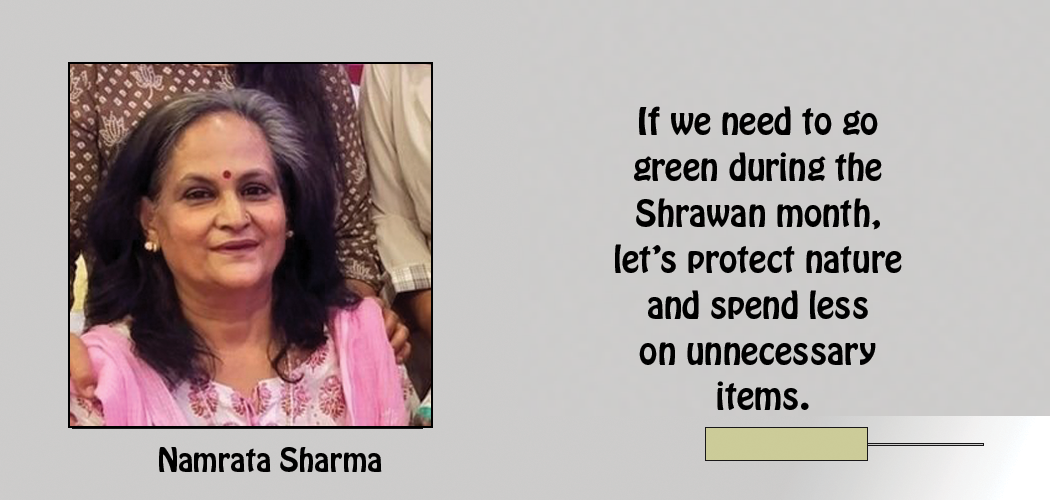
If we need to go green during the Shrawan month, let’s protect nature and spend less on unnecessary items. Spending on stuff that is probably used once or horded over the years is not a very smart financial behaviour. It is important to review on what values are we leaving behind for the new generation that could be harmful for a sustainable lifestyle based on equality.
(Namrata Sharma is a journalist and women rights advocate and can be reached at namrata1964@yahoo.com Twitter handle: @NamrataSharmaP )