- Thursday, 4 June 2026

Strengthening Ward-level Service Delivery

Under Nepal’s federal structure, ward-level governance is particularly important because the 6,743 ward offices are the institutions most accessible to ordinary citizens. They provide basic administrative services, support local development and act as a bridge between communities and governments. Theoretically, ward-level local governments are expected to ensure participatory democracy, accountability, efficiency and inclusive service delivery. However, in reality, various administrative, political, financial, and institutional challenges affect their performance. Therefore, the study of ward-level service delivery in Nepal requires an understanding of both theoretical ideals and practical realities.
One of the main theories related to local government service delivery is the theory of decentralisation. Decentralisation means transferring power, authority and resources from the central government to local governments. The main objective is to improve efficiency and responsiveness by allowing local authorities to make decisions based on local needs. Another important theory is democratic participation theory. This theory argues that democracy becomes meaningful only when citizens actively participate in governance and decision-making processes. Ward-level institutions encourage public participation through ward assemblies, public hearings, social audits, and community consultations. The subsidiarity principle also supports ward-level service delivery.
Good governance
According to this principle, governmental functions should be performed by the lowest level capable of handling them effectively. Similarly, the theory of good governance is central to ward-level administration. Good governance emphasises transparency, accountability, responsiveness, efficiency, participation, rule of law and inclusiveness. Ward offices are expected to ensure all of this. These theories have provided light for designing the legal architecture of ward-level governance. The Constitution of Nepal 2015 provides constitutional recognition to local governments as one of the three levels of government. The Local Government Operation Act 2017 further clarifies the powers, duties, and responsibilities of local governments and ward offices. According to the law, each municipality and rural municipality is divided into wards for administrative convenience and democratic representation. Each ward has an elected ward committee consisting of one ward chairperson and four inclusive members.
Ward offices deliver a wide range of public services. One of their most important functions is administrative service delivery. Citizens regularly visit ward offices for birth registration, death registration, marriage registration, migration certificates, citizenship recommendations, relationship verification, social security verification, and business recommendations. These services are essential for daily life and legal identity. The establishment of ward offices has significantly reduced the need for citizens to travel to district headquarters for basic administrative work, saving time and money.
Ward offices are also playing an important role in local development activities. Through participatory planning processes, wards identify community priorities and recommend projects related to roads, drinking water, sanitation, irrigation, schools, health posts and other community infrastructures. Sometimes, they also generate development needs of the people and protect the poor and vulnerable ones. Another important function is social welfare and inclusion. Ward offices support the distribution of social security allowances in coordination with bank branches to senior citizens, single women, persons with disabilities and marginalised groups. They also help identify vulnerable households for government and non-governmental support programmes. They mobilise communities for better living conditions.
Ward committees have also been contributing to local dispute resolution through mediation and community dialogue. Minor disputes related to land boundaries, family conflicts and social disagreements are often resolved at the local level, helping maintain social harmony. They also undertake a number of activities to promote social capital at the local level. In addition, ward offices are increasingly involved in disaster management and emergency response. During floods, landslides, fires, epidemics and other disasters, ward representatives coordinate rescue operations, relief distribution and local response mechanisms. They are the first aid.
However, the reality of service delivery also reveals many challenges. One major issue is limited administrative capacity. Many ward offices lack skilled personnel, technical staff, modern equipment and digital systems. There is a staff shortage in many wards. As a result, citizens often experience delays and inefficiency in service delivery. Financial constraints are another major problem. Ward offices depend heavily on municipal budgets and usually lack sufficient independent financial authority. Limited resources affect both development activities and administrative services. Budget distribution to the wards is not objective.
Political interference
Political interference also affects service delivery in some areas. Political favouritism and party influence sometimes affect project selection, beneficiary identification and resource allocation. This weakens public trust and fairness. Irregularities and lack of transparency remain additional concerns. Weak monitoring systems occasionally lead to misuse of public resources, irregularities in project implementation and unequal service distribution. Furthermore, coordination problems among federal, provincial and local governments create confusion regarding responsibilities and authority. Overlapping jurisdictions can delay projects and reduce administrative efficiency. This has weakened state-citizen relations at the very grassroots level. Remote rural wards face even greater difficulties because of poor transportation, non-developmental attitude, weak infrastructure, limited internet connectivity and shortage of human resources. In Madhes, social inequality, poverty and administrative weakness further affect effective service delivery.
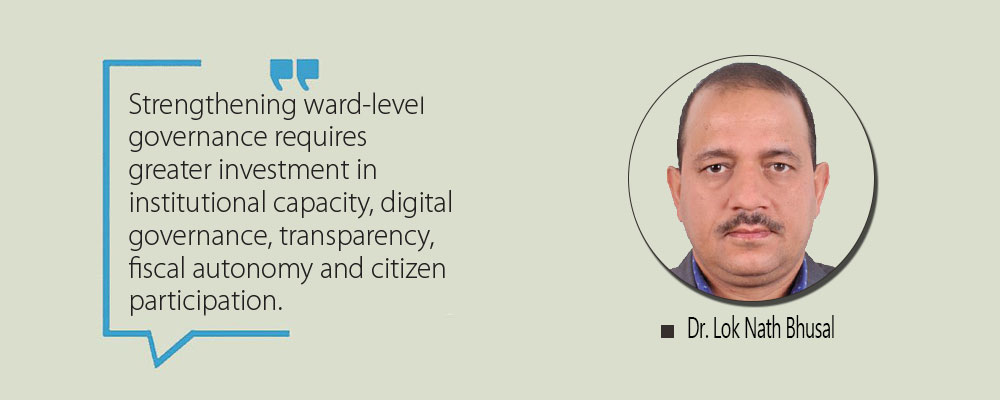
In sum, wards play a vital role in ensuring development, grassroots democracy and public service delivery. Theoretically, ward governance is based on the principles of decentralisation, democratic participation, subsidiarity and good governance. Legally, wards have been empowered to deliver essential services and promote local development. Consequently, many ward-level governments have improved access to public services, strengthened citizen participation and promoted inclusive representation. However, challenges such as limited administrative capacity, financial constraints, political interference, corruption and weak coordination continue to affect effective service delivery at the bottom. Therefore, strengthening ward-level governance requires greater investment in institutional capacity, digital governance, transparency, fiscal autonomy and citizen participation. Effective ward-level service delivery is essential for strengthening federalism, promoting inclusive development and improving the daily lives of our citizens.
(Dr. Bhusal is an expert in poverty, employment and social protection.)