- Monday, 25 May 2026

Two-month-long festival drains Dhimal community financially
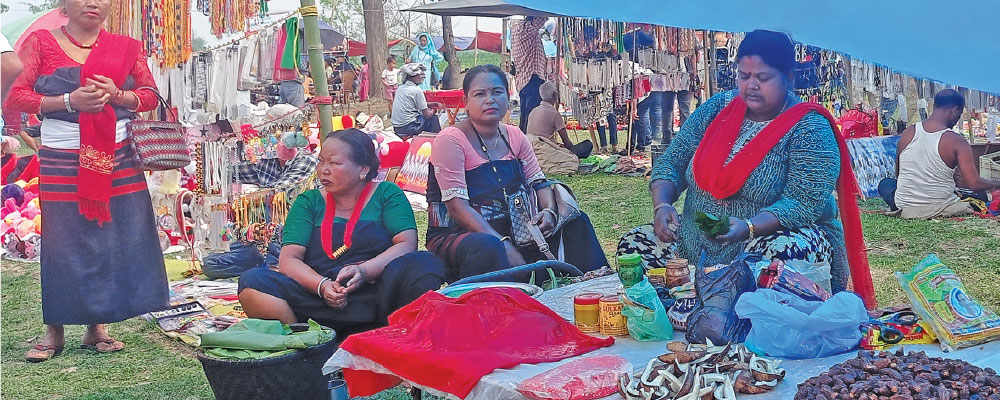

By Hari Prasad Koirala, Urlabari, May 25: With the change of time, the traditional way in which young boys and girls of the Dhimal community used to search for life partners during the Jatari festival has changed. Earlier, they would offer betel nuts, betel leaf and coconut as part of a cultural tradition to express love and interest.
Nowadays, instead of traditional offerings like betel leaf and other things modern foods and sweets such as jilebi, laddu, momos, chowmein, thukpa, and other fast foods dominate the fair.
In the past, the men of the Dhimal community also attended the fair in their traditional dress, but now they have stopped wearing it. Women still come dressed in traditional attire, though the number of women wearing traditional clothes decreases every year.
Not only members of the Dhimal community attend the fair, other people also come. As people’s attraction toward modern food increases, women who used to sell traditional Dhimal foods have become discouraged because of poor sales.
Punam Dhimal, who came to the fair from Damak-3 to sell traditional “chichiri” rice dishes, said, “I prepared 10 kilos of rice for chichiri dishes, but even after the fair ended, I couldn’t sell them.”
Young people are no longer attracted to traditional Dhimal foods such as gendro, vigiya, ghora, and chudur.
Every year, after worship is performed at the Maharajsthan in Rajarani, Letang-1 of Morang considered the origin place of the Dhimal people, the festival begins on April 15 (2nd of Baisakh). From Rajarani, the fair spreads to around 80 Dhimal settlements.
The Dhimal people, who worship ancestors and nature, pray for protection from disease, good rainfall during planting season and safety from wild animals. They perform communal worship and animal sacrifices such as ducks, chickens and pigs at Maharajsthan.
Dhimal leader Prakash Dhimal said that in the past, when community members’ wishes were fulfilled after worship, they continued the tradition by celebrating the Jatari festival every year.
He said, “Because of excessive spending during the fair and festival season, many Dhimals who were once landlords have now become landless squatters. In earlier times, people used to sell land to fund two months of feasting and celebrations. That same practice has now left many Dhimals without land.”
He recalled that Safilal Dhimal, former head of the then Bayarban Village Panchayat of Morang, once owned 600 bighas of land. “Today, some of Safilal Dhimal’s descendants do not even own a single plot of land,” he said.
According to him, the Dhimal community once even owned two elephants and donated hundreds of bighas of land, yet some family members are now landless.
According to Vijay Dhimal, central chairman of the Dhimal Journalists’ Association, the tradition of celebrating fairs continuously from Baisakh 2 to Asar 2 by feasting, drinking, and entertainment has economically weakened the community.
Community leaders estimate that Dhimal families spend more than Rs. 30 million during the fairs held across 80 locations.
Ajit Dhimal, Secretary of the Dhimal National Development Centre, says there are 108 Dhimal settlements in Jhapa, Morang, and Sunsari districts. No fair is held east of Mai River in Jhapa, but 80 fairs are held west of Mai.
On some days, the Jatari Festival is celebrated simultaneously in five places. A single family may spend up to Rs. 15,000 during the festival season.
Because the festival traditionally begins on April 15 and lasts until June 16 (Baisakh 2 to Asar 2), some fairs overlap. Community leaders say that along with cultural programmes, gambling and youth-oriented entertainment activities have gradually weakened traditional values and beliefs.