- Sunday, 31 May 2026

Menstruation Isn't Luxury
 Chesta Shrestha
Chesta Shrestha
Chesta Shrestha
Menstruation is as common as breathing. But for many Nepali women every day, it is still plagued with stigma, secrecy, and undue suffering. On average, 290,000 Nepali women are said to menstruate each day. This is no small matter or “women’s issue,” but a major issue of public health, economics, and human rights, requiring immediate action.
Yet even now, Nepal levies a 13 per cent Value Added Tax (VAT) on menstrual supplies. Through this action, the government effectively classifies sanitary pads and other menstruation-related items as luxuries rather than essential health provisions. This decision directly conflicts with the Supreme Court’s ruling in June 2025, which called for the lifting of this tax. More than a year has passed since then, but its implementation has been delayed, costing millions dearly.
The effects can be seen and quantified. According to the findings of the 2022 Nepal Demographic and Health Survey, only 47.6 per cent of Nepali women aged 15 to 49 use menstrual protection, including pads, tampons, or menstrual cups. The rest are unable to afford these sanitary products or have no awareness about menstrual hygiene management. Thus, for these people, every period turns out to be a struggle.
Even today, the issue of menstruation is surrounded by the taboo of uncleanliness from a cultural point of view. Despite the practice of chhaupadi being illegal, the practice continues in certain societies of Nepal, where women and girls go into sheds and secluded places to observe their periods. Although not overtly practiced in cities, menstruating girls are expected to keep away from kitchens and temples, not touch any special foods, and even hide their menstruation status. Menstruation itself is considered a shameful process that is barely ever discussed across families.
It is even harder for young girls who face numerous problems. They go through puberty not knowing what is happening to them because they have never had prior knowledge about periods. In many schools, there is no provision for sanitation, the availability of clean water, or methods of disposing of menstrual products. Some girls end up skipping classes or dropping out of school altogether after commencing their periods.
Poverty makes matters worse by limiting the ability to purchase sanitary pads every month. Women have been known to use old saris and reused rags. These items could carry bacteria if they are not thoroughly washed and dried. There are chances of acquiring reproductive tract infections as well as UTIs if the woman uses such dirty items. Cervical cancer could even be caused by poor menstrual hygiene.
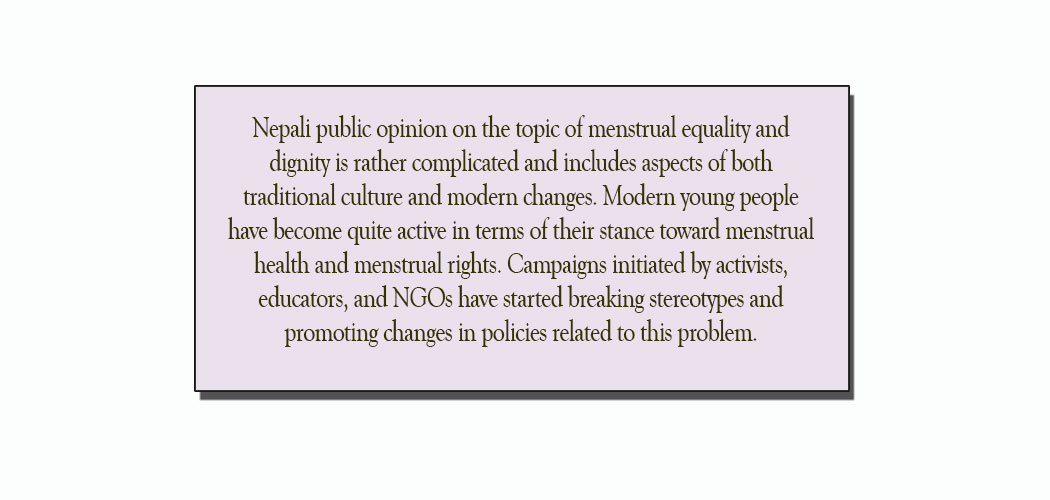
Nepali public opinion on the topic of menstrual equality and dignity is rather complicated and includes aspects of both traditional culture and modern changes. Modern young people have become quite active in terms of their stance toward menstrual health and menstrual rights. Campaigns initiated by activists, educators, and NGOs have started breaking stereotypes and promoting changes in policies related to this problem.
The postponement by the government to act upon the Supreme Court’s ruling is disturbing. It implies that menstrual health is still not a pressing issue even after all the facts about its significance have been laid out. The removal of VAT from the menstrual products will be the first concrete step towards addressing menstrual hygiene, a crucial but insufficient step.
Nevertheless, policy measures can move beyond these small steps. A comprehensive education programme on menstrual hygiene should be incorporated into the school curriculum. Public health programmes should target those who live in remote villages and impoverished communities.