- Tuesday, 5 May 2026

FM Wagle promises to reduce high taxation
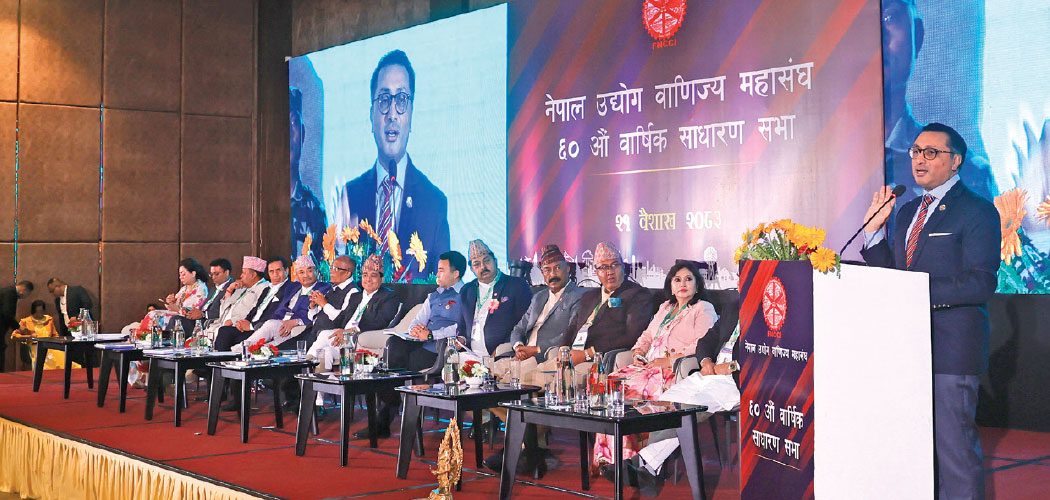

By A Staff Reporter, Kathmandu, May 5: Finance Minister Dr. Swarnim Wagle has said that the government is moving toward policies that encourage private sector growth while reducing the burden of high taxes.
Addressing the 60th annual general meeting of the Federation of Nepalese Chambers of Commerce and Industry on Monday, Minister Dr. Wagle emphasised that cooperation between the government and the private sector is essential to steer the economy in a new direction.
He made it clear that the private sector will play a leading role in achieving the goal of expanding Nepal’s economy to a size of 100 billion dollars in seven years.
“We will allow the private sector to spread its wings and fly, but the state will always remain in a regulatory role,” he said.
Budget in line with RSP's commitment
He claimed that the budget formulation process will no longer be as unclear and uncertain as in the past.
“The upcoming budget will be based on the manifesto of the Rastriya Swatantra Party, and we are implementing what we have promised through the commitment paper while going into election,” he added.
He said that the government has begun reforming the tax system to reduce unnecessary tax burdens on the private sector without affecting tax mobilisation.
He also made it clear that the old practices of using influence, bribery, and informal channels to get things done will be ended. “We have decided to repeal 15 laws,” he added, “and the upcoming budget will significantly reduce excessive tax burdens.”
"Now, the bureaucracy with bad intentions that hurts even genuine businessmen will not be tolerated, we will subdue it," he said.
No reason for private sector to panic
He said that the cabinet meeting held on Monday has passed a special strategy to protect and promote the private sector. Finance Minister Dr. Wagle assured that an environment of unnecessary fear or arrest will not be created for businessmen.
He urged people not to have unnecessary doubts about the government. “There is no need for unnecessary suspicion or panic. There is no long list of arrests,” he said.
However, he warned that those involved in criminal activities must face punishment.
“Businesspeople need not fear, but those involved in criminal acts under the guise of business must face consequences,” he said. “We have not initiated new investigations; we have only reopened old cases that were hidden or shelved under political cover.”
“We understand that it is impossible to build the country without the cooperation and participation of the private sector. The private sector must also respect the unprecedented public mandate of RSP,” he concluded.
Highlighting administrative reforms as a priority, he said efforts are under way to eliminate complexities in the licensing system and end the so-called “license raj.”
Dr. Wagle emphasised strengthening cooperation with the private sector for economic reforms and urged entrepreneurs to demonstrate transparency, accountability, and commitment to the nation.
“Nobody expected that young people would lead the nation, but the people's mandate has ensured this. Therefore, the private sector must earn public trust in an unprecedented way,” he said.
He stressed that all stakeholders must work responsibly to elevate the country’s economy and called for learning from past mistakes to enter a new era of reform.
Private sector ready to lead economic growth
On the occasion, FNCCI president Chandra Prasad Dhakal said that the private sector wanted to lead economic development of the nation.
"We, the private sector, are ready to lead the economic development of the nation. For this, the government should promote the private sector," he said.
Dhakal urged stronger cooperation between the government and private sector to achieve sustainable economic growth and self-reliance.
He said that current political stability should be utilised as an unprecedented opportunity to achieve the country’s economic prosperity as the political stability must serve as the foundation for economic progress.
“At present, the country has been presented with an unprecedented opportunity. At a time when we had been seeking all-party consensus for policy stability due to the absence of a stable government, the presence of nearly two-thirds majority of a single party in Parliament is a remarkable opportunity. We urge that this governmental stability be properly utilised as a chance to drive national development and ensure stability across all sectors.”
Expressing gratitude to the government for approving the Private Sector Promotion and Protection Policy (PSPP) as proposed by the FNCCI, he said that it would ensure both policy-level and physical security for entrepreneurs.
Expressing concern over rising unemployment, Dhakal highlighted the need for large-scale investment and a secure business environment to retain hundreds of thousands of youths leaving annually for foreign employment.
While the private sector already provides a significant share of jobs, he stressed that creating well-paying, dignified employment within Nepal—learning from neighbouring countries—should now be a top priority.
Senior Vice President of the Federation of Nepalese Chambers of Commerce and Industry (FNCCI), Anjan Shrestha, said that special initiatives will be taken to improve economic governance and implement necessary reforms. He said that research will be placed at the centre of efforts to strengthen the federation.
He further added that continuous dialogue will be held to enhance the capacity of members, along with the establishment of a mechanism for identifying and resolving grievances.
A detailed action plan covering these initiatives, along with around 60 other activities, will be made public soon, he said.
Shrestha emphasised that the federation is not a spokesperson for the interests of any single entrepreneur or group. Rather, it is a shared institution representing more than 500,000 entrepreneurs and businesspeople across the country and serving as a partner in the national economy, he said.
He also said that instead of treating the private sector merely as a witness, the government should create an environment of cooperation with it.
The AGM will elect a new executive committee of FNCCI with Shrestha as next president.