- Wednesday, 27 May 2026

Information Gap Misleads Parents

These days, a lot of confusion is in the air in relation to school education in Nepal. Some of them include if there is two-day weekend (Saturday and Sunday), then there will not be sufficient working days to complete the course; now, children up to grade five should not have to take any sort of examination; the government is going to make school education free even in the private schools; the parents, whose children go to the institutional schools, should not have to pay tuition fees of this Baishakh; the private schools are going to be closed, blah, blah, blah.
Mainly, social media is responsible for spreading all sorts of fake news and sadly, a majority of people rely on such news; they do not bother to cross-check with the authentic media. And the word of mouth is very strong to influence people. For instance, the other day, some new parents came to our school to inquire about the admission process for this session. At that time, someone just appeared and intervened, "Hey! You don't have to admit your children this time. The government has made admission free. Plus, you don't need to pay tuition fees for the month of Baishakh." As soon as those parents heard this, they left the school without asking for clarity from our side.
Misinterpretation
How can people misinterpret the information? It is clearly said by the Ministry of Education that before beginning the new session, neither a school can admit students nor can it take any sort of fees. There is nothing new but the government is only emphasising following strictly what is mentioned in the Education Regulations formulated in 2059 B.S. Furthermore, it is also stated that schools cannot take monthly tuition fees for more than 12 months in a year. Doesn't the government know that the staff salary in private schools is managed by the monthly tuition fees? How dare some people spread such baseless news?
For the educated parents, it is not difficult to process all sorts of information and understand the government policies, but unfortunately, many of the parents in our community are uneducated or illiterate and do not have access to the authentic information, so they are affected by rumours the most. Until now the general public strongly believes that their children get better education in institutional schools in comparison to community ones. So, they prefer to send them to such schools even if they do not have high-income sources. They work hard in odd jobs just to be able to afford private education for their children.
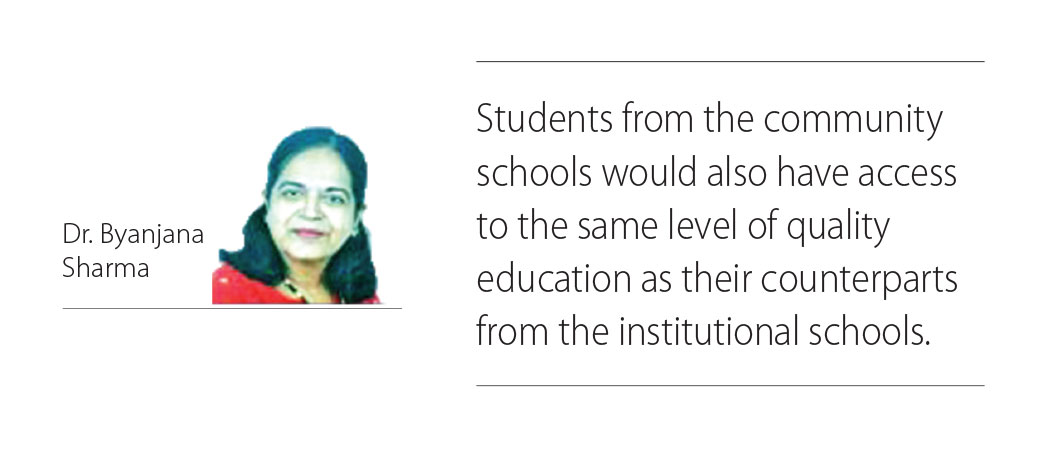
There is no doubt that the government is trying to bridge the gap between these two categories of schools and introduce different directives on an everyday basis, which sounds good. This way, students from the community schools would also have access to the same level of quality education as their counterparts from the institutional schools. However, it feels a bit hasty to confuse people and make them doubtful on the implementation side of these directives.
Currently, there is a kind of vacuum regarding the commencement of studies for this session. The government has made an announcement that the teaching-learning at schools will begin from only the 21st of Baishakh. This has given parents a headache. They are quite worried about not finding ways to engage their children at home. As everybody knows, these days children are more interested in mobile phones rather than in books. For them, school is the only place to be in touch with books and this opportunity has been snatched. Another problem associated with the delayed beginning of the session is with working parents. They find babysitting very challenging.
Many parents are complaining these days feel like COVID-19 days or even worse. At least, on those days their children would take online classes, but now they are staying at home idly. They think the situation has created unnecessary tension in them and nearly a month is going to be wasted. There is no uniformity in following the governmental directives in all municipalities as well. Some municipalities have issued a notice to start a new session from the first week of Baishakh, some from the second week and some from the third. The situation is getting haphazard. Nobody has understood why to wait until the 21st of Baishakh to start school, as schools, parents and students are all ready and everything is perfect too.
Reform
Reform in education is a must but the government decisions seem to be abrupt; because of this, there arise many confusions. The transition period for everything should be as smooth as possible but the stakeholders of school education have found this quite harsh. If we take an example from Australia, this point will be much clearer. Realising the adverse effects, the Australian government decided to ban some of the social media platforms for users under 16 years old. For this, a Bill was passed in 2024 and it came into force only in 2025. This indicates that people need a substantial amount of time to shift from one situation to another so that their transition will not be problematic.
In contrast, the Ministry of Education in Nepal has issued nine directives for immediate implementation. This sounds over-ambitious. There is a popular idiom in English that says 'one step at a time,' meaning you do just a little at a time so that you can break down your complex tasks into manageable and simpler ones to complete them easily. This way, you will maximise chances to achieve your goals. We should not forget that sometimes haste makes waste.
(The author is the director of Vidya Shilpa Academy, Damak, Jhapa.)
-square-thumb.jpg)