- Tuesday, 26 May 2026

RSP’s Foreign Policy In Spotlight

With the Rastriya Swatantra Party (RSP) all set to form a powerful government, all eyes are now on its foreign and economic policies. Some old political parties that have drunk from the well of conspiracy theory still look askance at the rise of Balendra Shah (Balen), poised to be the country’s new Prime Minister this week. Balen has been a model for the Gen Z youths, who overthrew the KP Sharma Oli government through their 48-hour revolt in September last year. For the traditional parties like the Nepali Congress and the CPN-UML, the Gen Z movement was something designed by ‘outsider’ forces. But the RSP stands to give a fitting reply to them by executing a balanced foreign policy, demonstrating its commitment to nationalism and the overall progress of Nepalis.
In its election manifesto, it has announced that it will adopt a balanced and dynamic diplomacy to cash in on the progress of neighbours for the country's development. It has stressed the need to transform Nepal into a vibrant bridge rather than a buffer state, bearing in mind the strategic concerns of neighbouring nations and the changing balance of global power. It seeks to diversify the opportunities of direct foreign investment and trade through intense economic diplomacy and international collaboration, while utilising cultural capital and promoting diaspora-centric diplomacy. Based on its documents and the speeches of its leaders during the election campaign, it is clear that the RSP will maintain the foreign policy pursued by the previous governments.
Skepticism
The political parties, particularly the communist ones, have shown skepticism about whether the RSP will tilt to India and the West. But their distrustful perceptions are likely to go away if one scans through the terms the RSP is using in defining their future foreign policy conduct. They include ‘trilateral economic partnership and connectivity,’ ‘development diplomacy,’ ‘digital infrastructure,’ and ‘vibrant bridge,’ among others. The party is yet to explain the term ‘trilateral partnership’, which implies cooperation between Nepal, India and China for shared economic benefits.
However, the concept of trilateral cooperation involving Nepal, China and India is not new. Former prime minister Pushpa Kamal Dahal Prachanda had floated the notion of ‘trilateral strategic partnership’ during his informal meeting with Indian Prime Minister Narendra Modi and Chinese President Xi Jinping on the sidelines of the BRICS Summit in India in 2016. But it failed to gain ground after India did not show much interest in it. The idea of a vibrant bridge was also raised in the past. However, this does not mean that these concepts can’t be materialised. With a huge popular support, the upcoming government can build the necessary economic capacity and diplomatic basis to realise them.
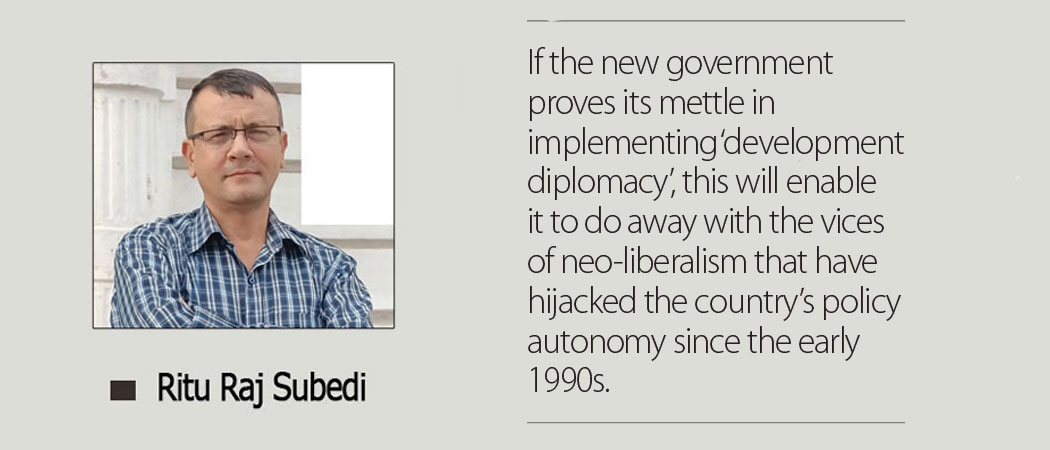
RSP chairman Rabi Lamichhane has emphasised ‘development diplomacy’ to achieve growth and foster economic cooperation with neighbouring countries, friendly nations, and international institutions, without strings attached. This sort of diplomacy focuses on development without falling into any geopolitical traps. It aligns with the country's non-aligned foreign policy, grounded in the principles of Panchsheel, the UN Charter, and other international laws and conventions. If the new government proves its mettle in implementing ‘development diplomacy’, this will enable it to do away with the vices of neo-liberalism that have hijacked the country’s policy autonomy since the early 1990s. Neoliberalism is the economic ideology of the Washington Consensus that puts conditions on aid recipient nations. It goes against the grain of Nepal’s constitution that envisions a welfare state and a socialism-oriented economy.
The essence of ‘development diplomacy’ has changed over the decades. The idea has supposedly received currency with the US-funded Marshall Plan (1948) that aimed at rebuilding European economies destroyed by World War II. The Plan primarily sought to stop the spread of communism in Europe, as Eastern Europe had already come into the Soviet orbit. This shows that development diplomacy, in principle, also has hidden political motives. But Nepal should strive to set aside the aid conditionality while prioritising foreign direct investment, trade, technology transfer, capacity building, infrastructure development, poverty alleviation and building global partnerships to attain rapid growth and Sustainable Development Goals (SDGs)
There is a strong curiosity as to how the RSP government will implement China’s Belt and Road Initiative (BRI). Nepal and China have signed various agreements to implement a total of 10 projects under the BRI framework but they have yet to reach a funding modality to this end. The RSP has stressed securing concessional finance from China to build infrastructure in Nepal. In its congratulatory message to the RSP on the latter’s electoral success, the Communist Party of China (CPC) has underlined the need for moving forward with high-quality BRI for the shared benefits of the two nations. The CPC describes Nepal-China ties as having been elevated to a strategic partnership and wants to move accordingly.
Financial modality
As the myth of debt trap diplomacy has found a considerable number of audience in Nepal, the new government is likely to face pressure from India and the West to shelve the BRI projects. Given that Nepal has already implemented the US-funded Millennium Challenge Corporation (MCC) project, it should give impetus to the BRI projects by forging a deal on an appropriate financial modality and a broader consensus so that they are smoothly executed and yield desired outcomes to both sides.
In Nepal, every government has to walk on eggshells when it comes to handling foreign policy due to its sensitive location and economic and political vulnerabilities. With nearly two-thirds strength in the parliament, the RSP government is in a solid position to execute an independent and non-aligned foreign policy without compromising national interest, sovereignty and security. This is also necessary to ensure internal stability, development, and shared prosperity.
(The author is Deputy Executive Editor of this daily.)