- Saturday, 2 May 2026

Tackling corruption central to major parties' manifestos

By A Staff Reporter,Kathmandu, Feb. 21: Major political parties have placed good governance at the heart of their manifestos, promising sweeping reforms to tackle corruption, streamline public services, and restore public trust in state institutions.
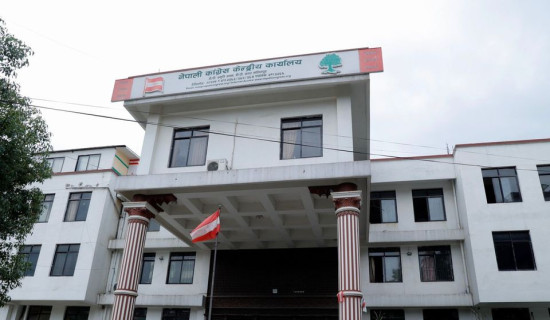
The oldest political party, Nepali Congress, has unveiled an ambitious pledge under the slogan “Now Nepal: A Well-Governed Nepal”, vowing to build a harassment-free citizenry, a corruption-free society, and an accountable government. Acknowledging past failures to effectively implement anti-corruption laws, the party has pledged “zero tolerance” towards corruption and promised to establish a powerful High-Level Asset Investigation Commission within six months of taking office. The body would probe the assets of all individuals who have held high public office since 1990.
The party has further committed to amending the Commission for the Investigation of Abuse of Authority Act to clearly define and criminalise policy corruption, decisions taken under the guise of policy-making that benefit vested interests. It also proposes legislation to prevent conflicts of interest, mandatory public asset declarations before assuming and after leaving office, and automatic suspension of office-bearers facing corruption charges.
A major thrust of the Nepali Congress agenda is digital transformation. With the guiding principle of 'file not mobile', it promises cashless payments, faceless services, and paperless administration. Most public services, except those requiring physical presence, such as citizenship certification, would be available online 24 hours a day, seven days a week. A governance lab in the Prime Minister’s Office and governance units in each ministry would fast-track service delivery and remove bureaucratic bottlenecks. Citizens would also be entitled to compensation if services are not delivered within a legally specified timeframe.
The Communist Party of Nepal (Unified Marxist–Leninist) has similarly foregrounded clean administration. Its manifesto pledges to institutionalise transparency, accountability and corruption-free governance through stronger legal and technological mechanisms. The party proposes the use of artificial intelligence-based detection systems to investigate corruption and ensure that most public services, from passports to driving licences and land records, are digitised.
The UML also vows to strengthen judicial efficiency so that the majority of cases older than one year are resolved promptly. It has committed to enacting an Open Data Act to guarantee public access to non-sensitive government information and to remove Nepal from international financial monitoring grey lists by improving financial transparency. Large and medium development projects would be executed through fully electronic procurement systems to eliminate collusion and ensure international standards of competitiveness.
The Rastriya Swatantra Party (RSP) has centred its platform on ending physical queues in public offices. “Public service will be online, not in line,” the party declares, promising a fully integrated national identity database to underpin data-driven governance. It has pledged to eliminate middlemen, reduce unnecessary direct contact between citizens and officials, and introduce a time-bound digital service delivery action plan.
The RSP has also taken a strong stance against the politicisation of state institutions, vowing not to form affiliated sister organisations and to ensure that civil servants serve the constitution rather than political parties. It proposes the creation of an autonomous transfer board to manage predictable postings for civil servants and a strengthened internal party discipline mechanism to
uphold integrity.
Meanwhile, the Nepal Communist Party has called for a High-Level Asset Investigation Commission with a one-year mandate and the nationalisation of assets acquired through corruption. It proposes merging the anti-corruption commission and the Office of the Auditor General into a powerful Lokpal-style ombudsman. The party also advocates a smaller cabinet, strict term limits for parliamentarians and redistribution of authority in line with federal principles.
Across party lines, a common theme has emerged claiming the promise of digital governance, institutional reform and uncompromising action
against corruption.
-original-thumb.jpg)