- Tuesday, 9 June 2026

Voting Is A Civic Responsibility

The general elections are set to be held on March 5 this year to elect 275 members of the House of Representatives. Of the 275 total seats, 165 will be directly elected by the people based on the first-past-the-post system, while the remaining 110 will be chosen based on the proportionate electoral system. Over 60 registered parties are participating in the election fray, and over 3400 candidates, including party representatives and independent candidates, are contesting the election.
Democracy is the people’s polity. All rulers in the world call their regimes democratic, seeking public and international legitimacy. Even notorious dictators call their rule democratic. However, not all regimes are democratic. Genuine democracy is the system wherein periodic elections are held on a multi-party basis and citizens are allowed to choose their representatives in a free, fair and fearless manner. In other words, democracy is the government of free and responsible citizens. Thus, the democratic polity has attracted overwhelming response, interest and enthusiasm of people across the world.
Political lingua franca
Democracy has become a global political lingua franca. It is the democratic polity that alone treats every citizen as an equal member of human society and guarantees the people their freedom and rights. Democracy is thus called the genuine people’s polity. Elections are held in many countries and in different political systems. However, not all elections are free and fair. It is only in a democratic system of governance that genuine elections are held in which people freely vote and choose their representatives without any kind of fear.
The level of democracy is judged on the basis of the electoral process and accountability of the government. It is said that democracy begins with the ballot. So the first step to ensure democracy is a free and fair election. If elections are doctored and manipulated, the trust of people on the regime erodes, which weakens the very foundation of the system itself.
Elections are, thus, the soul of democracy. Against this background, an election is being held on March 5 after the Gen Z revolt that toppled the government that had commanded a two-thirds majority.
This is the manifestation of the fact that a government that fails to win the trust of the people is always doomed to collapse despite its parliamentary majority. If the government fails in delivering part, it may slowly start to lose people’s trust and fait ultimately leading to the rise of popular protest. The recent Gen Z protest is a case in point, which led to the collapse of the government and announcement of fresh elections to the House of Representatives.
As the election is approaching, concerns are growing about it. The government and the Election Commission have reiterated their commitment to hold the election in a free and impartial manner, for which they have made necessary legal, official, financial and security arrangements so that people would use their franchise without any kind of fear and apprehension. However, some political parties, especially the CPN-UML, still seem to be apprehensive. Given the commitment and preparations made by the government and the Election Commission, there should not be any apprehension and suspicion about the impartiality of the election as well as the safety and security of the voters on the election day.
There are always four components in ensuring free, fair and trustworthy elections, which include constitutional and legal provisions, the government’s commitment, Election Commission’s role, security arrangements, and strict vigilance of the civil society. The constitutional and legal provisions are adequate and better for ensuring the fairness of the election. Security arrangements also seem to have been made adequately and all three organs of security have already been mobilised for the security during the election. Similarly, political parties are actively participating in the election.
Voters, too, are enthusiastically waiting to cast their ballots. Civil society also appears to be equally vigilant and active. Several civil society groups are observing and monitoring the entire electoral process and election activities. The Election Commission has formally recognised and permitted more than a dozen national as well as international groups to monitor the election and hundreds of both national and international observers will be monitoring the election. The observers will see multiple factors related to the election, including the pre-election process, election-day activities and post-election developments. The presence of national and international observers is itself yet another important initiative to make the election free, fair and impartial.
An election should genuinely reflect the people's sentiment and voice. Given the enthusiasm of political parties and the people, it seems that the voters’ turnout will be higher this time than in the last elections. In the elections held three years ago, the voters’ turnout was 61.37 per cent. It is expected that more people will turn up to vote in this election. It should be taken into account that voting is not only the right of the citizens but also their fundamental duty. As George Jean Nathan has said, ‘bad officials will be elected by good citizens who do not vote,’ implying that if people do not vote, they would be failing to perform their major political duty.
Eligible voters’ duty
Thus, all eligible voters need to participate in the voting. However, voters living out of the country will not be able to exercise their voting rights as there is no arrangement for Nepali citizens living abroad to vote, despite consistent and long demands for such an arrangement. However, given the resource constraints, it may not be possible to ensure voting for citizens living abroad. However, it may be possible in the near future.
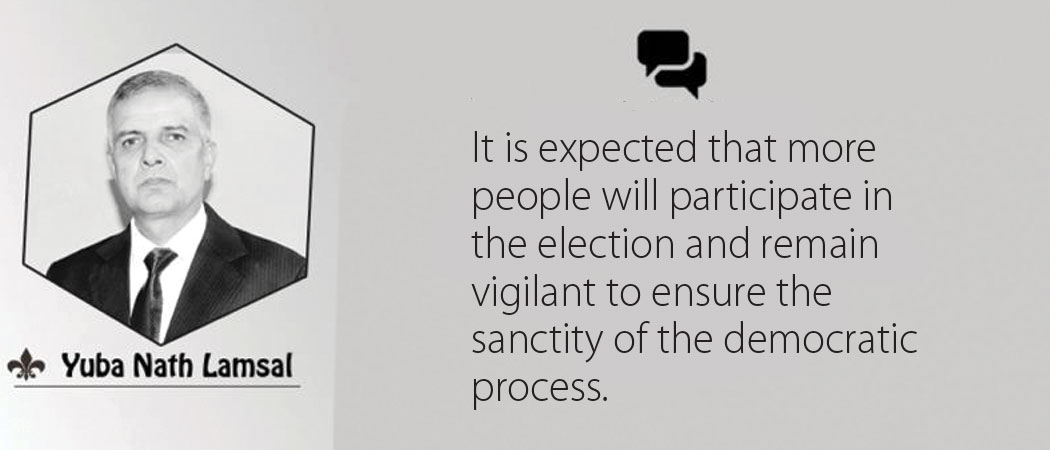
An election is a political and democratic festival in which all eligible voters need to participate joyfully. If they do not vote, they will be failing in discharging their duty to the country. Election is the process through which people participate in a country’s governance and decide their own fate. Thus, it is expected that more people will participate in the election and remain vigilant to ensure the sanctity of the democratic process.
(The author is a former chief editor of this daily and a former ambassador. lamsalyubanath@gmail.com)