- Wednesday, 29 April 2026

Govt activates local networks, intelligence to seize weapons


Kathmandu, Feb. 18: The government has launched an expansive and multi-layered operation to track down thousands of escaped prisoners and recover looted firearms following the violent escalation of the September Gen Z protests.
Officials at the Ministry of Home Affairs confirmed that local governments, security agencies and intelligence units have been mobilised in a coordinated push aimed at ensuring accountability and restoring public confidence.
During the unrest on September 8 and 9, violence erupted across the country, leading to the escape of more than 14,550 inmates from prisons nationwide. Although thousands have since been re-arrested or returned, over 4,400 remain at large.
Security assessments suggest that several fugitives may have exploited country’s open border with India to flee across the frontier. Of those still missing, approximately 600 are reported to be Indian nationals or citizens of third countries.
Authorities are now working through local ward offices to verify whether escapees have returned to their homes or contacted relatives. Lists of absconding inmates have been circulated down to ward level, with ward chairpersons instructed to assist in gathering information.
Joint Secretary and Spokesperson for the Ministry of Home Affairs, Ananda Kafle, said that security forces have been directed to prioritise fugitives and stolen weapons during both solo and joint patrols.
“We have sent detailed lists to ward-level authorities and established contact with local representatives. Patrol units have been instructed to treat the search for escapees and weapons as a central objective,” he said.
Cross-border alerts and Interpol involvement
The Nepal Police has shared detailed records of escapees with security agencies of neighbouring countries. Meetings have reportedly been held with counterparts across the border to facilitate cooperation.
Police Spokesperson and Deputy Inspector General Abi Narayan Kafle for the Police Headquarters confirmed that permanent addresses of fugitives have been forwarded to local police posts nationwide to tighten surveillance.
He added that for those convicted of serious offences, authorities are prepared to seek assistance through Interpol channels and pursue diplomatic measures via the Home Ministry.
“Police posts are aware of which individuals have absconded. Monitoring and enforcement actions are under way. We are also coordinating with local representatives and the public, it is difficult for someone to disappear entirely from their own community,” he said.
Intelligence-led profiling
According to officials from the Department of Prison Management, updated profiles of escapees are being compiled. Contact numbers of relatives and close associates have been handed to police in an effort to trace movements indirectly.
Spokesperson for the Department Chomendra Neupane said updating records and tracking networks of association is currently a top priority.
Security agencies are also preparing to release photographs and identifying details of high-risk fugitives through local media if necessary, in order to encourage public cooperation.
Missing weapons
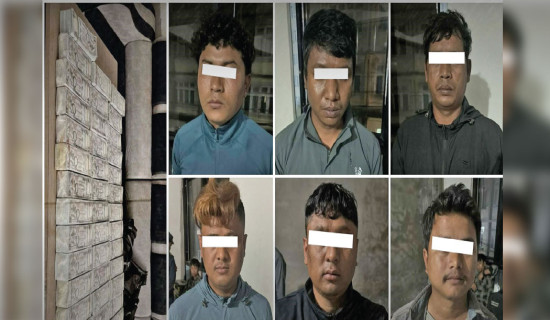
The unrest also resulted in the looting or loss of approximately 1,276 firearms from police armouries. While officials claim that ‘most’ have since been recovered, an exact figure has not been officially disclosed.
However, the Police Headquarters has said that over 760 missing weapons have been recovered so far. So, around 516 weapons are yet to be recovered, said police.
Police say special task teams remain active and intelligence-based operations continue. The public has been urged to provide confidential information.
Authorities have further issued public notices requiring holders of licensed firearms to deposit their weapons at nearby police stations ahead of upcoming elections. District Administration Offices have warned that failure to comply within the stipulated deadline may result in legal action. The government has pledged that lawfully owned arms will be returned one month after the completion of the polls.
According to retired AIG Devendra Subedi of Nepal Police, the possession of both illegal and licensed firearms by individuals remains inherently unsafe, particularly during the election period.
He warned that failure to comply with administrative directives and official orders could allow such weapons to become a serious security threat at any time during the polls.
Subedi further said that large number of looted weapons still in circulation, along with licensed firearms that have not been surrendered to authorities during the election period, has compounded security challenges. He emphasised that the state must adopt a firm and uncompromising stance to address the issue.
The Home Ministry has earlier decided to incorporate the progress of fugitive arrests into the performance evaluation metrics of Chief District Officers and district-level security chiefs. The move signals an effort to ensure administrative responsibility at every tier.
With intelligence units, local representatives, border coordination and international policing mechanisms now in play, the government appears determined to demonstrate that the chaos of the Gen Z unrest will not translate into long-term insecurity.
Of 21,004 total licensed weapons, 17,720 out of administration control
According to data of the Ministry of Home Affairs, a total of 21,004 firearms are licensed across the country. Only a small proportion of these have been renewed this year. Lumbini Province holds the highest number of licensed firearms, with 6,107 permits issued. It is followed by Sudurpashchim Province with 3,831 registered weapons. Koshi province has 2,141 licensed weapons.
Similarly, Madhes Province has 2,525 licensed firearms, Gandaki Province 2,296, and Karnali Province 2,254.
The fewest licences have been issued in Bagmati Province, with 376 recorded. However, within the Kathmandu Valley alone, 1,472 firearm permits have been granted, according to Ministry records. These figures reflect those who presented their licences for renewal.
Despite clear government instructions requiring the temporary surrender of licensed weapons during the election period, the number of firearms returned remains markedly low. In Koshi Province, out of 2,141 weapons, only 278 weapons have been submitted in the administration for election purposes.
In Lumbini Province, only 918 out of more than 6,000 licensed weapons have been surrendered, leaving over 5,100 still in private possession. In Sudurpashchim Province, just 760 of the 3,831 registered firearms have been returned.
In Madhes Province, 349 weapons have been deposited, while 2,176 are yet to be deposited to the DAO. Gandaki Province still has 1,598 licensed firearms yet to be brought under administrative control. In Karnali Province, only 49 of the 2,254 licensed weapons have been returned, leaving more than 2,200 outside state supervision.
Bagmati Province reports the lowest number of outstanding firearms, with 232 yet to be surrendered.
However, in the Kathmandu Valley alone, 1,386 licensed weapons remain unreturned.