- Wednesday, 27 May 2026

Ways To Achieve Prosperity

The country's economy is gradually improving. It has sufficient foreign exchange reserves. Remittance income is high. The inflation rate is very low. The balance of payments is satisfactory. Deposits and cash flow in banks are good. In the past, the agriculture sector constituted a larger portion of the national economy, but there is now a big shift. The contribution of the service sector to the Gross Domestic Product (GDP) is about two-thirds. Foreign employment has become a source of income for many Nepalis.
However, the economic growth is slow, with a rising unemployment rate. The average inflation rate is not high but there is no uniformity in the prices of daily consumer goods. There is no assurance of the availability of quality goods. The growth rate of revenue as a source of state revenue is not expected. Neither internal nor external investment has increased. Middlemen dominate all types of economic activities. The hundi business has flourished. Capital flight has not been stopped. Despite this, the country's economy has not gone out of control.
Low capital spending
We bring a large budget every year. But the capital expenditure is very low. The size of the internal and external debt is increasing every year. It is difficult to meet the current expenditure with internal revenue. Although the country has adopted the policy of the three-pillar economy, there is not much harmony between them. The private sector, considered the driver of the economy, is doing business expecting tax exemptions from the government instead of running innovation-driven businesses and industries. The size of the informal economy is expanding. In the last fiscal year 2081/82 B.S. alone, the Central Bank found more than 9,000 economic activities suspicious.
The improvement in the Doing Business Indicator is not attracting foreign investment. The Corruption Perception Indicators have not moved beyond. The Happiness Index also shows that people are unhappy. In this situation, the practice of hundi transactions and cryptocurrencies should be controlled. Foreign aid should be received according to our priorities, not as per the wishes of donors. Projects run with government funds should be profitable. Unnecessary expenses such as going on foreign trips, buying expensive cars, and hosting parties should be completely controlled. Similarly, complete frugality should be adopted in current expenses as well.
Looking at the prospects of economic development in Nepal, it seems that a lot can be gained from the agricultural sector through organic farming. For this, organic fertilizers should be used instead of chemical one. Biological pesticides should be used in place of chemical ones. We should go for a rotational farming system. For mechanization and modernization, the use of zero tillers, harvesters, mini tractors, and reapers should be promoted. In addition, hybrid, block system, cash crop, and herb farming should be adopted on a cost-benefit basis.
Nepal can benefit more from the tourism sector through adventure sports. For this, adequate investment should be made in trekking, bungee jumping, paragliding, ropelining, expeditions, rock climbing, cycling in the Himalayan region, etc., to attract domestic and foreign tourists. Nepal has the potential to store natural gas and petroleum products. The iron ore mine operating in Nawalparasi should be expanded. Cement should be produced from Nepal's limestone and exported to the South Asian market.
Good profits can be made by cutting the special types of stones available here into gemstones. There is also potential for gold and uranium mining. Similarly, emphasis should be placed on copper mining, slate industry and marble production. Nepali handicrafts have established a market in the world's tourist hubs. In particular, there is ample potential for the export of Nepali pashmina, hand-woven Nepali carpets, various Nepali paper products, banquet paper, mandalas, caps, flags, national flags, etc.
Breathtaking waterfalls
There is no shortage of breathtaking waterfalls in Nepal. If such spring water can be distilled by maintaining its quality, the country can earn a good amount of foreign currency by exporting it. There is a possibility that herbs found in Nepal can take to the world market. Among the herbs found in Nepal, Yarsagumba, Panchaule, Kutki, Jatamansi, Timur, Bhakur, Chiraito, Tejpat, Nagbeli, Bojo, Asuro, Satuwa, Amla, Gurjo, Pipla, Bardo, Bel, Harro, Dalechuk, Lothsalla, Sugandha Kokila, Padamachal, Chutro, Cinnamon, Dhaturo, Pipla and Kantakari carry huge commercial prospects.
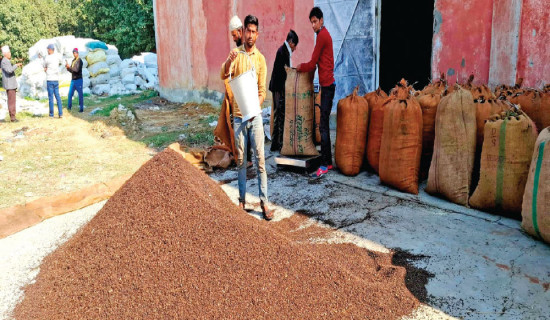
Similarly, the country’s export trade can be boosted by increasing the production of ginger, cardamom, honey, tea and coffee. In addition, there is significant potential in Nepal for the highly sought-after floriculture business in fruits, plants, butterfly species, and rare species. Similarly, we have the potential to reap extensive benefits from the cultivation of hemp, mustard, and sunflower, forest products such as daleghas, rattan, bamboo, chiuri dhuyu, lokta, beekeeping, amriso, lapsi olive, lothasalla, tejpat, timbur, dalechuk, bodhichitta, rudraksha, argeli, chiraito, shrikhand and mentha. By harnessing these potentials, Nepal will be transformed into a prosperous country.
(The author is the former secretary of the Nepal government.)

-square-thumb.jpg)