- Saturday, 6 June 2026

Technical Intelligence Possess No Boundaries
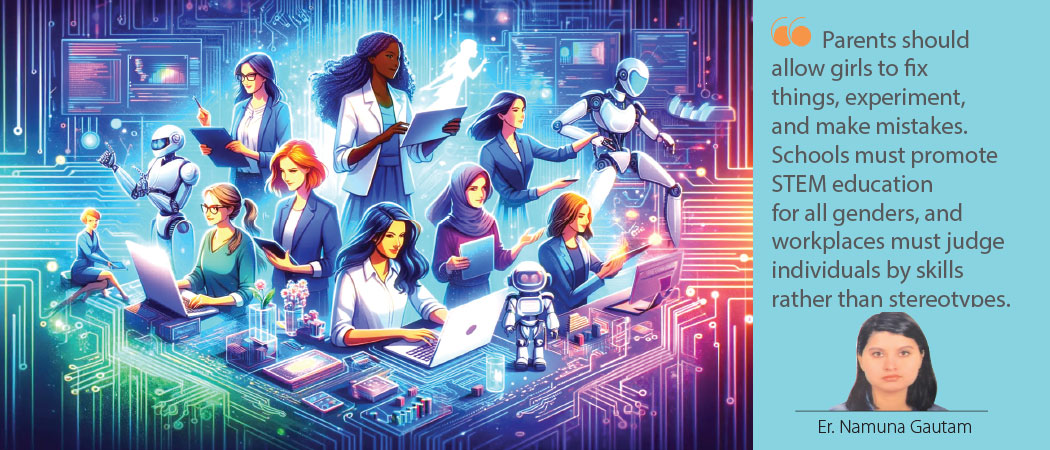

For generations, technology has been considered a male-dominated field, with an underlying assumption that we, women, were simply not ‘technical’ people. In IT, computers, mechanics, or driving, we are often assumed to be inferior before we can show our skills. This is especially true in South Asian countries like Nepal, which have strong traditional gender roles and social expectations about what women pursue as a career. But what we’re seeing in the world around us is something very different: a narrative of competence, innovation, and quiet determination.
Across the world, women are steadily advancing in technology. Studies show that women now make up one-third of the technology workforce, and that share is gradually increasing. In South Asia, despite cultural and structural barriers, women are leading in fields such as software development, data analysis, networking, cybersecurity, and artificial intelligence. In Nepal, more women than ever before are studying IT, computer engineering, and electronics, and many are building successful careers in both local and international tech enterprises.
Yet the bias does not begin in the workplace; it starts at home, in a mindset. In many Nepali and similar Asian households, sons are encouraged to fix electrical switches, repair equipment, ride motorcycles, or explore tools. Daughters, by contrast, are encouraged to do kitchen work, cleaning, and other household duties. From an early age, boys are trusted with technical tasks, while girls are rarely invited to explore how machines work. This task division teaches children that technology belongs to men and that domestic tasks belong to women, leading to career options long before adulthood.
It is almost the same in schools, where boys are praised for being smart with machines, while girls are appreciated for being careful or helpful. Even when girls show interest in computers or sports, they are sometimes disappointed with comments such as 'It’s dangerous' or 'It’s not suitable for girls.' Over time, this messaging starts self-doubt, not because girls lack ability, but because they lack encouragement.
In the real world, the same attitude continues. Many women in the IT field have been in a place where their skills are frequently doubted. A woman explaining a network issue may be looked at with scepticism, while if a male colleague explains the same, it is accepted without uncertainty. Women drivers are judged more harshly for small mistakes, consolidating the stereotype that women battle with anything automated or technical. These everyday incidents may seem small, but collectively they create an environment where women are forced to prove their competence.
I have myself faced this unfairness firsthand as an IT professional. There used to be incidents when clients assumed I was not capable of handling their technical issue and asked to speak to a male colleague instead. There have been times when my ideas were overlooked until repeated by a male colleague. Such experiences are common among women who work in technology, not because they lack skills, but because society still associates technical proficiency with manhood.
Despite these hurdles, women still continue to excel and make their mark. Women in IT manage to solve complicated systems and critical problems under pressure and adapt to new technologies. Research steadily shows that diverse teams perform better, particularly in problem-solving and invention. When women are included in technical teams, products become more comprehensible, solutions more complete, and decision-making more stabilised.
In Nepal, women are seen breaking stereotypes and advancing into technical and non-traditional professions once dominated by men. Sony Rana is celebrated as the first Nepali woman pilot to hold a civilian aviation licence, flying into the skies in the early 1990s, encouraging future generations of female aviators. Rakshya Rana also made history in aviation in Nepal as a female pioneer, completing both international and domestic training at a time when few women were seen in the cockpit. On the ground, Laxmi Sharma became Nepal’s first female tempo (auto-rickshaw) driver, learning mechanical skills and entering a male-dominated transport sector.
Across cities like Kathmandu, women such as Harmita Shrestha and Nisha Chaulagain are now driving buses and electric public vehicles, proving that professional driving and public transport operation are not limited by gender. In construction and heavy machinery, pioneers like Muna Ghimire Shrestha have operated dozers and excavators—roles rarely seen for women in Nepal—challenging long-held assumptions about physical and technical work. In the technology sector, women such as Jayanti Mala Chapagain, who advanced from web development to founding her own IT firm, and software professionals like Dipti, who led tech communities and advocate for inclusivity, represent the growing female leadership in computing and digital innovation. These examples prove that a noticeable shift has been seen in Nepali society where women are willing to take a risk and stand where society believed they were not suitable or competent. We can see women employees leading in different technical fields, such as aviation, transportation, engineering, and information technology, reshaping expectations and inspiring the whole next generation to follow their ambitions despite traditional beliefs.
We don’t lack technical skills or knowledge, but what we really lack is opportunity, trust, and encouragement. If we are trusted and receive proper education and mentorship, we can perform as well as men. We can clearly see this in society nowadays, as there are women leading tech startups, software developers working for global companies, teaching computers, pilots and riders among others.
Changing this mindset must begin from where it was started: at home, in schools, and within society. Daughters should be encouraged to explore tools and technology and be allowed to participate in problem-solving just as much as sons. Parents should allow girls to fix things, experiment, and make mistakes. Schools must promote STEM education for all genders, and workplaces must judge individuals by skills rather than stereotypes.
We have a technical mind. We have always had it. What was lacking is our recognition, opportunities, and trust. Today women continue to rise and reshape the technical world. The myth will slowly fade, replaced by a simple and powerful truth. Technology belongs to everyone.
(Gautam is an IT officer at Agricultural Development Bank Limited.)