- Tuesday, 2 June 2026

Sustainable Development Key To Peace

Sustainable development is positively linked to peace. It provides a stable basis for the improvement of ecological, social, economic and political indicators. Positive peace grows with the social nature of human beings, where they cooperate to satisfy each other’s physical needs for survival and protect nature’s rhythm of self-renewal, circularity and web maintenance. The health of people is tied to the health of the environment. The climate crisis pertains to the survival of all living species. Nature’s resilience is vital to shun negative fallouts of climate change and promote justice, inclusive institutions and stable communities that are the keys to just governance.
When national problems are interlinked, their solutions demand coordinated responses. This means sustainable development is allied with coherent national, regional and global development policies. Multi-level cooperation is thus needed to elevate a culture of justice, progress and peace. Three facts of development are linked with peace: meeting the needs of the present generation without draining the sustenance of future generations, alleviating poverty with inclusive and nature-sensitive economic growth and reducing the risk of conflict arising out of scarcity. This requires managing forests, protecting the earthly ecosystem, curbing biodiversity loss and reducing the temperature to 1.5 degrees Celsius.
Non-polluting energy sources
Transition to alternative, non-polluting energy sources such as biogas, solar, hydro, winds and nuclear energy can protect people from disruption. Sustainable progress where each Nepali can have a stake in it contributes to peace by means of a just, resilient and equitable social, economic and political edifice sustained by people’s participation. Its contents embody the values of human rights, ecological justice and greening of employment policies. Sustainable Development Goals (SDGs) of the UN, of which Nepal is a party, aim to achieve a decent standard of life and a peaceful, sustainable future. All goals are integrated. Goal 16 is especially focused on peace, justice and inclusive and accountable institutions at various levels for positive payoffs.
This purports to provide people security, freedom from fear of the spectre of violence and public safety irrespective of social distinctions. The preconditions for peace underscore an end to poverty, provide education, eliminate gender discrimination and foster women’s empowerment and right climate action. Other salient elements are building effective institutions of law and justice to make Nepalis safe and engaging women and youth in security and peacebuilding. Sustainable development is chiefly important for Nepal to eliminate the future source of conflict.
The nation has experienced a decade-long violent conflict that took the lives of 17,000 people, displaced many and crippled development infrastructure. As a result, the scale of poverty, hunger, bad health, migration, inequality, etc. has soared, adding adverse impacts on human rights, including food, shelter, health, job and well-being. Nepal has ended this conflict after the signing of the Comprehensive Peace Agreement. It is a step forward to power-sharing than to real peace by uprooting conflict-generating causes. The fate of disappeared people and transitional justice remains in a halfway house.
In no way has it set the foundation of sustainable progress founded on good governance, broad-based and inclusive economic growth, social cohesion and elimination of disorder. Political fractures, governmental instability, the boom of special interest groups, grand-scale corruption and capital flight reduced the constitutional prospect of an egalitarian society as a condition for enduring peace. The nation has gained a rights-based constitution, a secular, federal democratic republic state, integration and rehabilitation of combatants and two commissions on truth and reconciliation and the investigation on enforced disappeared persons to deal with conflict residues. They are expected to avert the recurrence of violence in the future.
Contesting the position of leaders has, however, lingered in the transitional justice as leaders prized power over peace indicators. To escape scarcity, large-scale youth migration to the global labour market is afoot. It has created a void in stepping up the throbbing agriculture, industry and commerce, while the thriving service sector economy served the interests of privileged elites only. The COVID-19 pandemic has added an extra burden on its sustainable development as resources were diverted to control its contagion effects. The revolt of Generation Z added additional causes and consequences of development. Investment in productive sectors of the economy declined and imports, debt and inflation surged, fertilizing the causes of political chaos.
Progress is noticed in reducing child and maternal mortality, improving hydropower, electricity and telephone coverage and a slight growth in per capita income, which stands at $1,500. The IT sector also hints at positive signs. Nepal’s carbon emission is tiny. Awareness about the interface of peace and development is growing in Nepal. But what is essential is the massive use of cutting-edge green technologies at the grassroots level and coordination of resources and policies of the international community, the state, the market and civil society to capture the virtual circles of participatory governance whereby even the poor can reap green benefits of public goods and services.
Green space
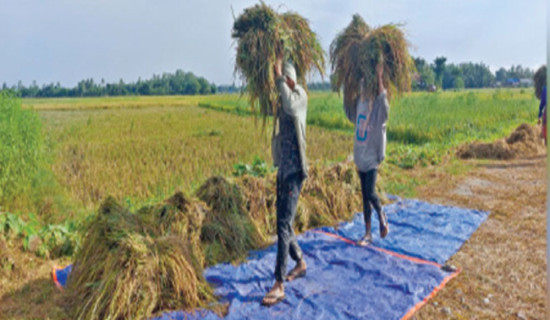
Thinking through the challenges is vital to grasp their magnitude, prepare a mental map and mobilize human and non-human resources to achieve sustainable progress. Sustainable development cannot be delinked from the art of agriculture in Nepal. Modernisation of agriculture has to deal with soil fertility, control of landslides, emphasis on community forestry, use of improved seeds, investment in organic fertilizer, pesticide and conserving the dipping water table and community forestry. Fostering ecotourism is a milestone to foil ecological degradation.
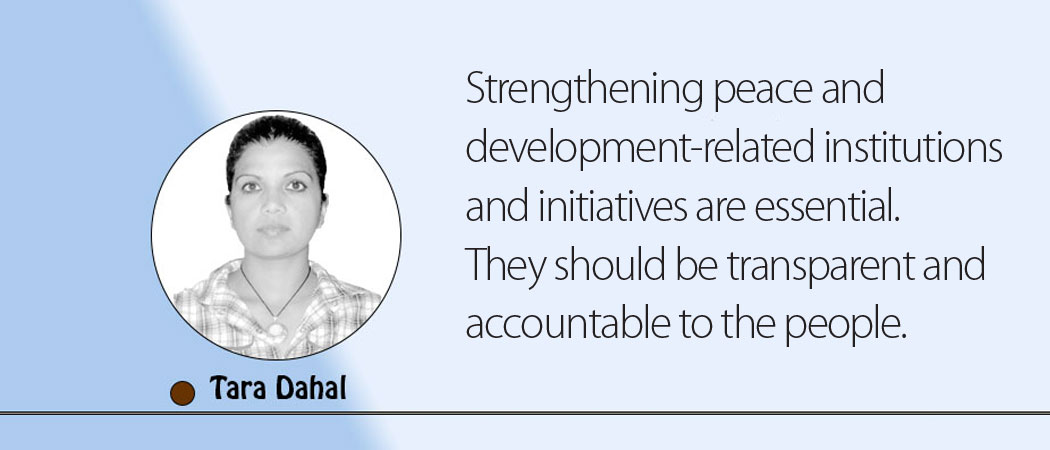
Urban planning can add another factor in green space, park construction and public transportation, where people can converse and think about their localities. Strengthening peace and development-related institutions and initiatives are essential. They should be transparent and accountable to the people. Sustainable development itself leads to positive peace, where the rights of people are realised and this contributes to social capital for inter-community cohesion. Nepal has to invest in sustainable infrastructures to adjust its ecological, social and economic networks vital for thinking about needs, issues and institutions to make a difference in the lives of people aspiring for sustainable development and peace.
(Dahal holds an MA in Peace and Conflict from Otto-Von Guericke University, Germany.)