- Tuesday, 9 June 2026

Essential Conditions For Fair Polls

Despite the declining euphoria of the periodical election, Nepal is heading to a general election to be held on March 5. Enthusiasm is soaring among political parties and the candidates representing them, albeit less so among the general public. In this respect, this election appears different from the previous ones.
In a rapidly changing context, the political landscape is also evolving rapidly. In recent years, the essential spirit of the political ideals established by BP Koirala, Pushpalal, Krishna Prasad Bhattarai, Ganesh Man Singh, and Man Mohan Adhikari seems to have disappeared from the political arena. The ideal political actors have now been pushed into the background, leaving space to the flippant ones in the foreground. We often hear that second-tier and third-tier politicians treat first-tier leaders' voices as mere slogans, paying lip service to them and using them to serve their personal interests.
Election scenarios
As political ideals change rapidly, so do election scenarios. Previously, enthusiasm prevailed among the general public, driven by the hope of strengthening democracy and human rights. The chief reason for people’s enthusiasm was euphoria, a state of intense happiness and excitement after the democratic revolution in 1990. The republican revolution was no less exciting. As time went by, the public's great enthusiasm gradually declined.
Today, most politicians have become superficial. They do not seem to learn from the ideals of the seminal political leaders. They often change their voices to suit the momentary situations. Some aggressive speakers would like to use words in their speech as piercing as arrows to hit humans. They are often inconsistent in their words and deeds. They are engaged in accusing their fellow travelers of being traitors, who they earlier thought were great heroes. Vilifying and valorising have become popular pastimes for today's insincere and dishonest leaders.
Cadres fare no better. They are becoming less critical, so they blindly follow their incompetent leaders. If we closely examine the political discourse, we find that the same leader has changed their tone, saying their views align with the Nepali context. The worst thing we saw in the phase of securing a ticket for fighting the upcoming election this time was more than shameless, as a local or even national leader abruptly deserted the mother party and opted for another simply to garner votes for the House of Representatives. They are even accused of spending heavily to secure votes.
No wonder they may succumb to temptation if they become ministers responsible for allocating and distributing state resources for their own benefit. People say this is what has been happening in recent years. We used to hear the roaring sounds of youths in the streets in the aftermath of the democratic and republican revolutions of the last three decades. The loud voices of their sounds were meaningful to the nation at that time and, even now, seem to continue, albeit in a less audible voice and in a different form. Their slogans for the establishment of democracy and human rights were so powerful that people took them for granted without any question.
The political discourse of that time heavily impacted public opinion. As the linguists claim, words have the power to produce illocutionary effects on the hearers, no matter whether positive or negative. However, the way novice cadres are painting Facebook walls with discourteous language to blemish others is not much different from the cacophony of meaningless sounds raised by the madding crowd in the streets at certain points in history. It does not necessarily mean, however, that all Nepali politicians are driven by the desire for such malpractice. Many of them are guided by principles and ideals established by pioneers.
They want to strengthen democracy and socialism. They want to make the nation prosperous and people happy. They understand that their politics is for the pursuit of happiness of the general public, not simply of the limited few. In the context of turbulence and turmoil, the government must hold a general election and hand over power to the newly elected government. This is a challenging task, but there is no escape from it if we have to survive and sustain as a sovereign nation. Likewise, the Election Commission of Nepal must enforce some essential conditions for a free and fair election, which can be enumerated as:
First and foremost, the bundle of doubt caused by the rumour about indirect foreign intervention in Nepal must be unraveled. So long as some politicians continue to blame the other political actors for being conspirators who were allegedly instrumental in burning the national icons of public buildings, such as the Singha Durbar, the Supreme Court building, and the parliament house. What a grave danger if this is really true! Likewise, the blame often imposed on the erstwhile Prime Minister and the then Minister for Home Affairs for killing the innocent people who were lined up in the street against what they called the corrupt government must also be settled with arguments established based on authentic evidence.
Fair play
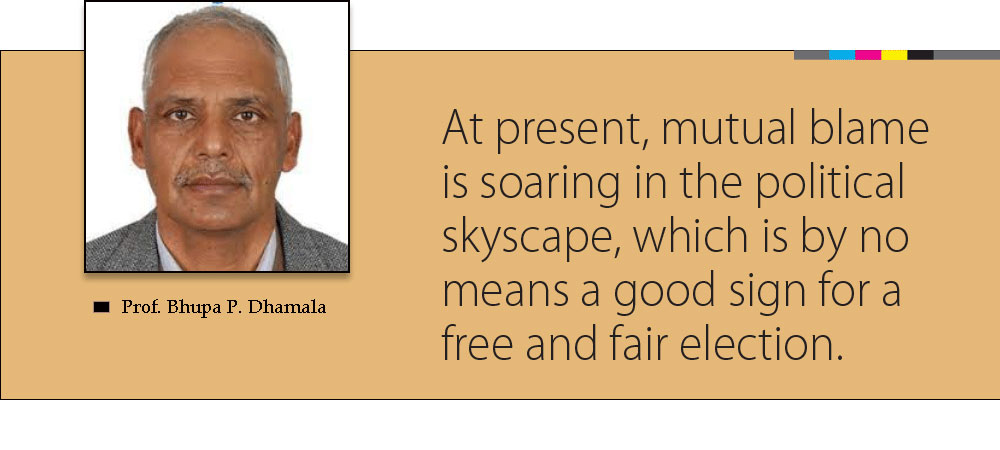
At present, mutual blame is soaring in the political skyscape, which is by no means a good sign for a free and fair election. People fear it may trigger violence at any time. They are not opposed to the election as such, but are desperately waiting for peaceful polls. Second, there must be a fair political game among the political players. The unhealthy competition between political parties and their actors should end immediately and without any conditions. Fair play wins, foul play ruins.
Third, government officials and election authority personnel should be practically neutral and impartial in their execution. This must be implemented in the real sense of the term to make the people believe that the state mechanism is neutral, fair, and impartial. Otherwise, it may lose credibility, which in turn could lead to chaos, confusion, uncertainty, and instability. If the above-mentioned conditions are met, the election at the door will be held successfully, and power will be peacefully transferred.
(The author is the chairman of Molung Foundation. bhupadhamala@gmail.com)