- Saturday, 6 June 2026

Social Justice Still Remains A Far Cry

American activist Martin Luther King Jr., in a letter written from Birmingham Jail, penned a timeless sentence: "Injustice anywhere is a threat to justice everywhere." This statement was not limited only to the American civil rights movement; it is an eternal truth for every society that stands on the side of human civilisation, dignity, and self-respect. When we examine this statement in the context of Nepal, our chests do not only swell with pride; somewhere, they also begin to burn with self-reproach and pain.
Beneath the surface of our society, which looks calm and serene from the outside, countless lavas of discrimination are boiling. In this geography spanning from Mechi to Mahakali, as long as even one person continues to be insulted based on their caste, colour, language, gender, or region, the word 'justice' remains incomplete and unfinished. If the water touched by a Dalit in a remote village is not accepted, then speeches on equality delivered from Singha Durbar in Kathmandu cannot guarantee justice.
Caste discrimination
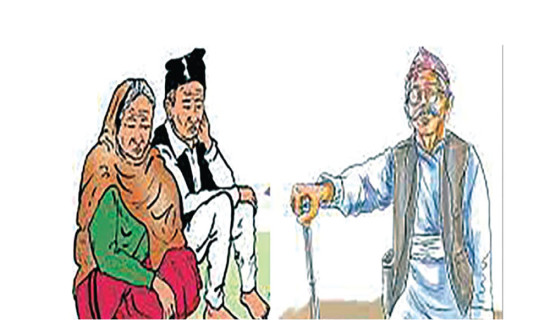
The most disgraceful stain on the forehead of Nepali society is caste discrimination. Although called a garden of "four varnas and thirty-six castes," in this garden, some flowers are not even given the right to sprout, let alone bloom. In the 21st-century era of science and technology, there can be no subject more shameful than humans treating other humans as 'untouchable.'
In some villages of Western Nepal, Dalit communities still face the prohibition of entry to temple steps. This discrimination is not limited to villages; it is alive in the city, wearing a mask of modernity, under the pretext of 'not renting out rooms.' Whether it is the Soti incident in Rukum or the pain of the Musahar settlements in Madhes, these incidents confirm Martin Luther King’s statement.
Until one community can feel safe, the security of another community is merely an illusion. This structure of injustice has not only crushed human self-respect but has pushed a large segment of the country's workforce out of the mainstream of nation-building. Another aspect of justice is linked to regional and linguistic equality. For years, the state power of Nepal kept a certain geography at the centre and treated the rest of the geography as the 'periphery.' The pain of Karnali and the anger of Madhes are products of this psychology.
Madhes, which is the granary of Nepal and is culturally very rich, faces another form of injustice where its citizens must repeatedly undergo an 'ordeal by fire' to prove their nationality. The psychology of considering someone a 'foreigner' or a 'second-class citizen' based on colour, appearance, and language has weakened our national unity. Similarly, the developmental discrimination suffered by Karnali and Sudurpashchim is no less painful. While paracetamol is abundant in Kathmandu, people die in Humla because they cannot get oral rehydration salts (Jeevan Jal).
While talking about justice, the situation of women, who occupy half the sky, cannot be ignored. In Nepal, women are still mistreated on accusations of witchcraft, teenage girls die of suffocation in Chhaupadi huts, and women are burnt alive on the pretext of dowry.
The system of viewing women only as 'objects of consumption' or 'family honour' due to patriarchal thinking is the fundamental injustice. Discrimination between sons and daughters starts in the womb. Even though the law has given equality, in practice, the equal right to property and the right to freedom have not yet been fully established. Violence against women is not a 'private matter' within the house; it is a failure of the state and the cruelty of the social structure.
The constitution of Nepal (2015) is considered one of the best and most inclusive constitutions in the world. It has laid a strong legal foundation to break down the walls of injustice. Article 18 (Right to Equality) clearly states that the state shall not discriminate among citizens on various grounds, including origin, religion, caste, gender, or region. More importantly, Article 24 accepts caste discrimination as a serious social crime, while Article 42 ensures the right to social justice through proportional inclusion.
But a serious question arises: Has the 'justice' written on paper been able to erase the 'injustice' of real life? The constitution wrote the rights of 'Dalits,' but the mindset of society could not accept them as equals. The constitution made a woman President, but patriarchy inside the home did not stop domestic violence. The law is strong, but implementation is weak. A constitution is not the goal, but only a means. Until the hands that operate it and the minds that believe in it are pure, it remains just a book.
Spirit of constitution
To fulfill the spirit of our constitution, we must adopt a multi-dimensional approach:
Firstly, Zero Tolerance and the Rule of Law: The state must abolish the culture of "out-of-court settlements" in cases of caste discrimination and domestic violence. Ensuring the judiciary and police remain free from political interference is essential to creating a genuine fear of the law among perpetrators.
Secondly, Psychological Transformation through Education: The treatment for injustice must start in the mind. Our national curriculum should include mandatory subjects on social justice and human values, teaching the next generation to value humanity over caste, religion, or gender.
Thirdly, Economic Empowerment and Political Will: Providing reservations is not enough; marginalised communities need targeted economic packages and technical education to achieve true independence. Furthermore, political parties must ensure these communities have a meaningful voice in leadership, not just a place in a "vote bank."
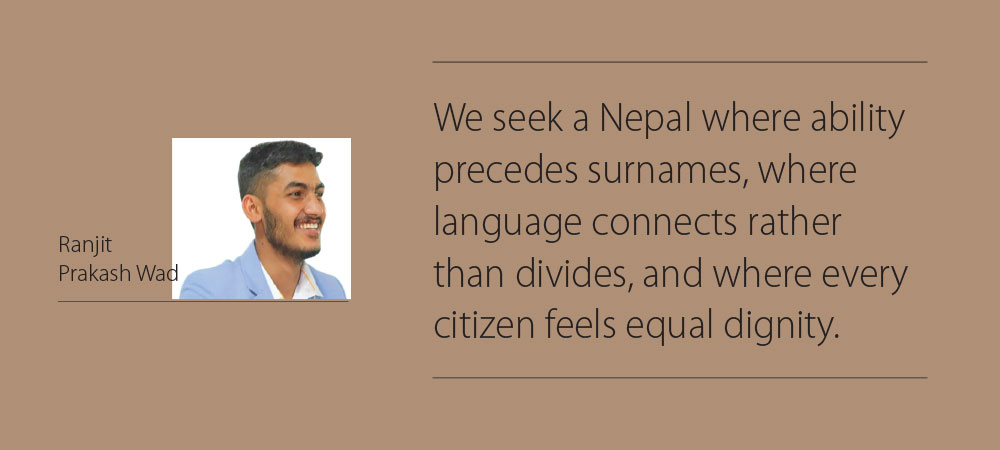
To speak against injustice is to speak for the security of one’s own future. We are all passengers on the same ship; a hole in the lower deck will eventually sink those on the upper deck. The Constitution has given us the "weapon of rights"; now we must have the courage to use it. The next revolution must happen in our thinking 'change of heart.' We seek a Nepal where ability precedes surnames, where language connects rather than divides, and where every citizen feels equal dignity. If justice dies, the nation dies. Let us pledge to keep our country alive by making justice a living reality.
(The author is a B.A.LL.B student at the Kathmandu School of Law.)