- Saturday, 6 June 2026

Building Common Ground Vital For Stability

The central stream of national political life begins from the wisdom of politics. This is vital to pull people to form reasoned opinions and uphold their responsibility in action. The nation is encountering stir of perplexing nature. It reflects the complex nature of reality where nearly all political parties of Nepal are driven by electoral euphoria, where 3,484 persons from137 parties and independents are contesting in 165 electoral constituencies. The EC has made all necessary provisions for the parliamentary election slated for March 5. Still, political channels confound Nepali leaders. First, they are troubled by their link with their own ideologies and becoming realistic.
Second, their ability to wriggle out of the situation of national political stasis lingers owing to a lack of rational habit and a common course of their political parties. Risk of factionalism, defection and rebellion can snag conventional political space. Third, they face the refusal of youths to accept ascribed opportunity and seek a poise between generational justice, which balances passion, emotion and experience without the trait of politics of negation. Integration of youth in political parties and giving them a sense of justice is essential for the agility of politics and catching the erosive force of democracy.
Social trust
Fourth, leaders’ failure to subdue the uncanny propensity of interest groups and the deep state allowed the latter to benefit from protracted political flux. Social trust and image building of political parties are vital to the institutional participation of voters and a striking sense of political shift. All political parties of Nepal are banding together with willing parties to increase their electoral leverage against their competitors in a mood of zero-sum mindset. The strategy to outmaneuver competitors’ moves is animus to democracy’s cooperative game that respects opposition. Those leaders who know the golden mean of politics crave the middle of the road.
Derived from the national historical context, it can accommodate right-wing populists, left radicals, conservatives and those in between. The demeanor of this path is modest, moderate and tolerant of others’ positions and viewpoints, not impulsively assertive and fervently confrontational. The incubation of multi-polar politics requires a common ground based on an equal consideration of the interests of each and equal weight to their concerns demanded by the election code of conduct. Common ground can evolve if Nepali leaders know in advance the worst effects of wild positional row and reconcile their position to stroll together on issues of vital public and national importance.
The common purpose of electoral output is to earn legitimacy for the leadership needed for national tasks. Intractable contradictions within and across political parties fritter away the potential for conformity to the democratic path endorsed by election laws. In this context, Nepali leaders must be aware of the general public opinion, independently of those who roam around them with vested interests. When old habits die hard, it is difficult to reconcile with the changing times and adapt to the emergence of new correlations of forces, thrilling to dislodge old constellations, thus sapping the delight of democratic sensibilities.
A healthier electoral competition among the Nepali political parties, as per the constitutional rules of the game, can create a modicum of political order as a public good. An ethical edifice of Nepali politics can open reasonable choices for voters and become a meeting point for all, reflecting people’s desire, opinion and aspiration and encourages peaceful change of society. Timely change in the quality of politics turns conflict superfluous and moderates the passion of plutocratic, aristocratic and techno-feudal adventures against long-term public and national interests.
This, however, requires patriotic and democratic leaders to perpetually improve the condition of Nepalis beyond impulsive drive. Modern times demand the adaptation of old institutions and habits of mind, including that of justice in proportion to the change of value system and increased constitutional and human rights of people. In Nepal, the contesting political parties are less open to each other for a common ground for the opening of possibilities for taking national initiatives worthy of ecological resilience, social cohesion, economic progress and political stability.
The harmony of intellectual, moral and practical parts of politics are preconditions for uninterrupted cooperation among political parties of various sizes and hues and offers Nepalis an opportunity to relish freedom, will and social peace. This requires Nepali leaders to exercise democratic inclusiveness, stand above their personal ego and partisan dictates and prioritise common goods over partisan interests. Failure of governance to attain correct disposition in Nepal has stacked a myriad of national problems, rather than resolving them one by one and creating a space for the sovereign Nepalis to engage in their creative pursuits and civic engagement.
The scope of fairness and equality can create a template for the endorsement of a just order of society, and people have been longing for mutual progress. Democratic authority of leaders resides in prizing true public opinion, free and fair elections and rational and natural obedience of people for reasoned national coherence, not infantile lenience. The Nepali constitution can serve as a common ground for all parties if its vision is shared by all political parties, with timely reforms to make it fully owned by all. Many public policies and practices run counter to its spirit and vision.
One fundamental fact is the provision of popular sovereignty. It equalizes Nepalis with rights and frees them from primordial loyalties, prejudice and feudal domination, espousing the vision of decent life in harmony with others and nature. Ironically, adoption of constitutionally incongruous educational, health and economic policy has drained the economic metabolism of people to equally compete in the economic and political domain. Popular sovereignty and legitimacy are the foundation of democratic governance. The Nepali constitution, built on these premises, requires subordination of personal selfishness to public goals.
A just foundation of the rule of law can create a common ground condition for the shared future if the conditions of life of people remain fairly satisfactory. Common ground provides a basis for the compromise of varied ideas, identities, positions, ideologies and interests and accommodates the diversities of Nepali life-world. Excessive irrational position can offer no scope for the solution of differences, as it incentivizes the narrow expediency of leaders for everything over democratic doctrine. The majestic sign for the height of national life is required for political leaders who hold a national perspective and the quality of the wisdom of statesmen and can supply integrative potential above an insular point of view and parochial interests.
Application of general democratic principles is vital to subsume the opinions of all sides in a general national consensus on vital initiatives and forge the harmony of ends and means of electoral politics. This means regular national dialogues of all politically significant forces are vital to generate energy to unite all Nepalis for a shared electoral environment and adopt corresponding political programmes as per the Directive Principle and Policies of the state. Here, independent media and scholars can draw many converging points for cooperation among political, economic and social forces and increase the costs for those who violate electoral norms.
At the heart of common ground is to build a shared understanding of values, interests and policies. Identities of political parties may differ but building a general understanding about the constitution, general rules of the game and national issues is vital to frame a common path forward. This is important for nation-building, political stability, social cohesion and economic resilience. Entirely interest-oriented actions of political parties and major actors of society outside the frame of the constitution can easily unravel the mechanism of governance and erode its legitimacy and integrity.
What stirs hope and moves the aspiration of Nepalis is the desire of parties to participate in the election to renew the legitimacy of political life. The question is: are Nepali voters sufficiently fitted with civic sense and skills? At the moment, Nepal faces not only generational divides in politics but also digital divides and emotional gaps. Lack of constitutional constraints on the power of the majority in the parliament has sparked a youth revolt that tossed out the NC-CPN-UML government out of office and set an interim government that declared the election to defuse unrest. The declaration of election has mustered the support of major political parties, if not all, while spoilers are preparing for political stirs.
Skewed choice
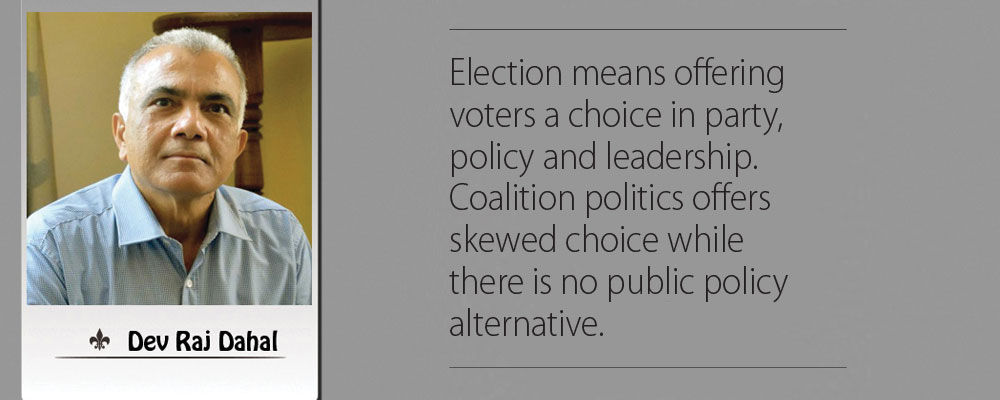
Updating of the voters list, party registration for elections, the election code of conduct and recruitment of temporary police are afoot. Still, political leaders from old parties do not feel comfortable with the election milieu for fear of anti-incumbent din, security deficits, radical challenge to conventional politics and politics of negation. Election means offering voters a choice in party, policy and leadership. Coalition politics offers skewed choice while there is no public policy alternative. Voters are thinking about which kind of leaders serve their interests.
Public accountability of leaders can grow if they assume the consequences of their decisions and build harmony of constitutional goals, stand on the same moral and political template and concert collective action for the resolution of national problems. Invention of common ground for an ideal of compromise of interests, however, demands common belief in democracy, faith in national institutions and corresponding actions distinctive of civic culture.
Nepal has a history of compromise of interests across the political spectrum in various phases of power sharing. Various forms of polity have been invented attuned to a new reality but the outcome endured only for a decade or so because each of them was based on a changing power equation, not internalising enduring values and institutions to bear an authentic response to ordinary Nepalis' lives.
(Former Reader at the Department of Political Science, TU, Dahal writes on political and social issues.)