- Sunday, 3 May 2026

A retired teacher's journey of cultural preservation
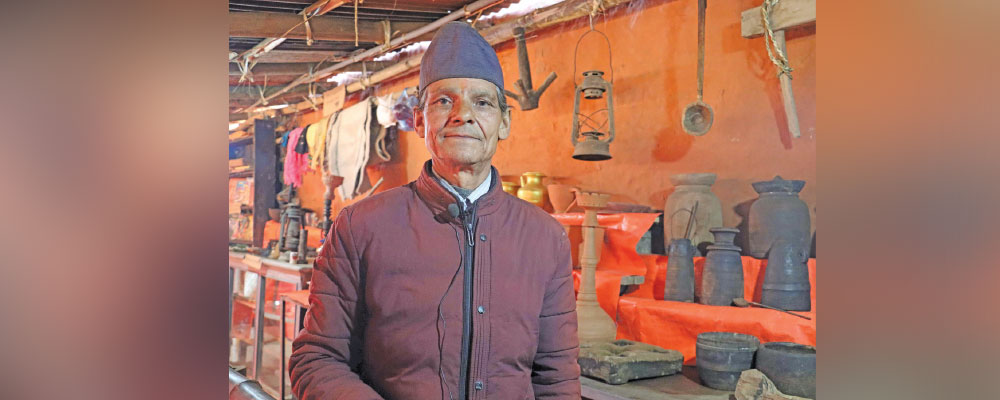
Photo : TRN Retired teacher Shivahari Paudyal stands at his museum.

By Top Lal Aryal,Resunga, Jan. 8: Bishworaj Paudyal, widely known as Shivahari, from Rurukshetra Rural Municipality-4, Gulmi, has turned his retirement into a mission of historical preservation.
An educator and passionate social thinker, Paudyal is quietly doing something historic by preserving Nepal’s disappearing material culture for future generations.
Now 61, Paudyal retired just a year ago after dedicating 35 years to teaching social studies at local schools. He began his teaching career in 1989 in Balechaur with a modest monthly salary of Rs. 300 and concluded his service at Janabodha Secondary School upon reaching the age limit. Even after leaving the classroom, his commitment to society has not diminished.
Over the past five years, he has collected more than 200 historical artifacts and books, all preserved in a private museum he established himself at Ruru Museum.
Housed in a structure built on his own land in Baletaksar Thaplung, the museum showcases everyday objects once essential to rural life.
Among his collections are handmade items used by travelers such as namlo (head straps), damlo and rassi (ropes), bamboo baskets, sewu, and thunse. Wooden household tools like theki (butter churn), madani (churning stick), ploughs, yokes, saws, and other farming implements reflect traditional livelihoods.
The museum also preserves cultural expressions through traditional musical instruments including ekatara, sarangi, khaijadi, murchunga, madal, and flutes.
Clay utensils such as ghainta (water pot), matula, handi (cooking pot), and tharke, along with woolen items like blankets, caps, gloves, sweaters, and mufflers, further enrich the collection. Religious books are also part of the archive.
Paudyal said that all materials were collected locally within the district, some purchased, others received through personal requests.
“At the root of modernity lie natural elements. Human determination, exploration, and research made things modern,” he said. “I have preserved items made from natural materials so that future generations can learn from them.”
Despite the effort and time invested, Paudyal has not calculated the financial cost. “Ancient objects do not carry monetary value,” he added. He provides free facilitation to anyone who visits the museum for observation or study.
Paudyal lives with his wife Indra, two sons, and a daughter. His children are all self-reliant and engaged in their own professions. Sustained mainly through agriculture, the family supports his vision of contributing to society through cultural preservation.
Rurukshetra Rural Municipality Chairperson Yadu Gyawali expressed appreciation after visiting the museum, calling Paudyal’s dedication inspiring.
He added that the local government plans to connect the museum rich in materials useful for social studies and future generations with a nearby school. Discussions are underway at the executive level to develop a concrete plan.
As long as his health allows, Paudyal plans to continue organising and expanding the museum. If necessary, he is even willing to hand it over to the state.
For him, Ruru Museum is not a personal achievement but a gift to society without walls, preserving lessons from the past.