- Tuesday, 9 June 2026

We seek solutions within framework of federal democratic republic

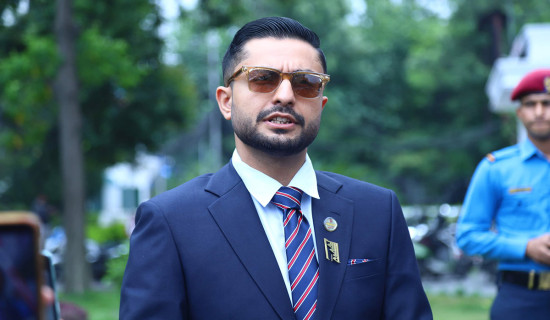
Photo: Manoj Ratna Shahi/Keshab Gurung

The Election Commission (EC) is preparing to conduct the House of Representatives elections on March 5, 2026. The polls have been announced by the government in accordance with the mandate of the Gen Z movement on September 8 and 9. In view of this, youths are actively participating in political activities, hoping for meaningful engagement in state affairs and politics after the election.
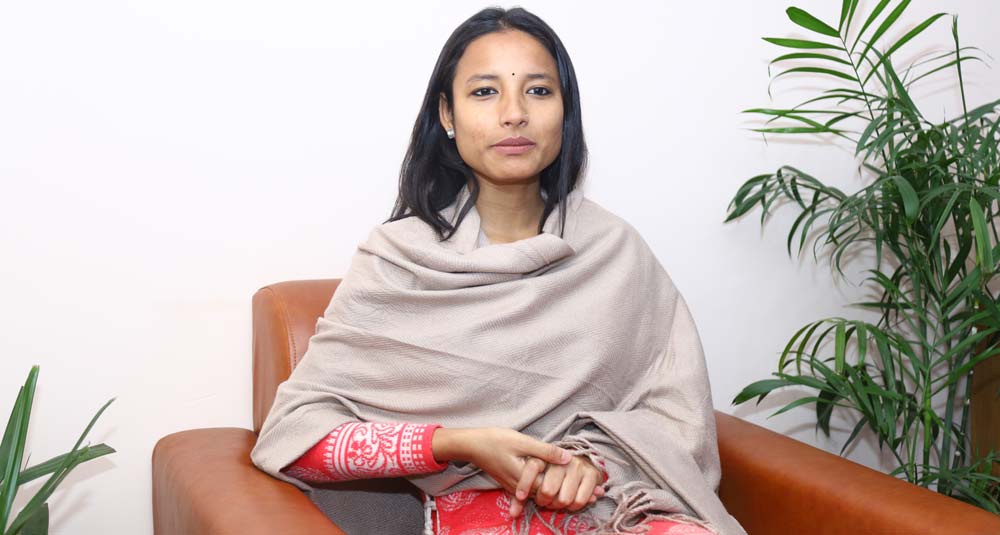
Manjima Dhakal of The Rising Nepal and a team from Gorkhapatra recently talked to Rakshya Bam, a youth activist from Kailali in Sudurpaschim Province, who has emerged as one of the most recognisable faces of Nepal’s Gen Z movement, on elections and other issues. Exerpts:
How has the implementation of the mandate of the Gen Z movement and the mandate received by the government to hold elections progressed? How is coordination between the government and Gen Z going on?
At the beginning, it is important to understand the spirit of the Gen Z movement and why it occurred. The movement began with general questions: Where is the tax money we pay, is it being misused? The general public had grown dissatisfied with the way mainstream parties had run the government for decades. There was widespread disappointment and frustration. For 25–30 years, the same faces dominated positions of power, and the Prime Minister’s office often seemed like a game of musical chairs.
Meanwhile, various political equations and power plays continued, while the issue of good governance was pushed into the background. People’s votes appeared to serve merely as tools for power-sharing rather than fulfilling the public’s basic expectations. Citizens expected that their fundamental needs would be met, that the state and government would function properly, and that their voices would be represented in parliament. Instead, power was misused, and corruption increased. This widespread frustration eventually gave rise to the Gen Z movement.
The movement led to the formation of an interim government. The primary mandate of this government was clear: to hold elections and ensure that future governments reflect the people’s mandate rather than being driven by political maneuvering.

Regarding the mandate of the Gen Z movement itself, a key demand was to end the practice of leadership as a musical chair. Those genuinely committed to the country must rise to positions of leadership. Political parties also need to strengthen themselves by handing over leadership to competent successors. The movement emphasised that internal party democracy must be reinforced because strengthening democracy within parties strengthens democracy in the country as a whole. The Gen Z movement sent a clear message to political parties: the old ways of working were off track, and change is necessary. The movement reflects the growing awareness and political consciousness of the people.
The interim government, formed under the leadership of Sushila Karki, operates under special circumstances. Its first mandate is to hold free and fair elections so that future governments truly reflect the people’s votes. Only then can the country be placed back on a proper political track.
As regards coordination between the government and Gen Z, there is some collaboration, but challenges remain. The Gen Z movement itself consists of multiple groups, each with its own agenda, which makes coordination more complex. Despite this, a certain level of coordination is happening.
The movement turned violent on 9th September. Why do you think the youths resorted to violence that day?
The government had killed 19 to 22 youths on 8th September by shooting them in head and chest. After that, it was natural that not only the youth but the whole country was enraged. That is why the events of 9th September spiralled out of control. We should not encourage violence. That was not what we wanted, we had gone to the streets to ask simple questions, we did not intend any violence. We had gone saying we would not even pick a flower.
But what kind of justice is it to shoot young people who went out to protest peacefully? That is why it is natural for young people to be angry, but anger is not an excuse to cause destruction. Who caused the violence and exactly what happened is still under investigation. In any case, that was not the spirit of our movement, and the spirit of the Gen Z was never to cause such destruction.
With only two months left before the election, Gen Zs seem scattered in all directions and lack a common coordinating leadership. Why is it so difficult for them to unite?
The Gen Zs are a whole generation, and a whole generation cannot think exactly the same way, diversity of opinion is natural. Even millennials haven’t joined a single party, why Gagan Thapa is in Congress while Yogesh Bhattarai is in the UML? That difference of opinion should be respected.
Despite that, it’s important to stand together politically, but unity is harder in party politics. In the movement, however, we remain united. The movement raised two basic issues -- corruption and good governance -- and on those we were collectively one. We marched with a broad, shared consciousness, not a narrow political agenda.
Even if there are different groups, how can we coordinate with a group that does not want democracy anymore? We want democracy, we want a republic. We still want a democratic solution. We cannot do anything else to those who have a different opinion than this, except to say that we respect their opinion.
Now in this situation, do you think the Gen Z movement will be institutionalised as a political force?
For the movement to become a lasting political force, parties must either run according to the mandate the Gen Z movement gave or accept that mandate. Right now a new equation has already emerged just as Balen, Kul Man and Rabi formed an alliance in the Rastriya Swatantra Party and openly claimed some ownership of the Gen Z movement, parties are positioning themselves around it.
The issues we raised are the agendas of all Nepalis, not only any particular party statutes or narrow party agendas. Good governance, for example, should be taken up by every party. If parties truly understand and adopt the mandate of our movement, and work on those issues with commitment, the movement will institutionalise itself. In other words, institutionalisation depends on parties carrying the spirit of our movement.
That does not mean we must form a new party. Opening a new party is a big promise and requires a clear roadmap if we want to present ourselves to the people as an alternative. Our strength has been that we have no personal agenda but a common agenda; if all parties take ownership of that agenda and act on it, the Gen Z movement will become institutionalised on its own.
In the context of the Gen Z movement, a ten-point agreement was signed with the government. What is the current status of its implementation?
We had very high expectations, especially after the formation of a civilian government. Initially, we expected significant progress, but politically things have not unfolded as we had hoped. Many developments are taking place, but not in the way we envisioned. That is why we remain in constant dialogue about how to move forward and what steps to take next. There is no alternative to implementation; the agreement must be implemented.
At the same time, we are also trying to place this mandate before political parties ahead of the elections. We have discussed forming a Gen Z Council, and a roadmap and terms of reference are being prepared. The purpose of signing the agreement was to establish our movement as a people’s movement rather than a political party’s, which is why we named it the Gen Z People’s Movement. That in itself is a significant achievement. We also ensured its publication in the Neapl gazette so that the movement cannot be criminalised in the future. This, too, is an important gain. Now, what is required is constant vigilance and persistence to ensure that the commitments made are actually carried out.
In Nepal’s political history, movements in 2007, 2046, and 2062/63 brought major political change. As you told, the Gen Z movement of 2082 may not bring immediate transformation, but what kind of change do you foresee over the next five years?
Let’s not be overly disappointed or pessimistic. If we see nothing but despair everywhere, then people will feel there is no space left for hope. Over the next five years, what this movement truly seeks is accountability. It has raised a fundamental demand that leadership must be accountable, transparent, and result-oriented.
We do want change, but we also understand that time will determine its pace and depth. What we are demanding is good governance not only accountability and transparency, or a corruption-free state, but a state in which people feel its presence and protection. People’s votes should not merely serve power equations; they should be genuinely respected and valued.
In the coming five years, we want leadership in Nepal that truly works for the people, leadership that delivers results and governs in an accountable, transparent, and responsible manner.
Overall, what kind of change is the Gen Z movement seeking -- structural, policy-based, or generational?
It is both structural and policy-based. When we talk about generational change, we need to be clear about what that really means. This movement has sent a strong message that a new generation is ready to take responsibility and lead. But generational change does not happen automatically; it requires a deliberate transfer of leadership.
In that sense, generational change is a gradual, step-by-step process.
After the election, how confident are you that Gen Z can truly take the spirit of state governance?
Organising a movement and mobilizing people in the streets with political consciousness does not automatically mean one can govern the state. However, if that were the only criterion, then state governance would also be within reach. What really matters is political maturity. There are people from Gen Z age group already involved in state governance, but ultimately it depends on how mature they are politically, how well they understand the country, and how deeply they understand society.
What is your personal plan for the upcoming House of Representatives election? Are you preparing to file your candidacy?
I am still thinking about it. On one hand, I feel this generation still needs to remain on the streets and continue asking tough questions. On the other hand, I also feel that the voice of the movement should reach the House. The decision will become clearer soon, especially within the timeframe set by the Election Commission.
The selection process for some candidates is already under way. It is often said that youth should have a meaningful role and participation in candidate selection. How can this be ensured in practice?
This is an important question. The core mandate of the movement is that youth must participate in mainstream politics. One way to ensure this is by presenting a clear mandate to political parties before the elections. Parties should be asked to formally discuss this mandate, reach a conclusion, and, if they accept it, act accordingly. In that mandate, youth participation should be clearly stated as essential in every sphere, including candidate selection.
At the same time, party leadership must genuinely understand this necessity. It is no longer possible to imagine any sector without the participation of young people. Youth are at a peak stage of energy, creativity, and engagement. Since the law allows candidacy for the House of Representatives from a young age, there should naturally be strong representation of youth across all fields. Ultimately, it depends on whether party leadership is willing to recognize, accept, and act on this reality.
The debate on youth leadership and the system has been going on for a long time. We have also been observing whether the current electoral system is truly youth-friendly. What is your view?
The system itself is youth-friendly, but the problem lies with the political parties. Despite what the law says, what is written in party statutes, and what the Election Commission envisions, parties are not ensuring meaningful youth participation. On paper, everything looks good, but in practice, opportunities are not being given. Now, however, it seems the time has come for youth themselves to claim those opportunities and demand their rightful place.
What kind of policy initiatives should the state take to attract young people to politics?
To attract young people to politics, the state must take concrete political initiatives. Today, many young people are leaving the country often for education because they feel there is no supportive environment at home. Policy-wise, the state needs to focus on a few key areas. First, meaningful reform in education is essential. Second, there must be serious efforts to create employment opportunities.
Beyond this, young people need to be introduced to a healthy political culture. This responsibility does not lie with the state alone but with society as a whole. The state should actively invest in political education through training programmes, awareness campaigns, and leadership development initiatives. Most importantly, it must create genuine spaces where young people can participate, be heard, and play a meaningful role in politics.
What should be the youth’s top priority in maintaining good governance once they assume leadership?
The most important priority is integrity honesty above all. Young leaders must be clear about their mission, vision, and goals: why they entered politics and what they intend to do once they take on leadership roles. Along with this, they must work honestly and with genuine dedication to the state.
The promises made to the people during elections should not be forgotten after reaching Parliament or positions of power. Leaders must continuously remember those commitments and work to fulfill them, not just recall them during election campaigns.
The old parties fought for democracy, and this is also a struggle, but it seems that some youth are feeling helpless. How do you evaluate this?
We view their contributions very positively, and they are certainly worthy of thanks. But the challenge is this: if we look back, politicians like Oli, Prachanda, and Deuba were similarly brave at our age. They came forward with energy and a vision to serve the country. Over time, however, people became disillusioned with them because they did not fulfill their promises. They offered dreams but failed to deliver good governance.
Today, our generation comes with similar aspirations to build the country and pursue meaningful change. But we must also implement checks and balances. We constantly ask ourselves: if we come to power, how will we prevent corruption and misuse of authority? Former leaders, once in power, failed to uphold accountability, and we want to avoid repeating those mistakes.
Even now, some say we are not doing enough, but that is not the case. Once in power, we must maintain self-scrutiny and continuously monitor our actions. We need the space to learn from mistakes, correct them, and move forward. Only through constant questioning and accountability can we ensure that we follow through on the ideals of the movement and the aspirations we are working toward.
Finally, what is your main message to the youth who are going to vote for the first time?
To the youth voting for the first time, remember that a single vote can change a lot. That vote is very important; value it and use it wisely. Ask questions to the candidates in your area. Treat elections as a festival of democracy; celebrate it, take responsibility for your community, and participate in a free and fair election.
I would also like to share a line from Rup Chandra Bista, “We do not belong to anyone, no one is ours; we belong to truth and justice, and justice and truth are ours.” When you vote for the first time, think carefully about what truth, justice, and fairness mean. Your vote is your responsibility, and it has the power
to shape the future.
How did you feel after reading this news?
-square-thumb.jpg)