- Tuesday, 9 June 2026

House Of Representatives Polls Urgent

The government seems to be making an enormous effort to hold the election for the House of Representatives (HoR) on March 5. However, the Nepal Communist Party (UML) and the HoR members of the Nepali Congress party have registered a writ petition with the Supreme Court demanding the reinstatement of the House. On the other hand, the Congress party has unanimously decided to participate in the election, and NCP (UML) is also saying that it is ready to participate in the election if it is held freely and fairly.
The ambivalent roles of these two large parties, the threat of some Gen Z leaders that they will not let the election happen without having their demands fulfilled first, the demand of other Gen Z leaders for the resignation of Prime Minister and the writ petition pending in the Supreme Court (SC) have made the election uncertain, though other parties like Nepali Communist Party, Rastriya Swatantra Party (RSP), Rastriya Prajatantra Party (RPP), other fringe parties and newly registered parties are showing readiness for the election.
September 8 and 9
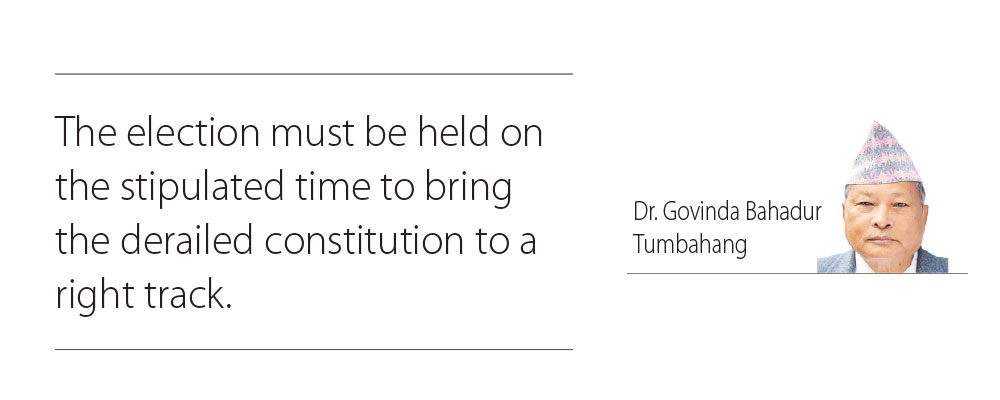
If one delves deep into the incidents of September 8 and 9 and their preceding and following events, they lead us to the conclusion that the election must be held on the stipulated time to bring the derailed constitution to a right track. In fact, the tragic events, which claimed 76 lives, occurred due to the unfavourable national and international situations, and due to the then-prime minister K.P. Sharma Oli’s inefficiency and incompetence in handling them. Four powers – China, India, the European Union, and the USA – have significant influence over Nepal. Our government must be efficient and astute to hold friendly relations with them through diplomatic means.
However, for the past decade, it has been inefficient to maintain balanced and friendly relations with them. India was not satisfied with the 2015 constitution of Nepal, as its concerns were allegedly not adequately accommodated in the constitution. Its dissatisfaction further worsened when a map including Kalapani, Lipulek, and Limpiyadhura was unanimously approved by the Parliament of Nepal and was authenticated by the President on June 13, 2020. Extreme poverty, increasing unemployment, rampant corruption, nepotism and favouritism, and the exodus of youths for jobs had disappointed people, including party cadres. Ministers, party leaders, and government officials had been implicated in large corruption cases like the Pokhara International Airport scam, Lalita Niwas Land scam, Bhutanese Refugee scam, and Visit Visa Extortion scam, to name a few.
Additionally, people were frustrated because they had to bribe government officials to get their work done, especially in the land revenue office, police office, transportation office, and administration office. The Gen Z group had heard that the political leaders were corrupt and that they had amassed a large sum of money through illegal means, and their children were living a prosperous life – all of which made them anti-party and anti-party leaders.
Oli participated in the Shanghai Cooperation Organisation Summit held in Tianjin, China, from August 30 to September 1. During his meeting with Chinese President Xi Jinping on the sidelines of the event, he raised Nepal's objection to the recent India-China agreement, without consulting Nepal, to reopen trade through Nepali territory at Lipulekh in Darchula district. He also met Indian PM Narendra Modi on the sidelines and held bilateral talks. Though Modi did not apparently show his displeasure through words or facial expression, he was unhappy with Oli for his complaints to the Chinese President.
Then, on September 3, Oli participated in the Victory Parade held in Tiananmen Square, Beijing, on the 80th anniversary of China’s victory in the Second Sino-Japanese War. He attended a state luncheon and participated in photo sessions with Xi Jinping, Vladimir Putin, and Kim Jong Un, among other world leaders. It annoyed Japan, as well as the European Union and the US.
When Oli returned home, both national and international conditions had grown unfavourable to him. Unaware of them, on September 4, 2025, he banned 26 social media outlets, including Facebook, YouTube, and Instagram, citing registration non-compliance. In reaction to it, on September 8, thousands of Zen Z people assembled in the Maitighar Mandela, marched towards New Baneshwar holding placards, chanting slogans, and demanding withdrawal of the social media ban, an end to corruption, bad governance, nepotism, and privileges to the offspring of high-profile political leaders.
Infiltration
At the beginning, Gen Z leaders said that the protest would be peaceful, but it spiralled into violence quickly. Then, some Gen Z leaders, sensing infiltration into the movement, declared that their protest programme was over. However, it went in vain. The uncontrolled violence killed 19 people on the first day itself. The buildings of the Parliament, Singha Durbar, Supreme Court, President’s Office, Police Offices, and the houses of party leaders were burned down.
On September 9, PM Oli resigned from his post on the advice of the Chief of the Army Staff (CoAS), and he was airlifted to a secure place. For two days, September 10 and 11, Indian social media outlets and mainstream televisions highlighted Sudan Gurung, Balen Shah, and Sushila Karki as the main figures of the movement.
Then, following Balen Shah’s advice, Gen Z leaders approached the CoAS, who facilitated the appointment of Sushila Karki by the President to the post of PM on the recommendation of KP Oli, the then PM of the caretaker government. The President then dissolved the HoR and declared March 5 as the date of the HoR general election on the recommendation of Prime Minister Karki. On her inauguration as Prime Minister, she received congratulations from prime ministers and presidents of several countries, including the Dalai Lama.
(The author is a retired professor of linguistics at the Tribhuvan University.)