- Saturday, 6 June 2026

Defining Leadership As Cultural Guardianship

People follow their leaders as a cultural role model who transmits a shared worldview, symbols, values, morals, ideas, norms, beliefs and institutions inherited from their ancestors. They offer cognitive maps for the actions of people and set national values and goals for conduct in private and public life. Since people live within their culture, it matters to spur their memories and self-awareness. It enables them to proscribe what is repulsive, not attuning to their character, temper and disposition. The evolution of culture and learning about it detaches people from the state of nature, symbolising a phase of insecurity in disassembled life. Cultured people are those who follow the civilised rules of life, adopt decent manners and build a circle of friends.
John Scott analyses culture at three levels: “learned pattern of behaviour, aspects that act below conscious levels, such as the deep level of grammar and syntax in language, of which a native speaker is seldom aware; and patterns of thought and perception, that are also culturally determined.” Many Nepali leaders willfully adopt the pattern of behaviour, think about the core national values and wear national dress while representing public functions, visiting abroad and attending meetings in international forums, including the UN General Assembly. Leaders embody culture and culture shapes the rationality and personality of leaders.
Love of community
The love of community leaders for their own culture, dress, songs and music, dance and food habits is profound. They, therefore, preserve their flair and taste and use them for socialisation to evolve personality traits, social construction and public policy goals. In Nepal, morality is defined by the notion of dharma (virtuous conduct). Cultural politics is not about the competing conception of power as adorned by today’s leadership but about the promotion of public goods. They embody the virtue of combining the agility of tradition and a fondness for fresh insight with changing popular wishes. Gautam Buddha called this the middle path, a right course of action held together by compassion and harmony, not the fear of penalty.
The founder of modern Nepal, King Prithvi Narayan Shah, without being a slave of passion, said that the treasure of the nation is national culture and people’s well-being. He was fit for multicultural leadership like sage king Janak. Nepali leaders of today need to imbibe certain of their qualities that can act as bridging and bonding social capital across the nation’s diversity, motivate each piece for national unity and assume responsibilities for the common good. Nepalis are fond of celebrating their culture and signifying their effects to sub-cultural groups to create overlapping values for cooperation across their realms.
Its classical metaphysics and spiritualism are highly syncretic, serving the soul of the Nepali nation. The notion of syncretism denotes the evolution of Sanatan Dharma flowing from antiquity and linking diverse cults and creating unity in diversity, not domination. Those Nepali leaders who feel shame in using particular cults of Hinduism, Buddhism, Lamaism, animism, Kirant, Islam or other religions refer to Sanatan Dharma. The psychological makeup of Nepalis is shaped by the family, community, culture, spirituality and media socialisation.
The pivot of the nation’s heartland, Tundikhel and other public places, stand for sites for the display of festivals of many caste, ethnic and cultic groups. Leaders of each community not only celebrate but also participate in the activities, demonstrating that they are a part of their culture, not apart from it, and love it. In national festivals such as Gai Jatra, Indra Jatra, Ram Navami, Bibah Panchami, Shivaratri, Buddha Purnima, Christmas, Eid, Democracy Day, Losar, etc., communities showcase their cultures in the public arena, and the government provides public holidays. Celebration of festivals forges a bond, togetherness, a spirit of solidarity and a matter of national pride.
Different cults have created temples, monasteries, mosques and community places to preserve their cultural sustenance. People donate to their respective institutions of faith and Guthi lands for their survival and growth. Ideological leaders, however, adopt an instrumental approach to culture to stratify the population, thereby enlarging the electoral base and mobilising primordial identities of class, caste, gender, ethnicity, religion, and region to rise to power. Such an approach fails to make them a cultural interlocutor. Transactional leaders do not muster cultural resources for conversation and national unity. The insular culture of many Nepali leaders fosters mini identities. It does not tend to the national identity of people loyal to the state who can carry out constitutional duties.
Reflective Nepali leaders are connectors of cultures and communities, essential for national strength. Nepali cultural historians have formulated ideas and narrated how many subcultures of people, though different from each other, are not treated as inferior. In a multi-cultural society like Nepal, any cross-cultural judgment requires the standards of its own rationality of the shared understanding of its members, rather than outside canon who may have intellectual prejudices. Nepalis are also promoting their vernacular language, art and cultural films with the unique characteristic of music, dress and performance of actors, adding to the cultural richness of the nation.
Historians and literary sectors have written dramas, songs, stories and poems. Films of historical personalities have been produced to preserve memories of the nation. Art galleries and museums stand to authenticate the nation’s histories and memories attuned to modern times. The animation of native knowledge, heritage and culture becomes a great defense of the Nepali nation’s love of freedom against colonialism and imperialism. History books portray the art of war and valor of Nepalis who sacrificed their lives for national sovereignty, while global Nepal is shaped by the projection of its hard power of diplomacy, trade, aid and strategic partnership, Gurkhas, etc., and soft power of Shivaism, Buddhism, tourism and workers.
Many nations’ monasteries at Lumbini spread the soft power of Nepal in their mother countries. In Nepal, sadistic impulses against culture are the sign of ideological narration of leaders and their rationalisation by their proxies, who have developed a captive mind and accepted the superiority of an external source of knowledge and mores to de-culturalise one’s own, deeming it a cause of backwardness. In the debate of modernity, many Nepali social scientists, administrators and politicians also seek to impose an external world of reality to modernise the nation, considering one’s own inferiority and maladaptiveness.
This is a symptom of cultural writhe, a sort of self-inferiority of one’s own culture. In Nepal, certain groups have adopted the process of Sanskritisation- espousal of the culture of high caste groups, while others adopted its antithesis, modernisation, which reviled the native model of social mobility and adopted its counterparts, deeming it useful to abolish blind faith, discrimination and indulge in self-chosen, rights-based life. Some leaders embody the fusion of both. Ordinary folk embrace their own native version of civic culture of duties.
Since the days of Prithvi Narayan Shah, Nepal has adopted multi-culture, recognising the nation as a garden of four castes and 36 colours and glued the nation together by tolerance to the heritage of diversity of race, language and culture and suggested each group to follow their kul dharma, ancestral spiritual path. Jung Bahadur Rana adopted the National Civil Code, which suggested that the courtiers dispense justice as per the sanity of their local cultural traditions. Driven by patriotic zeal, he legitimised coercion to stabilise the nation by abolishing the grimy politics of courtiers. He constructed temples in India so that the bond between Nepali and Indian people stays strong, each strengthening each other's culture and social practices.
Both nations have evolved many shared sites of pilgrimage and tourism to enrich their cultural foundations and use indigenous knowledge to fight for national freedom. Nepal’s tolerance of other cultures did not overwhelm its national identity and its political culture of granting asylum to outsiders. Nepal has embraced a salad-bowl approach to nation-building, not a melting-pot image of cultural uniformity. This is the reason so many cultural, linguistic and ethnic and caste diversities keep their identities till today. This diversity is not a problem in collective action but a source of national resilience in crisis times.
Yet, Nepal is also the crossroads of culture where each subculture shares various norms with the other, forming a national mosaic. Consumerism, global music, Valentine's Day and New Year celebrations have also led to the fusion of the horizon of culture, thus making the practice hybrid. Nepali leaders need to learn the insight from their own cultures of spiritualism and rationalism and also follow modern practices, as both are required for legitimacy. Nepali leaders often use the wisdom of Buddhism to spread the culture of peace in the world and carry the idols of Buddha to present to their counterparts while travelling abroad.
Many elite leaders have adopted the counter-culture of individualism against the native culture of community spirit and affinity to society and the nation. The thinning of Nepali culture can be attributed to contractual marriage, family divorce, atomisation of family, migration from rural to urban areas and abroad, the rise of materialistic values, etc. The ideological indoctrination of people and the growth of instrumental politics continue to erode the nation’s cultural values. The increasing materialisation of social life has infected the integrity of leaders to uphold dharma-based conduct. They are inclined to legalism.
Moral decay
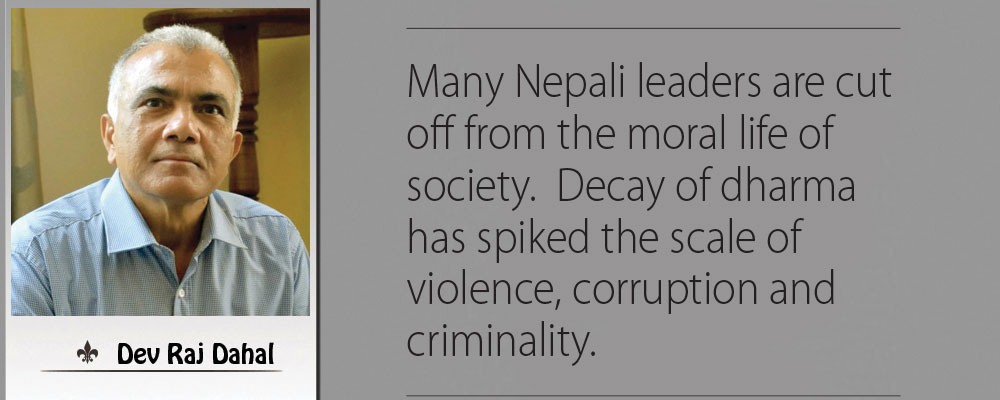
As a result, many Nepali leaders are cut off from the moral life of society. Decay of dharma has spiked the scale of violence, corruption and criminality. Many elites keep a double standard. Depending on the situation, they perform cultural rituals in private life while appearing atheist is public. Traditional Nepal’s intellectual culture was indifferent to material assets. Scholars were inclined to indulge in the pursuit of truth. But they disdained manual work and lived with bare survival means.
Still, they held community spirit glued by culture. They spread the value of education and organisation of rituals as a public duty, not class-based education and a corresponding worldview, which alienated those who lack resources. Leaders whose vocation is politics need to learn and reflect on people so that they become cultural bearers, not often the slave of passion.
(Former Reader at the Department of Political Science, TU, Dahal writes on political and social issues.)