- Saturday, 6 June 2026

Phewa Lake encroached amid political flux
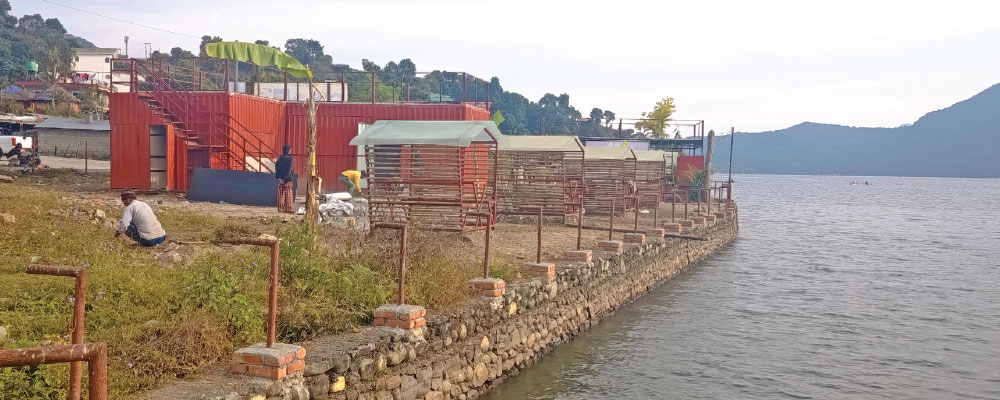
Photo: TRN Unauthorised cafe construction encroaching upon Phewa Lake’s protected land

By Phadindra Adhikari,Lekhnath, Dec. 24:The number of people boating on Phewa Lake has not declined even in the growing winter chill.
On clear days, many visitors can be seen taking photographs and videos with reflections of Machhapuchhre, Annapurna and other peaks shimmering on the water. While Phewa Lake continues to keep Pokhara -- the tourism capital -- lively even during the off-season, the lake itself is suffering from both natural and human encroachment.
Large volumes of soil, gravel and waste are being washed into the lake from rivers such as Harpan, Khahare and Firkhe, as well as nearby gullies.
Taking advantage of the political uncertainty following the Gen-Z movement in September, several structures are now being built directly from the lake water in some places, while land plotting and levelling continue in the wetland areas.
The Supreme Court ordered to maintain a 65-metre buffer zone from the lake’s edge, remove structures within it and restore greenery that has not been enforced. A few days ago, the California Garden Café was opened after a wall was built directly from the lake at Khapaudi in Pokhara-18. Another restaurant is also under construction nearby. Workers are busy building structures on land that falls within the buffer zone between the road and the lake.
To the east of the cafe, preparations are under way for yet another structure. In Raatmate, a coffee shop has recently opened right along the road that falls within Phewa’s buffer zone, with another structure coming up beside it.
Rights activist Ram Bahadur Paudel said construction has not stopped despite informing the ward office, the metropolis and the administration about the illegal works.
Advocate Bhagwati Pahari, who has repeatedly spoken out against encroachment, said it was ironic that such activities are being ignored. “They should be stopping these actions. Not only that, gravel and sand are being extracted, and land is being filled near the lake’s headwaters. It is happening in plain sight, yet treated as if unseen,” she said.
With the initiative of Pokhara Metropolitan City and the Gandaki provincial government, poles have already been installed at 65 metres from the lake’s highest flood level. A total of 611 physical poles have been placed along the roughly 16-kilometre perimeter to demarcate the lake area.
Shiva Prasad Parajuli, Chairperson of Ward No. 18 of Pokhara, claimed the ward was unaware of structures being built within the buffer zone. “They must have built them at night. We have no information. He also added that recommendations for houses and roads within the buffer zone have been halted and that the ward is committed to complying with the court order.
Pokhara Metropolitan City has sought records from the Survey and Land Revenue Offices to identify plots that fall within the buffer zone and determine which require compensation and which do not.
As those offices were damaged during the Gen-Z movement, the technical committee has yet to complete the classification.
Mayor Dhanraj Acharya said no new structures would be allowed within the buffer zone and that existing ones would be removed soon.
Acharya said, “We have been stopping new construction and will continue to do so. A notice to remove structures within the buffer zone will be issued in a few days,” he said.
“Soon, we will also start granting construction permits for land outside the 65-metre limit.” Preparations are underway to clear land after classifying plots that fall within the lake area and the 65-metre buffer, he added.
Surendra Raj Pandey, Chief Minister of Gandaki Province, said government structures within the 65-metre zone would be removed first. “There will be no delay. The federal government will provide compensation where required. Government structures will be removed first, followed by private ones after compensation,” he said.
There are plans to develop the Phewa lakeside area so that visitors can spend an entire day enjoying it, said Pandey.
The provincial government has also proposed building a ‘selfie bridge’ at Mungrebagar near the lake’s headwaters. Vehicles will not be allowed on the bridge, which is estimated to cost around Rs. 150 million and is intended for tourists to walk, take photos and enjoy the view.
Preliminary data show that more than 4,500 land plots fall within Phewa Lake’s buffer zone. In 2018, the Supreme Court issued a mandamus order directing the government to enforce the 65-metre standard, demarcate the lake boundaries and demolish all illegal structures.
-square-thumb.jpg)
-original-thumb.jpg)

-original-thumb.jpg)