- Friday, 20 February 2026

Mistreatment and harassment leave schoolgirls vulnerable to alienation
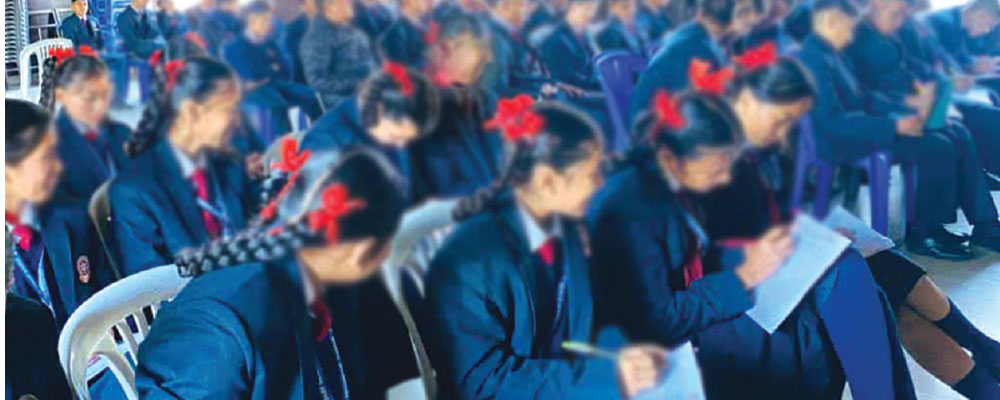

Kathmandu, Dec. 21: Monika (name changed), a fifth-grade student at a school in Jhapa district, was initially doing well in her studies. However, when she advanced to sixth grade, she faced sexual harassment from her own teacher, an experience that continued for a long time.
The maths teacher frequently touched sensitive parts of her body and even made advances towards her. Additionally, many students felt afraid of this teacher.
After several months of these unacceptable actions, rumours began to circulate that Monika was the maths teacher's girlfriend. This inappropriate accusation deeply affected Monika, leading her to experience significant emotional trauma.
Ultimately, she was compelled to drop out of school and later attended a different one. Unfortunately, she was unable to continue her education.
Juna Devi (name changed), a seventh-grade student at a public school in Sarlahi district, recently expressed her feelings of fear and insecurity regarding a troubling experience with a classmate. A few months ago, she encountered a love proposal from a boy who confronted her carrying a knife.
"While I was walking home, one of my classmates proposed to me holding a knife. It felt like a life threat, and it was more frightening rather than surprising. I couldn’t talk about this problem with my teachers or my parents. But I’m sharing my story with you because I believe you, as an independent survey team from Kathmandu, have more power than my teachers," Juna Devi explained through tears to the team conducting a survey at her school.
She mentioned that the emotional trauma from the incident affected her deeply, leading her to stop attending school for weeks, as she claimed to be sick. However, she felt unable to share her distress with her family, as her community tends to blame girls in situations like hers.
A few years ago, an immature love affair was made public at a school in Tanahun involving a ninth-grade girl and her classmate. They were in love with each other and one afternoon, they eloped from school, not returning home for several days. Following this incident, both families gathered at the school, hoping to bring them back home, even though the couple was not legally eligible to marry.
After a week, the couple returned as a new bride and groom, which was unacceptable to both families.
As a result, the families forcefully separated them. The boy continued attending school, but the girl faced severe bullying, harassment, and shaming after returning. Ultimately, not only did she quit school, but her entire family also decided to migrate to Chitwan.
Amidst the widespread bullying and harassment, no one could intervene to prevent a family from facing unwanted migration.
This was not just an immature love story between two teenagers; it was a profound and dark psychological trauma affecting a schoolgirl and her entire family. Many psychiatrists and experts argue that schools and communities often address these issues reactively, focusing on immediate incidents rather than considering their long-term impact on victims.
Dr. Ruja Shrestha, a psychiatrist who has counseled thousands of students and teachers, pointed out that both the community and schools tend to blame the victims.
“In such cases, many schools and communities lack the willingness to explore the causes of the situation from the victims' perspective.
They prefer to find a quick solution to manage the current circumstances rather than acknowledging the harm done to the victims.
As a result, many students, particularly girls, experience psychological trauma both in their schools and within society,” said Dr. Shrestha. She also noted that many girls are reluctant to share their problems with teachers or those close to them because they do not feel safe or comfortable doing so.
Many female students can’t express their problems due to possible blame and harassment on themselves, said Dr. Shrestha.
Who is supposed to be more responsible?
Experts emphasize that schools and parents must take greater responsibility in addressing harassment and bullying that many female students encounter in various forms.
Pawan Poudel, a mental health expert who has provided psycho-social counseling in over 100 schools, advocates for every teacher to receive this type of training to create a more supportive environment. “Every female student experiences some form of exploitation or discrimination at school or within the community at least once during their school years. However, our current systems do not effectively address these issues,” said Poudel.
In response to these challenges, some local governments have appointed psycho-social counselors, in accordance with the requirement that each school has at least one counselor or nurse. However, these efforts alone are insufficient to create schools or communities free from exploitation.
Dr. Shrestha argues that merely hiring a counselor is not a comprehensive solution to these problems, as many schools and communities struggle to build trust with teenage girls regarding sensitive matters. “First, school teachers and parents must demonstrate their commitment to supporting victims by respecting and safeguarding their privacy,” she stated.
Additionally, Dr. Shrestha raised concerns about the roles of Discipline In-Charges (DIs) in many schools who are supposed to maintain order. In numerous instances, it seems that DIs fail to protect victims' privacy, thereby exacerbating their suffering. According to Poudel, surveys conducted in various schools revealed that students often fear DIs rather than view them as supportive figures.
Some positive efforts
There are positive signs of psycho-social treatment being initiated by some local governments and schools. Over the past five years, the Kathmandu Metropolitan City has appointed several counselors and nurses to provide psycho-social support in various schools.
Schools that have appointed counselors have seen notable progress in students’ education and personality development.
Heramba Raj Kadel, Principal of Viswa Niketan School in Kathmandu, emphasized that these measures should have been implemented earlier, as his school has experienced significant growth in the last five years. Principal Kadel mentioned that they have two counselors, one for male students and another for female ones, along with a nurse.
“We appointed two counselors, as well as a nurse, who have led to positive changes. We have also installed a complaint box, and many students have recently expressed their concerns without hesitation. This has been beneficial for both their educational and personal development,” he said.
According to Principal Kadel, approximately 8 per cent of the complaints are related to exploitation, harassment, and discrimination against female students. He believes that while progress has been made, the results are still not satisfactory. He urged the government to create permanent positions for counselors instead of relying on local grants.
Despite these requests, the government has not addressed this issue so far. Shiva Prasad Sapkota, Spokesperson of the Ministry of Education, Science and Technology, stated that there are currently no plans for creating permanent positions for psycho-social counselors in every school.
“It is the responsibility of the local government to appoint personnel to help keep schools free from exploitation and harassment. At present, we do not have a plan,” said Sapkota.
He also added that every local government and community should be aware of the specific challenges faced by their schools and can appoint counselors and health personnel to address these issues in accordance with legal provisions.
Additionally, experts and some principals argue that while legal provisions are established, there are significant gaps in their implementation.

-square-thumb.jpg)