- Sunday, 3 May 2026

Need For Youth Efficiency Council

Nepal stands at a turning point. After decades of political instability, administrative paralysis, and unfulfilled promises of reform, it has become clear that our biggest challenge is not a lack of ideas — but a lack of efficiency in executing them. In this moment of transition, an interim government has a rare opportunity to lay the foundation for something historic: a National Youth Efficiency Council (NYEC) — a pilot initiative that could evolve into a full-fledged Ministry of Youth Efficiency and Innovation.
Nepal’s bureaucracy remains one of the most overburdened and underperforming in South Asia. Projects stall for years, public services lag behind, and innovation is strangled by red tape. The result? Wasted time, wasted money, and wasted potential. Yet Nepal’s greatest untapped resource is its youth. Over 60 per cent of Nepalis are under 40, but most decision-making positions are held by those nearing retirement. The generational gap in governance is glaring — and the cost is national stagnation. It is time to empower a new generation to lead reform from within.
Accountability
Nepal already has a National Youth Policy (2015) and Youth Vision 2025, both promoting leadership and inclusion. The National Youth Council, under the Ministry of Youth and Sports, coordinates youth programmes across the country. But these institutions are advisory, not executive. They organise, advocate, and report — yet they don’t modernise government systems or hold ministries accountable for inefficiency. Nepal recently redefined “youth” as ages 18–35, reaffirming their importance. Still, the framework limits them to participation rather than power.
Under a simple executive order, the interim government could establish the National Youth Efficiency Council under the Office of the Prime Minister. The Council would bring together around 100 professionals composed entirely of people aged 18- 45 years old — engineers, economists, managers, data scientists, policy specialists and digital strategists — all united by a single mission: to make Nepal’s government work smarter, faster, and more transparently. Its mandate would focus on efficiency audits, digital governance pilots, youth leadership programmes, and drafting a framework for a permanent Ministry of Youth Efficiency and Innovation.
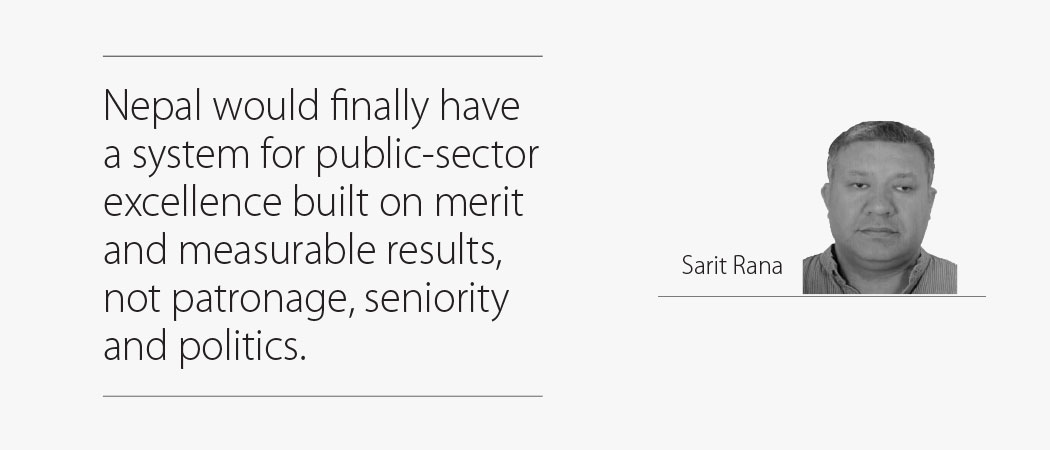
This would not be a political ministry — it would be an innovation lab inside government, reporting directly to the Prime Minister and insulated from party interference. Beyond fixing systems, the Council would train reformers. The best performers from the Youth Efficiency Council could later be integrated into the civil service or become advisers at another Ministry. Over time, it would serve as a leadership incubator — cultivating a generation of reform-minded administrators who understand efficiency, data, and accountability. Nepal would finally have a system for public-sector excellence built on merit and measurable results, not patronage, seniority and politics. Skeptics will ask how such a new body would be funded.
The answer lies in reallocation and partnerships, not new bureaucracy. Government efficiency dividend: Each ministry that benefits from process improvements or cost savings through NYEC audits could contribute a small percentage of those savings to sustain the Council’s operations. Public-Private Innovation Fund: Nepali banks, IT firms, and donor agencies could co-fund pilot projects on digitisation, automation, and data analytics under a results-based model. International support: Agencies like UNDP, IMF, ADB, the World Bank, Swiss Confederation, European Union and FCDO already fund governance reform programmes. Redirecting a portion toward youth-led efficiency reforms would multiply their impact without additional burden.
Talent fellowships: Instead of long-term bureaucracy, the NYEC could operate on renewable two-three year fellowships, reducing costs while maintaining a rotating talent pool of high performers. This model ensures the Council remains lean, measurable, and self-reinforcing — rewarding efficiency rather than expanding overhead.
To ensure credibility, the NYEC must recruit based on competence, not connection. A three-step system can guarantee quality and diversity: 1. Open national application: Invite professionals 18- 45 years from public, private, and diaspora backgrounds to apply, ensuring transparency. 2. Performance-based selection: Use structured assessments — problem-solving tests, case studies, and interviews — designed by an independent evaluation board with experts from the Public Service Commission, private sector, and academia.
3. Cross-disciplinary teams: Each project team should mix technologists, economists, and policy managers to ensure reforms are practical and data-driven. To retain quality, fellows would receive performance-linked pay, mentorship from senior reformers, and exposure to international models of governance efficiency. Some may argue that an interim government should avoid major institutional changes. True — but this proposal is not about restructuring power; it’s about piloting reform. The NYEC could be created through a Cabinet decision, as past governments have done with commissions and taskforces.
This reform requires vision, not votes and is exactly the kind of non-partisan, nation-building initiative an interim government can and should initiate — leaving behind an enduring institutional legacy for future governments. No existing proposal has envisioned a youth-only executive body tasked with improving the machinery of governance itself. Where other policies involve youth in development, this model empowers them to run the engine of reform. It would be Nepal’s first structural innovation in governance designed by and for the young — modernising the state from within, not outside.
Efficiency standards
If the pilot succeeds, Nepal could formalise the Ministry of Youth Efficiency and Innovation within five years. Its mission would be to oversee efficiency standards, train administrators, drive digital transformation, and embed data-driven policymaking across ministries. This evolution would redefine how the Nepali state functions — from a reactive, paper-bound bureaucracy to a proactive, performance-based system.
Nepal has tried political reforms, constitutional rewrites, and federal restructuring — yet real change must begin with how the government itself works. The Youth Efficiency Council is not symbolic — it’s a structural innovation aimed at breaking the cycle of inefficiency that has held Nepal back for decades. An interim government — often dismissed as powerless — has one key strength: freedom from electoral pressure. It can plant seeds that others might never dare to. Establishing a Youth Efficiency Council would be a gift to the next generation — a bold step toward a leaner, smarter, and more accountable Nepali state.
(Rana, who holds a Bachelor’s in Economics and Environmental Studies from Hobart and William Smith Colleges, is the executive chairman of Shaligram Hotel, Lalitpur.)