- Sunday, 31 May 2026

Kirat Rai people celebrate Sakela festival
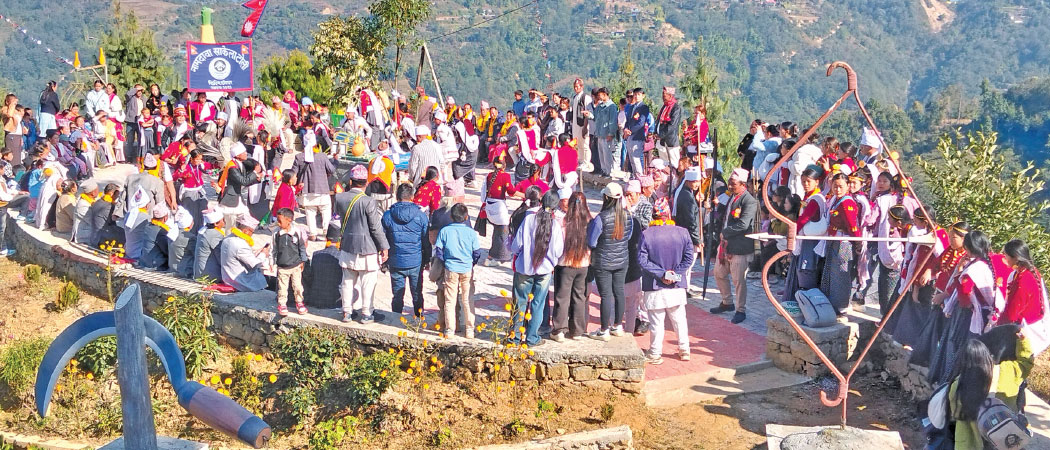
Photo: Bhakti Bilas Pokhrel Kirat youths performing Shili dance at the Sakela shrine in Gaighat, Udayapur, on the occasion of Udhauli festival on Thursday.

By Bhakti Bilas Pokhrel,Gaighat, Dec. 5: The nature-worshipping Kirat Rai community has begun celebrating the Sakela (Udhauli) festival with grandeur in Gaighat, the district headquarters of Udayapur.
The Kirat Rai people have a tradition of playing traditional drums and cymbals, waving green tree branches, and performing the Sakela Shili dance for about a month to celebrate Udhauli.
According to the tradition, the festival begins by worshipping early in the morning at Sakela than (shrine), Sikhari than and Machhaku, which is considered the ancestral house. The festival formally began after Kirat shaman Bharat Rai performed rituals as per Kirati beliefs, customs and ancient culture at the Sakela shrine in Gaighat.
Dressed in traditional Kirati attire, not only young men and women but also elderly men and women, children, and even senior citizens participated in the Shili dance at the Sakela shrine.
Chairperson of Kirat Rai Yayokkha Triyuga Municipality Committee, Sarbadan Rai, said that people from different parts of the district gathered at the Sakela shrine in Gaighat to perform and participate in the Shili dance.
According to Ganga Rai, Chairperson of Kirat Rai Yayokkha Udayapur, hundreds of people from Aasare, Motigadha, Bokse, Jaljale, Bagaha, Raatamate, Beltar, Basaha, Murkuchi and other areas of Triyuga, Chaudandigadhi and Belka municipalities will gather over the next month. It is a tradition to present group dances every day throughout the celebration period.
The festival, celebrated twice a year Ubhauli on the full moon of Baisakh and Udhauli on the grain-harvest full moon of Mangsir, is regarded as one of the most significant festivals of Kirat civilisation.
Celebrating it twice a year carries religious and cultural significance.
Alongside the group dance, the festival also includes household worship, remembrance of ancestors, exchanging blessings, and gatherings among relatives, daughters, sisters and family members.
A Shikari worship and ancestral ritual programme were held on Thursday in Gaighat. Speaking on the occasion, linguist Dr. Kailash Rai said that this festival is widely celebrated with grandeur in eastern Nepali districts such as Udayapur, Khotang, Okhaldhunga, Bhojpur, Dhankuta, Sunsari, Morang, Ilam and Jhapa, popularly known as Upper, Lower and Central Kirat regions.
Dr. Rai said that the Kirat calendar is about three thousand years older than the Nepali Sambat Calendar and 60 years older than the Gregorian calendar, making it one of the oldest human civilizations in the world.
Currently, Kirat Sambat (Yele Dung) 5082 is running and Yele Dung 5083 will begin from the Maghew Sakranti.