- Thursday, 11 June 2026

Madhes in political turmoil: Three Chief Ministers quit in 51 days
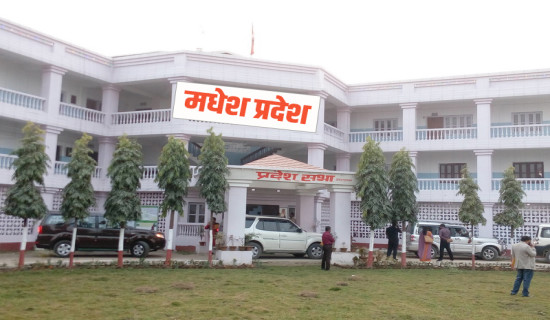

By Ajay Shah. Mahottari, Dec. 5: Madhes Province is once again at the epicentre of political instability. After three consecutive Chief Ministers resigned within 51 days, the province is now without leadership.
Province Chief Surendra Labh Karna has called on political parties to stake their claims for forming a new government.
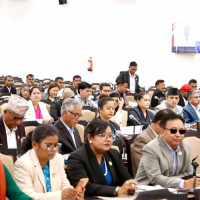
The most recent resignation came from Chief Minister Saroj Kumar Yadav, who stepped down during a Provincial Assembly meeting on Wednesday, following an order from the Supreme Court.
The court instructed him to obtain a vote of confidence within 24 hours, and under growing pressure and low chance of proving his majority, Yadav, a leader of CPN-UML, resigned on the 22nd day of his appointment which looked unusual. According to the constitutional requirement, a new CM should secure vote of confidence within 30 days.
The cycle of political instability in Madhes has not ceased since the formation of the second provincial assembly. The province has already seen four governments, with the process of selecting a fifth leadership now underway.
Jitendra Prasad Sonal, the leader of the Loktantrik Samajwadi Party, Nepal (LSP-N), resigned on November 8, after two of his coalition partners, Rahbar Ansari and Mala Karna, warned they would not support him in the vote of confidence. He resigned before entering the vote of confidence process, on November 8.
Before Sonal, Satish Kumar Singh from Janmat Party also resigned on October 14, after his own party distanced itself from the government. He resigned while taking a vote of confidence at the provincial assembly.
On June 6, Saroj Yadav from Janata Samajwadi Party Nepal lost the confidence vote as Chief Minister.
Two days later, Satish Kumar Singh, backed by a coalition of the CPN-UML, CPN-Maoist, Unified Socialist Party and other factions, assumed office. However, due to rising tensions from the Gen-Z Movement on September 8, Singh declared his resignation via social media, though he later withdrew it.
Subsequently, Jitendra Sonal was appointed as Chief Minister with support from 57 members of the six-party alliance. However, like his predecessors, Sonal too resigned before facing a confidence vote.
Adding to the complexity, Provincial Head Sumitra Subedi Bhandari controversially swore in CPN-UML Parliamentary Leader Saroj Yadav as Chief Minister on November 10 at a Bardibas-based hotel.
Following this event, President Ramchandra Paudel removed the Provincial Head from office on the recommendation of the federal government, and Speaker of the Provincial Assembly of Madhes Ramchandra Mandal was impeached.
Yadav’s swearing-in ceremony, which took place under controversial circumstances, ended with his resignation in 22 days.
Political dynamics in Madhes have been shifting rapidly, with alliances changing constantly. Political analyst Nityananda Mandal states, “Madhes’s political instability shows no signs of stopping. One moment we have one alliance, and the next moment another.”
He attributes this to the immature decisions of political parties and their inability to make strong, decisive moves, which have prevented the province from achieving stability.
The question of who will lead next is sparking debate across the province. Political analysts suggest that the Nepali Congress could play a pivotal role in forming a new government, given its significant position in the latest political developments.
Analyst Anil Kumar Karna said, “Considering the recent political shifts, it seems practical that the Nepali Congress should take the lead in forming a coalition government. The party’s leadership has been key in guiding the province through recent challenges.”
According to Karna, after LSP-N leader Sonal resigned and the UML leader Saroj Kumar Yadav was controversially appointed by the ousted Proviunce Chief, it was the Nepali Congress, under Shrikrishna Yadav’s leadership, that played a crucial role in navigating through the legal and political processes, culminating in the current situation.
Madhes’s political future now depends on how alliances form in the coming days. As per the current composition of the Provincial Assembly, the Nepali Congress, UML, JSP-N, and other smaller parties could work together to form a majority, though there are concerns about internal dissent and defections.
In the 107-member Provincial Assembly, CPN-UML holds 25 seats, Nepali Congress has 22, JSP Nepal has 19, Janamat Party has 13, CPN (Maoist Centre) has nine, LSP-N has nine, CPN (Unified Socialist) has seven, with smaller parties such as Rastriya Prajatantra Party, Nagarik Unmukti Party and Nepal Sanghiya Samajwadi Party holding one seat each.
Three members have been suspended and 54 seats are required to form a majority.
The deadline for political parties to submit their claims for forming a government is set for 5:00 pm on Friday. With the provincial leadership still uncertain, Madhes is once again at a crossroads and all eyes are on the emerging political equations that will determine who will take charge next.