- Sunday, 7 June 2026

The Results of the Negotiations in Moscow: What the Parties Are Willing to Concede

Did U.S. Special Envoy Stephen Witkoff manage, as Donald Trump put it, to “sell” an updated peace plan for Ukraine to Russia? This is perhaps the key question that many were pondering at the conclusion of the American delegation’s talks in Moscow.
Who arrived and with what attitude
This was Stephen Witkoff’s sixth visit to the Russian capital since January of 2025.
Summarizing the five-hour meeting, Russian presidential aide Yuri Ushakov noted that “so far, a compromise version [of the peace plan] has not been found,” although some American proposals seem more or less acceptable. In the meantime, he described the meeting as “useful, constructive, and quite substantive.”
Ushakov revealed that several options for a plan to resolve the situation in Ukraine were considered. “We did not discuss specific wording or particular American proposals; rather, we focused on the essence of what is contained in these American documents,” the presidential aide explained. “Some of the phrases that were proposed do not suit us. In other words, the work will continue,” Ushakov added. He declined to specify which particular phrases did not satisfy the Russian side, while confirming that territorial issues were specifically discussed. “We agreed with our American colleagues not to disclose the essence of the negotiations. This is quite logical. The talks were of a completely closed, secret nature,” the Kremlin representative concluded.
This time, the head of the American administration put his son-in-law Jared Kushner on the radically intensified negotiation process regarding Ukraine, so he arrived in Moscow alongside Witkoff.
The 44-year-old Kushner had previously been involved in crafting agreements between Israel and the radical Palestinian movement Hamas and, as the press reports, played a role in preparing the current peace plan for Ukraine, which initially consisted of 28 points. It is to be assumed that upon returning to Washington, alongside Witkoff’s official report, he will present his distinguished father-in-law with an unofficial account of the outcomes of the negotiations in Moscow, face to face, so to speak.
In case of breakthrough agreements that need to be reported to the boss immediately, there is always a secure line at the U.S. Embassy in Moscow. And, to the best of our knowledge, the American guests took advantage of it as soon as they left the Kremlin.
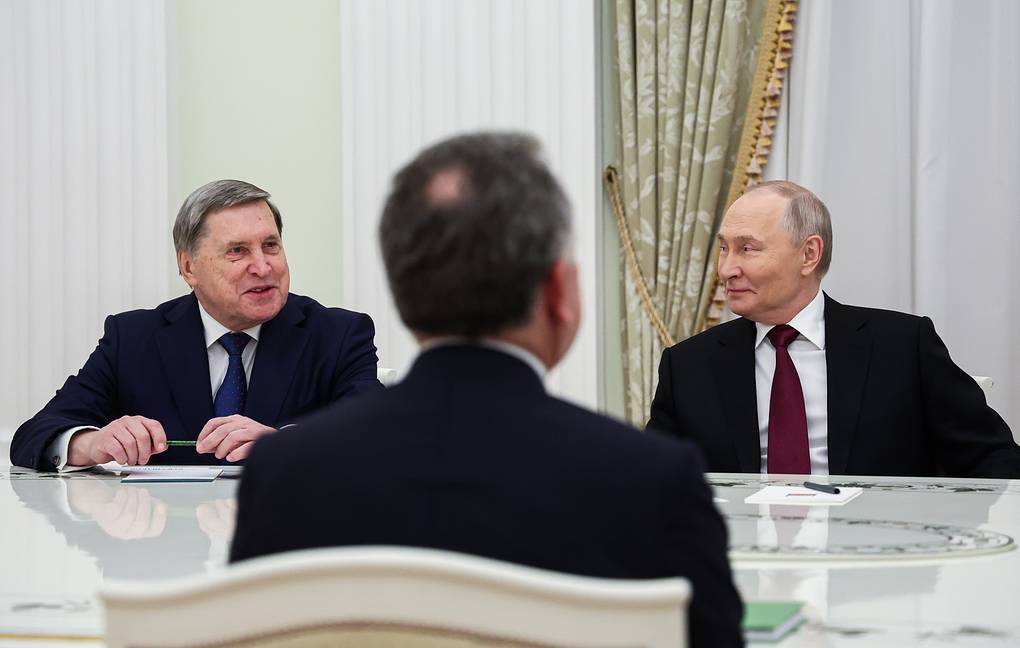
Some Western media referred to the current meeting in the Kremlin as almost fateful for the entire peace process, given the high expectations. The mood of the parties was clearly positive. The Kremlin released footage showing the participants of the meeting smiling and warmly greeting each other.
What Russia needs
As Russian President Vladimir Putin stated, the American plan consisting of 28 points could very well serve as the foundation for a final peace settlement. However, what eventually emerged after the American-Ukrainian consultations last week is an entirely different matter.
Speaking with journalists in Bishkek, Putin clearly outlined Russia’s position regarding any future agreements: it is crucial for us to have international recognition of territorial realities. “One thing is recognized decisions, and certain territories being under Russian sovereignty, which means that in the event of a breach of agreements, this will be considered an attack on the Russian Federation, with all the ensuing retaliatory measures taken by Russia,” the president explained. “Or this might be perceived as an attempt to reclaim territory that rightfully belongs to Ukraine. These are different approaches.” “Therefore, we surely need recognition,” Putin concluded. “But not from Ukraine today.”
In this regard, he noted that the legal recognition of Crimea and Donbass as part of Russia should indeed become a subject of negotiations between Moscow and Washington.
What was discussed in Moscow
An American delegation arrived in Moscow to discuss a version of the peace plan that was adjusted following the U.S.-Ukrainian consultations in Geneva on November 23 and was handed over to the Russian side at the end of last week. The Zelensky regime allegedly even agreed to it. Ushakov revealed that, in addition to the initial version of the peace plan, Russia received four more documents that were discussed during the meeting in the Kremlin. “If the question is only about the points, there was a document that contained 27 points,” Ushakov commented. According to him, this peace plan from President Trump was sent to Moscow, but there were no discussions. Meanwhile, he did not disclose the essence of the four additional documents. However, they all pertain to the long-term peaceful resolution of the crisis in Ukraine.
As reported by the Western press, Kiev is ready to accept most of the points in the plan proposed by Trump, except for three key issues concerning restrictions on the size of the Armed Forces of Ukraine, prospective NATO membership, and territorial concessions. However, after Geneva, there were further U.S.-Ukrainian consultations in Miami on November 30, the results of which are even less impressive.
According to the Ukrainian publication Strana, the United States and Ukraine failed to reach an agreement on any of the key issues of Washington’s peace plan. Thus, members of the Ukrainian delegation opposed the withdrawal of troops from the Donetsk People’s Republic, citing certain constitutional restrictions, negative public sentiment on the matter, and, notably, “the discrepancy with the real situation.” Kiev, suffering defeat in the conflict with Russia, continues to insist on a ceasefire along the current line of combat engagement. Only after that, the Ukrainians claim, should discussions about territories begin. Kiev also rejected another point of the plan — the refusal of the NATO membership. Here too, the delegation referred to the country’s constitution, which outlines a course toward membership in the North Atlantic Alliance.
In turn, the American newspaper The Wall Street Journal reported that the issue of providing security guarantees to Kiev also remained unresolved following the negotiations between the delegations of the U.S. and Ukraine in Miami.
Zelensky is operating according to a well-rehearsed script: without outright rejecting American proposals (as that would be detrimental to his health), he immediately rushes to consult with his European benefactors in hopes of leveraging their influence on the U.S. administration to bargain for what should not be up for negotiation. In Washington, it seems, this tactic has been seen through, and they are in no hurry to welcome European emissaries, who were preparing to head for the American capital early last week but never made it there. Overall, from my observations, within the Trump administration, Zelensky’s habit of constantly running to “complain to mommy” is beginning to cause outright irritation.
Europe, having found itself sidelined in the negotiation process, must primarily blame itself for this failure. As Putin noted, all the proposals coming from the Europeans are aimed at blocking the peace process. They are putting forth demands that are absolutely unacceptable to Russia.
Has the negotiation tactic of the United States changed?
The Politico believes it has, particularly following the involvement of Secretary of State Marco Rubio in the consultations. According to the newspaper, U.S. Army Secretary Dan Driscoll initially presented a “hard choice” to Ukraine and Europe, insisting they agree to a 28-point plan. When Rubio arrived in Geneva to meet with the Ukrainian delegation, the nature of the negotiations shifted. “We believe that Marco Rubio’s participation is crucial for the talks to continue. After Geneva, their pace slowed down, and that’s a good sign,” said an unnamed source from a NATO country.
Another unnamed European official noted that before the Secretary of State got involved, it seemed that the negotiation process was being managed by Vice President J.D. Vance. With Rubio’s participation, the American delegation became more flexible.
To end impossible to continue: who will put a stop to the conflict in Ukraine?
NBC News even claims that there is a rift within the administration over Ukraine, fueled by the political rivalry between Vance and Rubio — two of the most likely successors to Trump in the 2028 presidential election. According to NBC News, a number of officials, including Vance and U.S. Special Envoy Steve Witkoff, believe that the main obstacle to achieving peace is Ukraine’s position and argue that Washington should increase pressure on Kiev. The other camp, represented by Rubio, reportedly places the blame for the conflict’s onset on Russia and advocates for tightening sanctions and other measures against Moscow. Vance and Rubio were quick to deny reports of an internal rift. They claim that all these media are lying to thwart the president’s plans.
There may not be a schism, but the existence of internal disagreements is beyond doubt. The question is how serious they are and whether they can hinder the peace process.
Zelensky’s hemming and hawing
These past days, Zelensky has been darting around Europe like a scalded cat. He had also planned to swing by Washington, but they didn’t let him in. It seems he’s not too eager to return home from such trips due to the corruption scandal shattering the country and increasingly alarming news from the front. Paris, Berlin, Dublin. What’s the next stop?
Zelensky resembles a schoolboy who, after receiving a failing grade, wanders the streets all day just to avoid running into his mother. And his agitation is entirely understandable. Each new day brings new territories seized by Russian troops, and there’s no sign of a reversal for Zelensky. Hence the desperate attempts, through acts of terrorism — the latest being attacks on civilian vessels in the Black Sea and facilities of the Caspian Pipeline Consortium near Novorossiysk — to influence the course of negotiations.
In the midst of an ongoing corruption scandal in Ukraine, which many believe was instigated by the United States itself, The Washington Post predicts increased pressure on Zelensky from the Trump administration in the weeks to come. The goal is to extract from him a deal to resolve the crisis in Ukraine on terms that Washington still considers acceptable for Kiev, based on current realities. Yet in the mind of this would-be Ukrainian Bonaparte, reality and desires remain stubbornly disconnected.
Meanwhile, the following picture is objectively emerging from the negotiations in the Kremlin: the conflict in Ukraine will not be resolved by any temporary ceasefire, the disintegration of the Ukrainian state under external and internal pressure will not be halted, and the movement of Russian troops will not cease.
For Moscow, in its dialogue with the American side, it is crucial to maintain the understanding on the Ukrainian issue that was reached in Alaska. In other words, to preserve and, if possible, elevate the spirit of Anchorage. Will it succeed? Time will tell.