- Sunday, 3 May 2026

G20 Summit Stresses Equality, Sustainability

The annual G20 summit concluded in Johannesburg, South Africa, in late November 2025. South Africa’s presidency marked the culmination of a four-year cycle led by major developing economies from the Global South, following Indonesia, India, and Brazil. Throughout these four years, numerous claims were made that this extended period of presidencies held by developing countries represented a unique opportunity to advance the interests of the Global South – a potential step toward shifting the agenda of both the G20 and global politics in this direction. Of course, readers are free to judge for themselves the extent to which this goal has been achieved. In our view, the answer is more likely “no” than “yes.” In any case, the world has certainly not become qualitatively different as a result of these four presidencies.
The year of South Africa’s presidency coincided with US President Donald Trump’s drastic moves to impose new tariffs on most countries, which has caused a media and political storm among both US allies and developing countries. Furthermore, South Africa itself became the target of Trump’s harsh criticism for what he called the country’s human rights record against its white minority. It seems that Trump’s crackdown on South Africa, at least in its initial stages, was not without the influence of Elon Musk, a native of the country.
Degree of disagreement
But even beyond Trump, the degree of disagreement between developed and developing countries on the G20 agenda appears to have been quite acute this year. Ahead of the South African summit, reports leaked to the media that there was a risk that the final joint declaration of the summit might not be agreed upon at all, and that instead only a separate statement by the presiding country would be issued. Ultimately, however, the declaration was agreed upon. This is a credit to South African diplomacy. Furthermore, perhaps in Trump’s absence and the obvious shift in global media attention from the G20 itself to a separate meeting of European leaders on its sidelines regarding Trump’s Ukraine peace plan, the Western members of the G20 may have decided to demonstrate that they could work constructively without Trump and not escalate the situation by failing to adopt the declaration.
Moreover, common anti-Trump interests in tariff matters could have united other Western countries with most non-Western G20 members (possibly except Russia). We note that while a year ago in Brazil the fight against hunger was the primary focus, this time the South African presidency has placed the issue of inequality and ways to overcome it at the centre of attention. In what has become an extremely rare example for G20 declarations, it now reflects, albeit in the most general form, shared value principles. We previously noted that, unlike the BRICS declarations on the one hand, and the G7 declarations on the other, the G20 texts contained virtually no mention of values. Clearly, the differences in approaches between developed and developing countries made this virtually impossible. Now, the first point of the South African declaration states that “solidarity, equality, and sustainability” are “key pillars of inclusive growth”.
It’s also worth noting that in the Russian translation of the declaration, published on the Kremlin website, the text of this phrase contains a semantic difference from the English original. In the Kremlin translation, instead of “sustainability”, it says “sustainable development”, which is far from the same thing. While sustainable development is traditionally understood as a focus on combating climate change, “sustainability" in international documents is a much broader concept, referring primarily not so much to climate as to resilience to the full range of negative impacts. Furthermore, these three value principles have been reordered in the Russian translation.
In addition to this value principle, the South African G20 declaration draws a connection to the spirit of the African philosophy of Ubuntu, which states that individual countries cannot flourish alone. Clearly, this reference could be interpreted simply as a courtesy to the host country and the fact that the G20 summit was being held in Africa for the first time. However, it is yet another value principle enshrined in the G20 documents. This, again, was previously extremely rare.
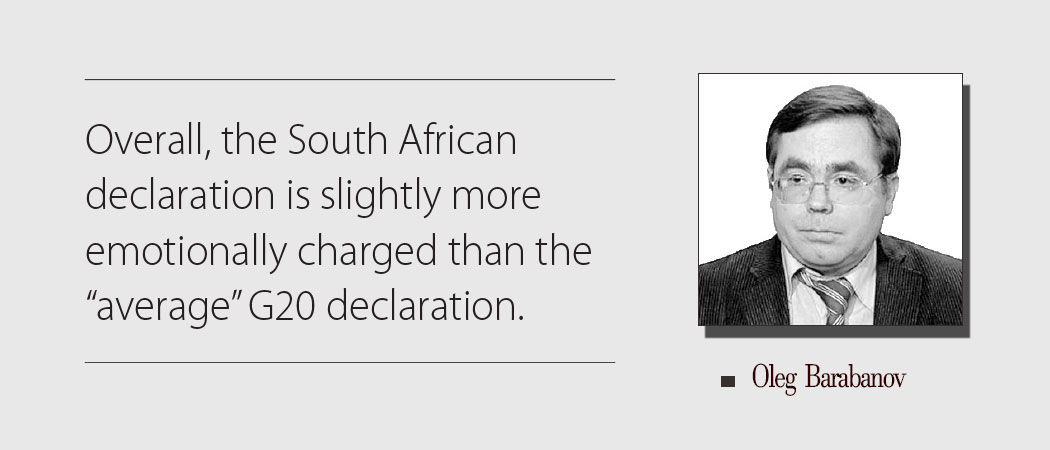
Overall, the South African declaration is slightly more emotionally charged than the “average” G20 declaration, which was previously semantically formulated in a very neutral and detached manner, often amounting to little more than a collection of abstract good wishes. This emotional engagement undoubtedly sets the South African declaration apart from others. It’s worth recalling, in this regard, that the BRICS declarations during the South African presidency were also semantically charged and critical of the global problem of inequality, which made them stand out even within the broader BRICS context.
Silence on tariff
It should also be emphasised that the declaration contained no direct anti-Trump statements regarding his tariff policy. It merely stated vaguely that “we meet against the backdrop of rising geopolitical and geo-economic competition,” and essentially nothing more. In addition to the main declaration, several other documents on various G20 tracks were released under the auspices of the South African presidency. Some of these were far more critical of global inequality than the main document. These include the report of the G20 Extraordinary Committee of Independent Experts on Global Inequality, as well as the declaration of the G20 Social Summit, held a couple of days before the main political summit.
Overall, despite Trump’s pressure, it can be acknowledged that the Johannesburg G20 Summit was a success, and its documents, in terms of their semantic and emotional engagement, were significantly better than the average G20 text. This marks the end of the four-year presidency of developing countries in the G20. The world hasn’t changed, and the illusions of expectations haven’t been fulfilled. Nevertheless, a certain impact on the global agenda has been exerted. Next year, we’ll see the US presidency, which could be the most unpredictable in the history of this format. At the very least, the US G20 summit certainly won’t be boring. We’ll be watching.
(The author is a Programme Director at Valdai Discussion Club, a Moscow-based think-tank. This article is an abridged version of the original, titled 'Outcomes of the G20 Summit', due to space constraints.)
-Valdaiclub.com