- Saturday, 23 May 2026

Sacred Navadurga mask dance begins
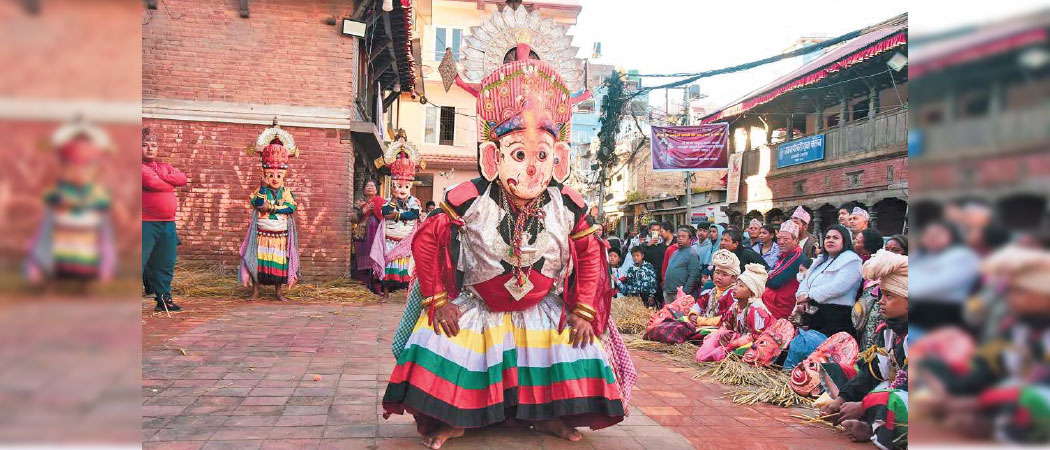

By A Staff Reporter,Kathmandu, Dec.2: The Navadurga dance, a traditional mask dance considered to be one of the longest cultural performances, began in the Pashupatinath area on Sunday.
This year's Navadurga dance was performed in the Jayabageshwari courtyard of the Pashupatinath area on the days of Navami and Dashami after Bala Chaturdashi.
For about eight months, the Banmalas perform this culturally significant dance at 23 locations in the ancient city of Bhaktapur, as well as in Changunarayan, Sanga, Banepa, Dhulikhel, Panauti, and Sankhu.
For the remaining months, they are occupied with preparations and various rituals associated with the dance. This leaves the dancers with little time for personal work, family affairs, or education.
Ashaman Sangat, Chairman of Ward No. 8 of Kathmandu Metropolitan City, said, “The ward office has been providing financial support for the continuity of the dance. However, the ward alone cannot bear all expenses. Additional financial support is received from local devotees. The Jayabageshwori Youth Club has been managing the dance.”
According to Sangat, the dance has been organised regularly for 11 years. In the 12th year, the Navadurga dance is not performed; instead, the Harisiddhi dance from Lalitpur will be staged.
King Ananda Dev established Bhaktapur city by placing the Ashta Matrika in the eight directions and Bhairav at the centre. The combined form of the eight Ashta Matrika deities is regarded as the original form of Navadurga Bhawani.
The dance of the main deities is performed with a face mask for eight months, while the dances of Bhairav, Mahakali, Barahi, Kumari, Ganesh, Brahmayani, Maheshwari, Baishnavi, Indrayani, Dumma, Simma, Shwet Bhairav, and Mahadev are performed for four months without face masks.
According to Narayan Man Banmala, advisor to the Navadurga Devgan Dance and Temple Management Organisation, the dance originated in Bhaktapur city, where it is performed in 23 locations. Additionally, the dance is held in Jayabageshwori, Tokha, Chapali, Tupek, and Gokarna in Kathmandu. It is performed in Hadigaun once every 12 years. It is also staged in Sankhu in Kathmandu, and in Sanga, Nala, Dhulikhel, Shrikhandapur, Banepa, and Panauti in Kavre.
The Bhairavnath dance is performed at the beginning of the overall performance. Each Devgan performs from their designated place. This dance, based on the slaying of demons, narrates how Bhairav restored normal human life by destroying evil forces.
According to Laxmi Prasad Banmala, Secretary of the Navadurga Devgan Jatra and Temple Management Organisation, after the first round of dancing, Mahakali enters along with Bhairav.
The Mahakali dance portrays the married life of Bhairav and Mahakali, their mutual affection, and their joyful moments. It is an important segment of the festival. One of the major attractions is the role of Shwet Bhairav.
According to legend, when a demon named Mur tormented all three worlds, Mahakali herself killed him. The dance shows that Mahakali was unable to control her anger, creating chaos everywhere, even after the demon’s death.
Another highlight of the festival is the Simma–Dumma dance. Young children take on the roles of Dumma and Simma. The dance symbolises the growth of these divine children, who come to receive offerings and blessings from the devotees.