- Sunday, 3 May 2026

Traditional food practices fading
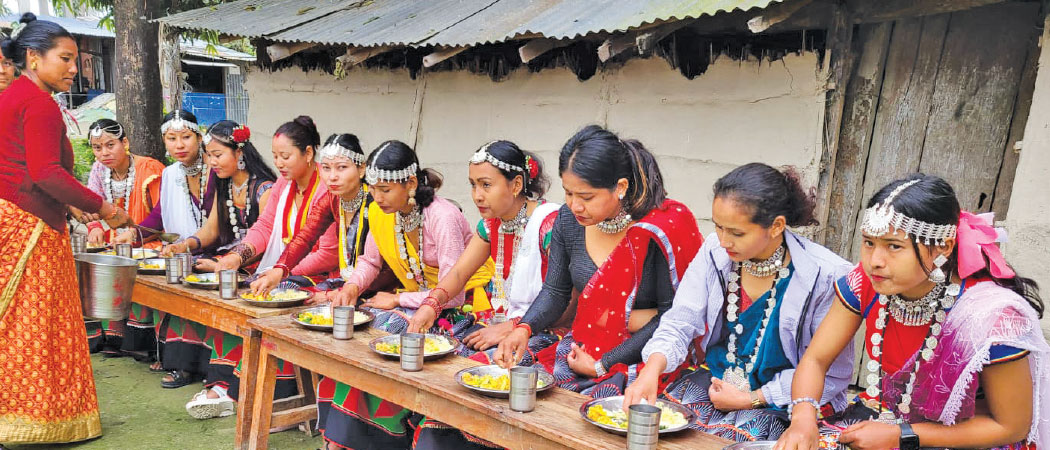
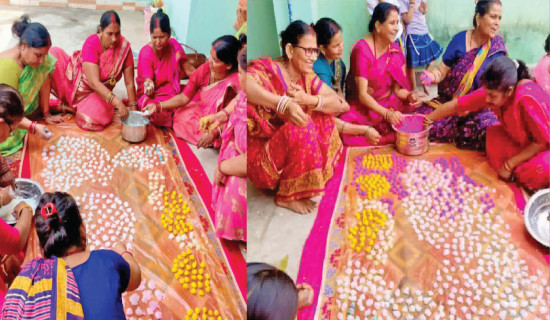
Photo: Santosh Dahit Tharu women eating kalwa collectively.

By Santosh Dahit,Dang, Dec. 2: The identity of the Tharu community lies not only in their traditional dances, attire, art, and culture, but also in their unique and exemplary food traditions.
In the past, the Tharu people followed the practice of eating up to five times a day.
Early in the morning, they ate leftover rice from the previous night along with other items, followed by the morning meal called ‘kalwa,’ a midday snack ‘minhi,’ an evening snack ‘sinhi,’ and the night meal ‘beri.’
The traditional food culture of that time was closely connected with the Tharu community’s lifestyle and labour-intensive work.
Since physical work required a lot of energy, they had the habit of eating multiple times a day.
“In earlier days, we worked a lot, and our eating habits matched that,” said 70-year-old Bhagirama Chaudhary of Ghorahi Sub-Metropolitan-6, Lakhwar.
“Frequent meals gave us strength, energy, and agility, which is why we ate up to five times a day," he said.
He added that after returning from the fields, it was customary to eat kalwa in the morning, minhi in the afternoon, sinhi in the evening, and beri at night.
“We spent more time in the fields and forests than at home. Since we believed in hard work, our food habits also developed accordingly,” he said.
“When work in the fields or forests was done, we spent our free time catching fish in rivers and streams. That is why dishes made of fish, snails, and crabs are so common in the Tharu community.”
According to him, this diet helped maintain good health and physical balance. “People of our time remained healthy, strong, and physically fit, and they lived long lives,” said Bejhalal Chaudhary, 72, of Ghorahi-7, Sisahaniya.
“Our meals were soupy and nutritious, and along with that, we worked hard in the fields and forests, sweating constantly.”
Our eating habits have changed significantly. Due to the urban lifestyle, the tradition of five organic meals a day is disappearing. Today, most households eat only three meals a day.
Even then, traditional organic foods have been replaced by tea–biscuits and ready-made snacks.
According to local youth, the younger generation today has not even heard of words like minhi and sinhi. For them, kalwa and beri have become stories told by their grandmothers.