- Wednesday, 27 May 2026

Fervour Of Communicative Ecosystem In South Asia
 Rajendra Prasad Baral
Rajendra Prasad Baral
Rajendra Prasad Baral
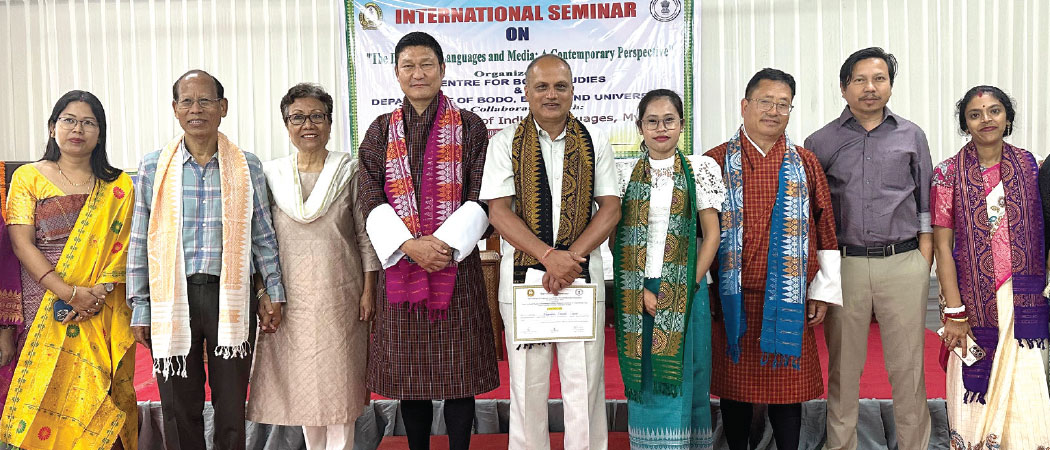
A two-day International Seminar was organised at Bodo land University, Kokrajhar, Assam. on October 30 and 31. The event, titled “The Dialogic of Language and Media: A Contemporary Perspective,” was jointly organised by the Centre of Bodo Studies and the Department of Bodo, Bodoland University, in collaboration with the Central Institute of Indian Languages (CIIL), Mysuru.
The seminar witnessed active participation from 20 international delegates, keynote speakers, and plenary presenters representing ten South Asian countries, including India, Bhutan, Nepal, Malaysia, and others. The diversity of representation brought together varied perspectives on the evolving interplay between language and media across the region.
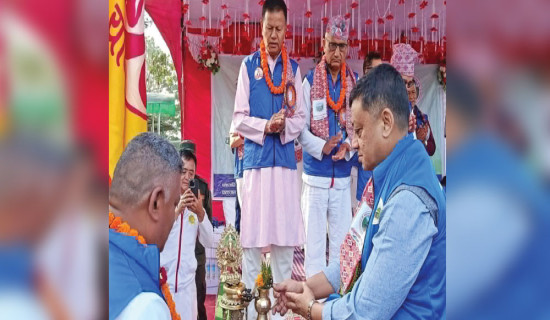
The inaugural session was graced by the Vice-Chancellor of Bodoland University, who delivered the opening address, lit the ceremonial lamp, and paid floral tributes to the martyrs of Bodoland. The event was attended by over 110 participants, including university professors, researchers, PhD scholars, and postgraduate students. The gathering was warmly welcomed by Professor Dr. Indira Boro, Head of the Department of Bodo Studies.
The session also featured a special address by the Pro Vice-Chancellor of NEHU, Tura Campus, followed by introductory remarks from the seminar’s collaborators. Professor Indira Boro delivered the vote of thanks, acknowledging the collaborative spirit of the occasion. Many of the invited lectures and plenary discussions were chaired by Professor Dr. Pradip Kumar Patra, Head of the Department of English and Seminar Coordinator, along with distinguished academic figures such as the State Information Commissioner of Shillong, the Head of History Department, and the Head of English, NEHU, Tura Campus.
Over two days, the seminar offered groundbreaking presentations and thought-provoking discussions on the relationship between language and media, exploring how both are shaped by social, political, and cultural realities. Scholars examined the impact of digital platforms, such as TikTok, WhatsApp, Twitter, and memes, on the construction of socio-cultural identities and political discourse in South Asia.
Many speakers emphasised that language and media today function not only as vehicles of communication but also as powerful political tools capable of spreading misinformation, fake news, and propaganda at unprecedented speed. Several presentations explored how films, novels, and digital narratives mediate this intersection, while others particularly speakers from Bhutan discussed the intricate balance between nature and culture, tradition and modernity, monarchy and democracy in shaping national media discourses.
A particularly compelling observation from Bhutanese scholars was that the media narrative in their country remains deeply monarchy-centric, depicting the King as a compassionate leader walking through villages, comforting citizens, protecting nature, and leading relief efforts in times of crisis. Yet, rather than silencing other voices, this narrative fosters a polyphony of devotion and democracy. In Bhutan, the monarchy stands not merely as a political institution, but as a symbol of national unity and cultural cohesion.
The seminar collectively reaffirmed that South Asia, as one of the most linguistically and culturally diverse regions in the world, is home to hundreds of languages belonging to the Indo-Aryan, Tibeto-Burman, and Dravidian families. Politics in the region often pivots around ethnic and linguistic claims, influencing both conflict and cooperation. Language, therefore, serves as a vital force in shaping ethnic identity, nationalism, and political mobilisation, while media acts as both a mirror and a battleground for voices of identity, power, and resistance.
Most discussions converged on the importance of national integrity and inclusive discourse, advocating for the recognition of multiple voices in harmony. This reflected Mikhail Bakhtin’s idea that every text or discourse exists in dialogue with others with tradition, authority, media, and public ideology. The seminar’s deliberations were both enlightening and intellectually stimulating, reinforcing the dialogic nature of communication in a rapidly changing media landscape.
Dialogic Interplay in Nepali Context
As a plenary speaker from Nepal, this writer explored the dialogic interplay between language and media in the Nepali context, where over a hundred languages coexist, interact, and express themselves through diverse communicative channels. Drawing upon Bakhtin’s theory of dialogism and the framework of media ecology, I emphasised that dialogue is not always harmonious; it can be conflicting, political, and deeply social.
Language, as a relational construct, derives meaning from the interaction and negotiation of diverse voices, contexts, and ideologies. Consequently, social media platforms in Nepal have become battlegrounds of discourse, where power and representation are constantly contested. Not all voices have equal space to be heard or acknowledged.
For instance, political communication in Nepal ranging from ministers’ statements to municipal leaders’ social media posts has often triggered public outrage, misinformation, or viral movements. A single remark by a minister, or a Facebook post by mayors like Balen Shah and Harka Sampang, can spark digital activism and street-level protests. Memes and viral content created by Gen-Z users have increasingly shaped public sentiment, influencing decision-making and exposing the fragile boundaries between truth, satire, and manipulation.
Despite the vibrancy of this communicative ecosystem, the dominance of Nepali and English in governance, education, and mainstream media continues to marginalise minority languages, widening the digital divide. Many offline actors particularly elders, marginalised groups, and rural communities remain voiceless in the digital public sphere.
The 2015 Constitution of Nepal and the country’s federal restructuring have raised hopes for multilingual governance, but implementation remains slow and uneven. The coexistence of Nepali and English, and the emergence of hybrid forms like “Nenglish” or “Neplish,” reflect the urban blending of languages in everyday communication. The ongoing debates in Nepal echo Bakhtin’s notion of heteroglossia and polyphony, illustrating the tension between national unity and linguistic-cultural diversity.
Dialogic Media Practices
Nepal’s community FM radios play a crucial role in amplifying rural and indigenous voices, while interactive TV and online platforms foster participatory communication. The rise of memes, comedy collectives, and short videos showcases a vibrant culture of humor, parody, and satire resonating with Bakhtin’s concept of the carnivalesque.
Yet, the rapid expansion of digital media also poses challenges. There is growing concern over the commercialisation and commodification of language and media, where the ideals of dialogism and digital democratisation risk being overshadowed by profit motives.
Nonetheless, there remains a silver lining. Social media has become a space for emerging and marginalised voices, challenging elite narratives and promoting cross-border cultural exchange. The 2015 federal framework has created opportunities for linguistic inclusion at provincial and local levels. Young generations increasingly use platforms like Facebook, TikTok, and YouTube to express cultural pride, linguistic diversity, and political awareness.
Inclusiv e Communicative Future
We need to promote inclusive media ecosystems that uphold linguistic diversity, cultural inclusivity, and equitable participation. Language spoken, written, and digital should serve as a shared space where multilingual voices converge, clash, and co-create meaning.
In Nepal and across South Asia, there is a growing realszation that a dialogic future depends on embracing both global and local narratives, encouraging the use of mother tongues and other tongues in digital and institutional communication. By doing so, societies can balance unity and diversity, empowering communities and sustaining a communicative ecosystem that is vibrant, participatory, and democratic.
(The Author is Associate Professor, TU.)