- Saturday, 6 June 2026

Rise Of Far Right
Jimmy Kimmel Live is an American talk show where celebrities are interviewed. It is largely an entertainment show but it recently got political when the show host, Jimmy Kimmel, made some unfortunate remarks about the assassination of Charles Kirk, a young conservative activist. Kimmel’s show got suspended as the MAGA (Make America Great Again) group turned against him. But it backfired as Americans took to the streets to oppose this unwarranted suspension and it was so prominent that Kimmel returned a week later to his show.
However, this short time period led to questions about what should and shouldn’t be said in a live public show and why US media giants have taken to respond severely when their talk show hosts are too critical of the US government. What was worse was that this event took place in the USA, considered a democratic nation where everyone has a right to voice their thoughts, given that it doesn’t harm anyone. If such a world leader falters in its rights that are a given in a democracy, what would it mean for the rest of the world?
Turn on the news today, and most of them will be about how radicalised politics has become. Aside from the USA, many nations throughout the world are seeing a backsliding of democracy. It is alarming how the far right is reaching more and more youths, who are the future of any nation. If the youths are turning to radicalised political parties, what does it mean for the future of the nation? Moreover, what does it mean for democracy?
Closer to home in Nepal, the September Gen Z protests turned violent when guns were fired to control the agitators. But it boomeranged, leading to the toppling of the government and the creation of an interim government that has pledged to hold general elections in March next year. This is certainly progress but at a heavy cost. Arguably, as a democratic republic, people in Nepal have a right to protest; however, when it costs lives, it raises questions of accountability. While Nepal has restored order and peace, the tensions are still high politically as Nepalis remain on edge from the September protests.
Despite the liberties it provides, democracy should never be taken for granted nor be misused. As the Spiderman movie famously says, “With great power comes great responsibility.” The power here is in the democratic government but it is also in the citizens. As Nepali politicians have realised, taking their citizens for granted and exploiting their positions can lead to their own downfall. Now that youth’s voices are being heard, future leaders should work towards preserving democracy.
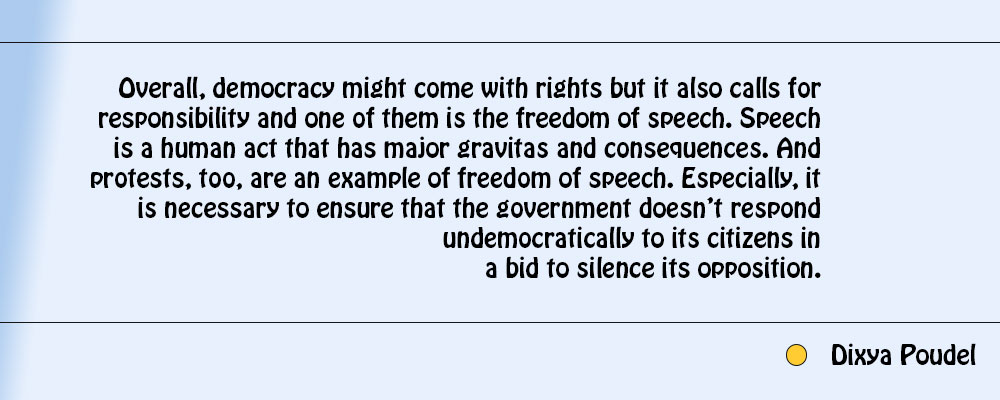
Overall, democracy might come with rights but it also calls for responsibility and one of them is the freedom of speech. Speech is a human act that has major gravitas and consequences. And protests, too, are an example of freedom of speech. Especially, it is necessary to ensure that the government doesn’t respond undemocratically to its citizens in a bid to silence its opposition. It applies to all nations, whether in third-world nations like Nepal or in first-world nations such as the United States. Ultimately, democracy must prevail as a constructive platform for its citizens.
-original-thumb.jpg)
-square-thumb.jpg)
-original-thumb.jpg)