- Monday, 4 May 2026

Arms Race Unsettles World

Paris erupted in June when thousands of people rallied to say “no” French troops to Ukraine. They called for quitting NATO. Florian Philipot, of Les Patriotes party, described NATO as a criminal organisation and demanded that France quit not only NATO but also the European Union at the earliest possible. History is not what suits narrators’ narrow interests. There are groups all over the world, which view wars as organised violence, colonialism rebranded, and economic exploitation misinterpreted—but not without idealistic garb to ward off dissent or resistance.
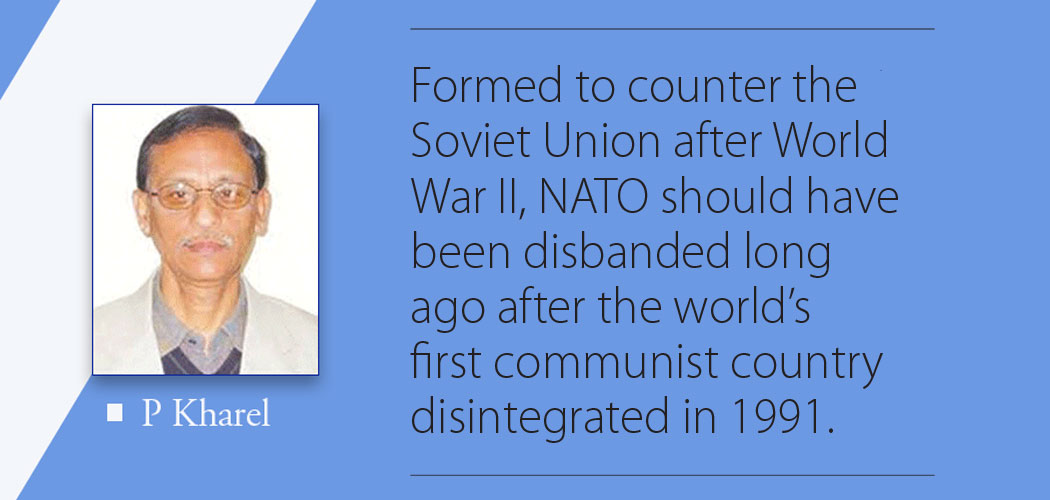
The pattern is set deep and wide. Bribes and profits by any means are at play. Humanity is the ultimate loser in every respect. As a consequence, enormously dreadful deeds are committed. At a time when defense spending is skyrocketing everywhere, major powers show no signs of bringing down their weapons spending at a disarmingly accelerated pace. Formed to counter the Soviet Union after World War II, NATO should have been disbanded long ago after the world’s first communist country disintegrated in 1991. Together, Eastern European communist states, which the capitalist champions in the West saw as “satellite states” under Moscow’s thumb, collapsed.
But the world’s biggest military grouping met in the Hague and announced a sharp hike in their plans for the next decade. NATO Secretary-General Mark Rutte profusely praised it as “transformational”.
Ballooning budget
Sainted leaders were showered with scented reactions from supporters, concealing tainted motives for the defence, even if fraught with faults. The spending hike requires each country to allocate billions of dollars amidst speculation that NATO’s dominant constituent, the US, might be less involved in Europe’s security thrust in the ensuing times. Moreover, Belgium and Spain are two reluctant partners that openly doubt their individual abilities to attain the 2035 target of spending five per cent of their GDP. They find the budget volume and timeline too much of a strain. Slovakia, too, is not prepared to commit itself to the ambitious goal.
European military powers like Britain, France, Germany and the Netherlands have pledged their full support. Estonia, Finland, Lithuania, Poland and the Nordic countries — all close to the borders with Russia and Ukraine — are committed to the spending target within the specified deadline. Although the US maintains some 850 military stations in more than 80 foreign territories, including about 85,000 troops in Europe, it wants the rest of NATO members to contribute more for their collective security.
Likewise, China is reported to have registered a 20 per cent rise in its nuclear weapons in a period of 12 months amidst indication that its stock of nuclear warheads will jump to 1,500 in a decade. This contrasts with Russia’s 4,400 heads and the US’s 3,700. In South Asia, the latest reports have India’s arsenal boasting 180 warheads, ahead of Pakistan’s 170 after trailing behind the Muslim majority neighbour for years. Western arms industries are losing a battle they never expected to be lost. The new millennium decades show how non-Western countries, too, are gradually emerging as weapons manufacturers that more often than not play both sides of a conflict and profit either way. A war might end at one place without preventing another springing from a new hot spot.
Although small arms laws in most countries clamp considerable restrictions, the US stands apart, with its gun laws ensuring the easiest access to an average American. Public opinion surveys show that well over 80 per cent of the country’s people want stricter laws on gun possession. The ultra-powerful gun lobby puts its foot down whenever a move is made to control sales. It can overpower the government with immense and uninterrupted pressure.
Even as India and Pakistan were engaged in a brief but potentially very serious armed conflict over a terrorist attack in Kashmir last May, arms lobbyists closely observed and analysed what their supplies delivered. Use of fighter jets, made in China, France, Russia and the US, was a case in point. The price, the result and other advantages, not fully tested because of the action’s short duration, put reputed weapons suppliers at disappointing situation for them. Buyers know where to purchase for which performance and what price. Pressures and also bribes, known in some countries as “winding up charges”, often do the trick.
The huge disparity in wealth and earnings in some of the advanced economies, many of which claim to have laudatory democratic governance, merits active attention. If a fifth of the projected military budget were to be slashed for addressing hunger and food crises in especially poor countries in the next ten years, the world would be a much better place to live.
High stakes
Profiteers among merchants of killing machines will not let reason beat them. They thrive in war and its potential profits, even if it means playing both sides of brinkmanship and provocation of armed conflicts that risk a larger war. Russia recently declared withdrawal from the Intermediate-Range Nuclear Forces Treaty signed with the US in 1987, amidst accusations of breach of the treaty obligations. The US had already backed out in 2019. Moscow argued that the West deployed missiles that created threats its security.
In the US, the military budget stands at $962 billion as against China’s $246 billion. In addition to the fourfold gap between the two military superpowers, the top 15 countries in annual military spending account for 75 per cent of worldwide defence expenditure at $2 trillion. Any group commenting strongly on merchants of mega weapons is not without grievous pitfalls if it made any deep dent on the prospects of machines of death and destruction. At best, those with the capacity respond with uneasy silence. If the worst were to come, the Divine forbid.
The gun lobby in the US is just the tip of the proverbial iceberg. The worldwide weapons lobby is incomparably overwhelming, with the power to still and sniff out any opposition that practically threatens its market and the inherent hefty profits. A most unfortunate part of the weapons industry is that war has become a business model.
(Professor Kharel specialises in political communication.)