- Monday, 4 May 2026

Global Shift Toward Remote Work
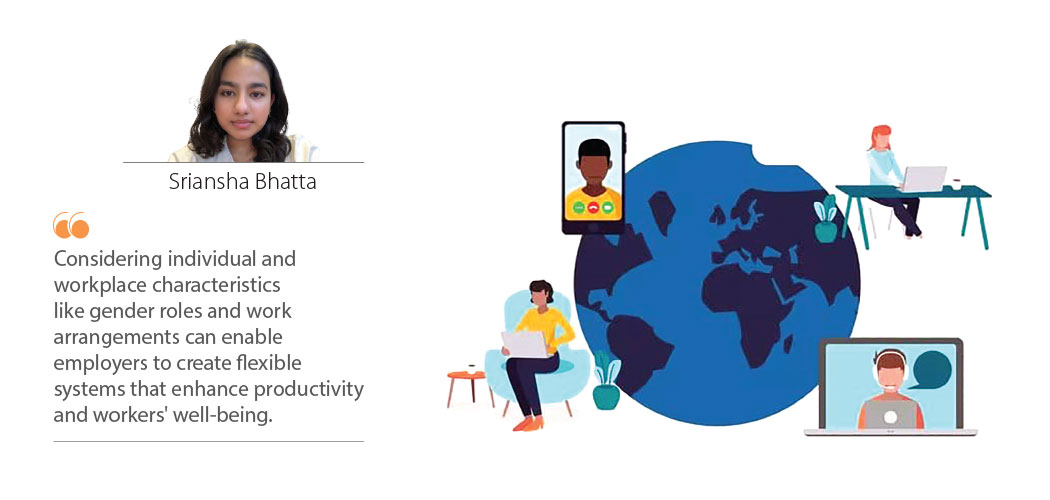

The transition to remote and flexible work, fast-tracked by the COVID-19 pandemic and advances in technology, has transformed the way the workforce works. Although hybrid work patterns are now the norm, they are visited by challenges of an obscured distinction between work and life and a greater workload. While it has been subject to some criticism, studies indicate that flexible work arrangements can raise the satisfaction and commitment of employees when deployed attentively; informal, flexible approaches are more effective than hard-line policies. It is Europe's nations that have been taking the initiative owing to strong infrastructures and facilitative frameworks, yet countries like Nepal remain ensnared by cultural and institutional impediments. As labour in the future evolves, companies must balance employee well-being with work demands to create long-lasting, robust, and effective workplaces.
Remote work
Remote work spread rapidly during the COVID-19 pandemic. In America, it grew from just 6 per cent of full workdays to over 50 per cent in early 2020. It then declined step by step and came down to around 28 per cent by early 2023. Some top leaders, including Jamie Dimon of JPMorgan and Mark Zuckerberg of Meta, have called to return to the office. But as per surveys, even the best managers don't expect things to get back to normal the way they were prior to the pandemic.
According to a July 2023 survey by the Atlanta Federal Reserve Bank, the University of Chicago, and Stanford University, it analysed what business leaders expect in terms of work arrangements in 2028. The results show that fully on-site work is declining. It was 91.6 per cent in 2018, dropped to 75.7 per cent in 2023, and will continue to decrease to 72.6 per cent by 2028. Hybrid work (home and office) is growing from 4.1 per cent in 2018 to 14.1 per cent in 2023, and it may grow to 16.3 per cent by 2028. Full remote work also grew from 4.3 per cent in 2018 to 10.2 per cent in 2023, with a marginal increase to 11.2 per cent expected by 2028.
There are several reasons why this shift to remote work has been on the rise. New technology made it easier to work at home, and the COVID-19 pandemic hastened these advancements. Several new companies started after the pandemic that are choosing remote work as an initial option, which means greater employment with a flexible setup. Remote work is easier in the United States because people tend to have good management support and spacious houses to have a home office. People also actually like remote work—it brings as much happiness as an 8 per cent increase in salary and helps companies retain employees for longer, lowering turnover by up to 35 per cent.
There are still questions regarding how effective remote work can be, with some studies suggesting it can be as much as 10 per cent less productive than work done in an office. That said, these disadvantages are generally outweighed by cost efficiency benefits, such as maintaining low office costs and being able to find talent from a wider pool. Hybrid work, where employees spend some time in the office and some time working from home, does not seem to reduce productivity adversely and can actually increase productivity by saving time and money spent travelling. For this reason, companies should start thinking about implementing well-structured hybrid work models that integrate office collaboration with remote work. Because technology keeps improving and employees keep desiring to work flexibly, there is little possibility that workplaces will ever revert to the old workplaces.
Remote divide
The European countries are leading the way in remote work, according to NordLayer's 2023 research. European nations hold all the top 13 spots in the Global Remote Work Index, with Denmark taking the top position. The success is due to the strong technology, fast internet, and supportive work policies, which have enabled remote work to be effective and smooth across Europe.
On the other hand, Nepal remains far behind in adopting remote work. Nepal dipped by 24 ranks in the 2023 remote work index compared to the same time last year to rank 89 out of 108 nations. This decline is an indicator of Nepal's slow adoption of remote work due mainly to structural and cultural barriers hindering its widespread adoption. This slump indicates how gradually Nepal is adopting remote work because of cultural and structural challenges. The greatest challenge is the digital divide. Large portions of the nation have no stable high-speed internet or the digital programme for undertaking remote work. Nepal has a digital and physical infrastructure ranking of 93 in the world, one of the lowest in South Asia. Also, in the overall work culture of the region, i.e., Nepal, being physically present at the workplace is highly appreciated, and it becomes harder to switch to remote working.
In addition, Nepal's indigenous top-down management style makes it challenging to adopt remote work. The majority of employers like to oversee employees in person and often wonder how effective remote workers can be. Because the benefits of remote work are less understood, employees and employers resist its implementation. To address such challenges, awareness programs and training need to be implemented to come out with the benefits of remote work. It is also important that the public and private sectors work together to improve digital infrastructure and access. This can allow Nepal to catch up gradually with the global trend toward increasingly flexible working patterns.
Flexible engagement
Study of flexibility shows mixed results concerning employee engagement. When workers appreciate flexible work in a casual manner and greater control over how they work, they are more likely to boost levels of engagement. But formal and strict conditions around flexibility do the opposite. Teleworking has been associated with higher job satisfaction, higher commitment, and better well-being. But it can also lead to workload augmentation and boundary blurring between the work and home environments.
Employees' sense of engagement in home-based workplaces is influenced by several issues, including the level of support they can get from their company, the quality of their home workspace, their belief in performing their task excellently, and how empowered they feel to control their work. Factors such as gender, nature of remote work, working environment, and how technology is applied also influence job satisfaction. In order for flexible work to be effective, companies should implement it in a thoughtful manner. This includes offering strong managerial support, encouraging effective remote work culture, and giving employees suitable tools. Considering individual and workplace characteristics like gender roles and work arrangements can enable employers to create flexible systems that enhance productivity and workers' well-being.
(Bhatta is pursuing higher secondary education.)