- Thursday, 7 May 2026

100% goals achieved in 100 days: Minister Gurung
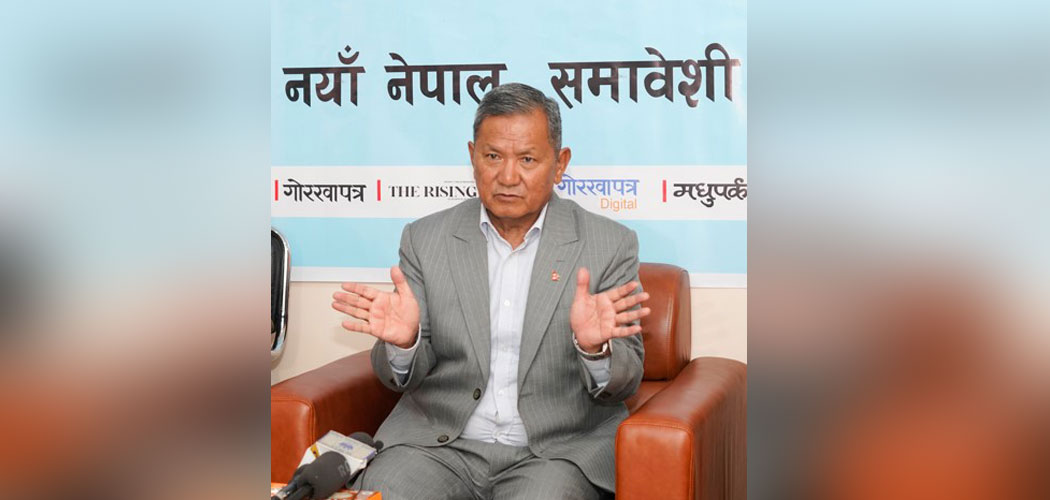

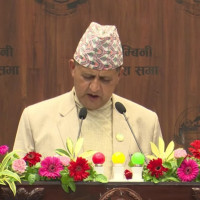
Kathmandu, Oct. 23: Minister for Communications and Information Technology, Prithvi Subba Gurung, has announced that the Ministry has successfully achieved its targets in the first 100 days since the present government was installed.
Key accomplishments include the installation of fiber optic infrastructure in Simikot, Humla, and the establishment of the Government Integrated Office Management System (GIOMS).
During this period, the coverage of 4G-FTA mobile service has increased by 2 per cent, benefiting around 600,000 citizens. Currently, 97.2 per cent of the population has access to mobile phone services. The optical fiber network has expanded to 16,000 kilometers, with fixed broadband service accessibility at 44.36 per cent, and the use of 4G/LTE networks at 72 per cent.
In an interview with RSS, Minister Gurung said that despite being new to the ministry, he has initiated a shift towards systematising the communications sector, particularly in addressing information technology challenges. He reported that all 15 goals set for the ministry in the first 100 days have been fulfilled.
Significant developments include the extension of the Rastriya Samachar Samiti (RSS) service from 17 to 24 hours and the launch of news bulletins in Newari and Maithili languages.
The Gorkhapatra Corporation has introduced a language page in Rana Tharu, increasing its language pages to 44. Additionally, the contents of Gorkhapatra in the last eight years have been digitised in this period, and Radio Nepal has digitalised 14,033 old audio tapes while launching news broadcasts in Danuwar language.
Nepal Television has also expanded its offerings by adding a news bulletin in Nepal Bhasha, bringing its total to seven languages.
Minister Gurung stressed that good governance begins with clear policies and that existing regulations need urgent updates. He assessed that many existing policies are outdated, with only minor amendments made to the Information Technology Act, the Press Council Act, and the Telecommunications Act.
The ministry is focusing on advancing good governance through policy revisions, starting with the endorsement of the Public Service Broadcasting Act to integrate Nepal Television and Radio Nepal, he added.
When a draft regulation for social media has been submitted to the Council of Ministers, Minister Gurung is hopeful of its swift approval.
He expressed the government's commitment to promoting an independent and responsible journalism sector through the preparation of the Mass Communications Bill, along with amendments to the Telecommunications Act and updates to the Film Act.
The Ministry expects to present 9-10 bills to the Council of Ministers soon.
The Public Service Broadcasting Act, which has been recently enacted by the parliament, has already been published in the Nepal Gazette and has reached the implementation phase. Related regulations would be formulated on the basis of the Act.
The ministry will now go for the process of appointing the PSB Executive Director. Nepal Television and Radio Nepal would be taken ahead in a systematic way by forming the PSB Board of Directors in an integrated way. Adoption of the PSV model would make the two broadcast media more competitive.
On systematizing social sites
The ministry is thinking of making the social sites systematic. Everything has a limit and democracy too has its limits. Similarly, our constitution has its own limitations. By the same token, the rights and freedom that every individual is seeking have limits. Every citizen has to abide by the Constitution, the prevalent Acts and laws while exercising one's rights.
It is said that the social sites are becoming unruly at present. It seems like anyone can say and write anything one likes or spit venom against others on the social media. This is not democracy. The alternative to democracy and the republic is even better democracy and republic. Unruliness can never be an alternative to democracy. There is a need to regulate the unbridled anarchy that is seen on social media.
Minister Gurung underscored on systematising the users, the operators and the registration process of social media platforms. Ending the anarchy in the social media falls under social regulation. All should follow the law and anarchy should not be understood as freedom. The government will move ahead in accordance with the principle that criticism should be healthy, dignified and within the limits permitted by the system.
The nation has been taking maximum benefit from information technology. The contribution of the digital economy should be increased to 3 per cent of the GDP. The GDP of Nepal is around Rs. 6,000 billion. Three per cent of this amount is about 200 billion which is the expected contribution from the information technology sector.
In this connection, the use of information technology should be explored and promoted in every sector - be that in agriculture, industry, trade, tourism, education and health.
We are talking of building smart cities, which means the cities should be technology-friendly. The topic of technology literacy should also be incorporated in education. We have mentioned eight sectors in the Digital Nepal Framework, but more than 10 topics should be incorporated into it. The government has the plan of complete digitization at all the 753 local levels for achieving the goal of 'digital Nepal'.
According to the Minister, the plan is to make all the government ministries and the bodies, commissions and various corporations under them completely digitalized.
RSS should be developed as epicentre of news
The Rastriya Samachar Samiti (RSS) or the National News Agency is the epicentre of national and international news for content production and dissemination. The RSS is required to disseminate news content that is suitable for all media outlets and RSS should build its institutional capacity and make in-house reforms.
The media houses have become techno-savvy in the latest period. The RSS should also emphasize making its activities and productions techno-savvy and contextual. RSS should be made IT-friendly. Building up the efficiency of its human resources as well as management should be in priority.
The operation of the round-the-clock news service by the RSS has given a positive message in the media sector. "The government's purpose is also to ensure people's access to information.”
The RSS should increase its human resources' efficiency with the expansion of its news service. It should disseminate the views of the President, Prime Minister, representatives of the constitutional bodies and other responsible individuals of the state apparatus.
According to the spirit and inclusive nature of the constitution, RSS has also started disseminating news in Maithili and Nepal Bhasha languages. RSS, Radio Nepal and Gorkhapatra are trying to follow the spirit of inclusive democracy. Earlier RSS was disseminating news only in Nepali and English languages, now it has been extended to five different languages.
This is the constitutional spirit of inclusiveness and state's investment should be made commensurate with all communities, groups and stakeholders. The government is effortful to reach its services to the doors of the people with its full efforts and responsibility.
The government has initiated to complete the remaining tasks of the peace process and ensure payments to the dairy farmers. The work of enacting laws related to cooperatives is also going to be passed soon.
Similarly, the government has made arrangements for immediate rescue and relief to the people affected by floods, landslides and inundation.
The roads affected by floods, landslides and inundation have been brought into operation after repair. Water, electricity and telephone problems caused by floods and landslides have also been resolved.
It is estimated that property and infrastructure worth more than 17 billion rupees have been damaged due to the recent floods and landslides across the country. The government has started reconstruction and rehabilitation of the destroyed structures and has made decisions keeping the victims at the centre. There is still a lot of work to be done in the field of corruption control and good governance.
We have a plan to reach internet services to each corner of the country. There is a plan to develop Nepal as the 'IT hub' of the world and it is possible too.
Prime Minister KP Sharma Oli has clearly stated Nepal's foreign policy and neighbourhood policy in the United Nations General Assembly which has further opened the door to extend foreign relations in different levels. Mainly for political stability within the country, the two main political parties, the Nepali Congress and CPN (UML) have formed a government together.
Minister Gurung also claimed that the government's 100 days performance has created positive and optimistic vibes among the people and they will gradually experience it in action. (RSS)

-original-thumb.jpg)