- Sunday, 7 June 2026

Need to modernise, commercialise agriculture
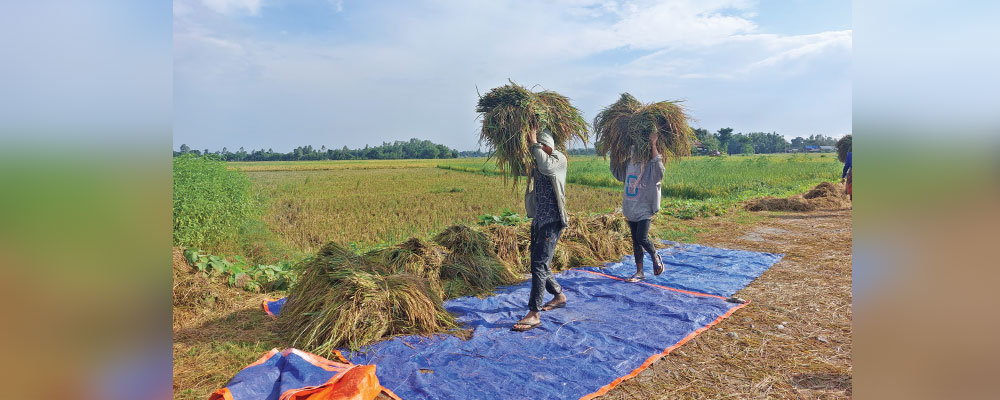

By Nisha Rai,Dharan, June 10: Two-thirds of the total population in the country have been embracing agriculture as their main occupation. The backbone of economic development and about one-third of the national income comes from the agricultural sector.
Due to our condition and tradition of farming since ancient times, agriculture has been adopted as a culture. However, there is a need to modernise and commercialise agriculture rather than continue in traditional mode.
Currently, the three levels of government are trying to introduce new methods and tools for the commercialisation and modernisation of the agricultural sector. In the past, agricultural products were exported to third countries, but recently, it seems that the country is becoming depended in the import of food grains.
To address situation, the provincial government has been addressing agriculture and farmers according to its capacity. Farmers have been eased by the provincial government's programmes such as formulation of agricultural policy, implementation of policies, monitoring, evaluation and reports for addressing the food security issues.
Along with federalism, in the year 2074 B.S., the Ministry of Land Management, Agriculture and Cooperatives was added to the service of the people of the province in Biratnagar, the capital of Koshi Province. Under the same ministry, Agricultural Development Directorate was established in 2075 B.S.
For the convenience of the farmers, agricultural promotion and training centres, agricultural knowledge centres and farms, laboratories were also established under the Agricultural Development Directorate in the same year.
According to Dr. Lekh Raj Dahal, secretary of the Ministry of Industry, Agriculture and Cooperatives, Koshi Province, the ministry has been making a long-term plan to make a significant contribution to the gross domestic product by developing agriculture as a diversified, commercialised, income-generating and respected occupation.
He said, “There is a need to commercialise the agricultural sector and increase the production and productivity. The Ministry is committed to play a role in poverty alleviation by reducing malnutrition situation through commercialisation of agriculture. We are oriented towards revitalization of agriculture by increasing food production.”
According to him, the ministry has been conducting various programmes to increase the agricultural and livestock products reflected in the national agricultural strategy and the first periodic plan of the province.
The contribution of the agricultural sector to the gross domestic product of Koshi Province is 37.75 per cent. According to the ministry, about 23.11 per cent of the total cultivated land of 3.391 million hectares of the country belongs to this province. This province contributes 23.11 per cent to the national food availability, said the Ministry.
According to the ministry, cereals and vegetables such as paddy, maize, wheat, potatoes, cardamom, ginger, tea, orange are the major crops in the province. Not only rice and maize, but also tea has been produced in large quantities in the province.
Agricultural expert Rajendra Upreti said that although the government had done many things in the agricultural sector, many people in the country do not like to adopt agriculture. According to him, most farmers have to depend on wage labourers to grow farm products. A few give the land to the tillers in the condition that they will receive half of the total yield.
Upreti said that if the existing three-level government arranged for safe storage of the yield produced by farmers, timely fertilisers, modern agricultural tools and machines, people's attraction to farming would improve. In the fiscal year 2022/23, under the subsidy programme based on agriculture, out of Rs. 1.5 billion, about Rs. 822.6 million was spent for subsidy, according to the ministry.
According to Balkrishna Basnet of Sunawarshi Municipality-3, Morang, the farmers would benefit more if the provincial government could arrange for timely distribution of fertilisation and irrigation for paddy production. Basnet said that there was a situation where farmers had to fight for fertiliser every year, and they had to use low-quality fertilisers that was smuggled.
Basnet said, “The occupation we have been pursuing so far is agriculture. As the government releases water in the canal in time, irrigation has been realised. Now there is some relief in the presence of the provincial government. When the MP of the provincial assembly comes to our houses, there is an initiative to voice the grievances of the farmers and solve their problems. We have not had to face many problems like in the past.”
Secretary Dahal said that grants had been given for agricultural equipment, agricultural infrastructure construction, fertilisers, seeds, tools and other equipment. In addition to this, the government has also distributed subsidies for moisture centres, cold stores, collection centres, warehouses and refrigerator-equipped transport vehicles.
It is expected that the farmers will also benefit as the ministry has been providing subsidies for organic farming and fish farming, poultry, modern shed construction, organic fertilisers, meat production, cows, buffaloes and pig rearing.
Similarly, 70-year-old Raj Bahadur Rai of Barahakshetra Municipality of Sunsari has been continuously enjoying farming for the past four decades. Stating that the young generation did not take up farming easily, Rai said that he was satisfied with the adoption of technology and easy availability of seeds over the years.

-original-thumb.jpg)