- Thursday, 28 May 2026

Tomatoes worth Rs. 200 million produced in a single ward in Bardibas
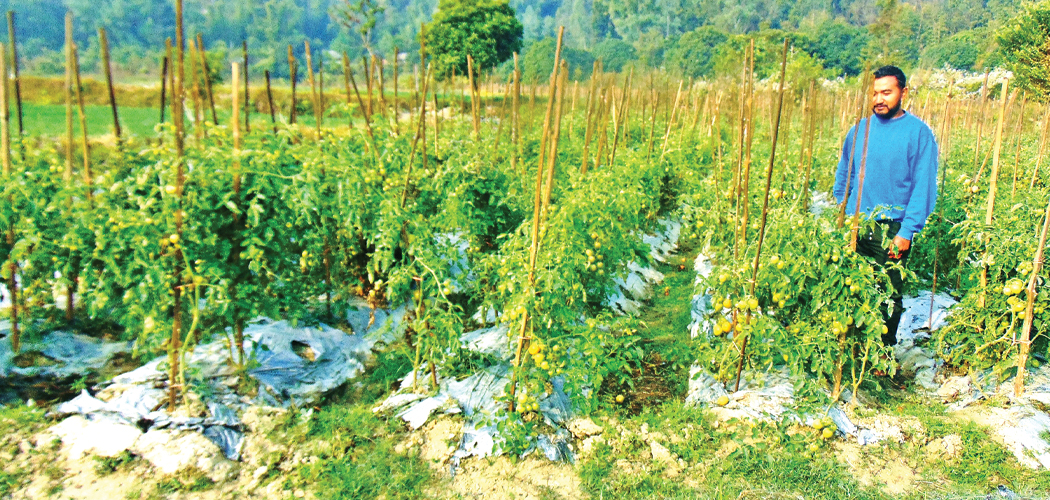

By Rabindra Upreti, Bardibas, Jan. 8: The local farmers of Khayarmara in the far northern of Mahottari district have surprised all by producing tomatoes worth millions of rupees nearby the river of a single ward.
About 400 farmer families of the village are now busy planting tomatoes. As the production and income started improving, the living standard of the farmers here is changing.
But Bardibas Municipality and Agriculture Knowledge Centre are not concerned about this place and the farmers where the largest amount of tomatoes are produced in Madhes Province.
Although the state has spent billions in the name of farmers and agricultural development, the farmers here have complained that they have not received support, sympathy and encouragement from the government bodies.
According to farmers, tomatoes worth Rs. 200 million are produced annually in Khayarmara. The whole village is involved in commercial tomato farming as tomatoes can be produced twice a year.
Khayarmara is the only village in the district under Bardibas Municipality-10 where tomato is cultivated twice a year in Shrawan and Magh (July and January). Tomatoes have been produced here throughout the year.
According to a young farmer of the village Laxman Shrestha, attraction of the villagers towards the cultivation of tomato has increased after getting more than expected income from tomato farming compared to traditional crops.
Shrestha said, "Tomatoes are being cultivated in around 150 bighas of land here. Tomato cultivation has expanded to Bhalujoda, Aran Danda, Ghising Tole and Mulkhola."
According to villagers, around 12 to 16 quintals of tomatoes are produced in the fields which do not produce even two mans of food grains in a kattha of land.
Tomatoes produced in winter season are sold for Rs. 1,200 to Rs. 2,000 per crate. Tomatoes produced in the spring season are sold for Rs. 500 to Rs. 1000 per crate. One crate contains 25 kgs.
"Currently, on an average, tomatoes worth Rs. 64,000 are produced per katha and Rs. 1.2 million to 1.3 million per bigha of land," said Shrestha.
According to this estimate, tomatoes worth Rs. 200 million have been produced annually in the area of 150 bighas of land in our settlement, he said.
By sharing this income among 400 farming families involved in tomato farming, each family has been earning an annual income of Rs. 487,500, he said.
After earning more than they expected, educated youths are also engaged in tomato farming.
Hira Sunuwar of the village has completed a Master in Business Studies (MBS) from Thakur Ram Campus of Birgunj.
He said that he left his job as a supervisor in a factory in Dubai and started tomato farming from the lockdown.
His brother Sunil has supported his pursuit.
"We have planted tomatoes in 14 katthas of land this time. We have a target of earning Rs. 1.4 million," Sunuwar said.
Badamaya Shrestha of Arandanda has 10 kattha farm. When the food crops were planted, there was not even a production worth Rs. 100,000. After her husband and son fell ill, she had to take a loan of Rs. 550,000 at an interest rate of 3 per cent from the creditor of the village.
She said that she earned around Rs. 300,000 by cultivating tomatoes in five katthas of land last year.
"Now I have planted tomatoes in three and a half katthas of land again," she said.
Eighty-year-old Tulman Shrestha of the same place has planned to expand tomato farming to 18 katthas of land after he was able to save around Rs. 200,000 from tomato farming.
According to farmer Harilal Shrestha, a person can cultivate tomatoes in three katthas of land. Because its production can support a family of five people, the attraction towards it has increased.
Similarly, 27-year-old Man Bahadur Ghising of the village said that he earned more than Rs. 200,000 from tomato farming in two katthas of land last season.
This year, he is preparing to plant tomatoes in additional two katthas of land rented at Rs. 5,000 annually.
The tomato farming here has not only benefited the farmers, around two dozen vegetable traders have also got employment opportunities.
Farmers are forced to farm based on guesswork and experience due to lack of technical knowledge. Due to the lack of easy irrigation, fertiliser and mulching plastic, tomato farming has become expensive and difficult. According to the farmers, it costs Rs. 15,000 to Rs, 20,000 to cultivate tomatoes in a kattha of land.
Due to the lack of cold stores, the farmers here have not been able to get proper price for their products. If the product is not sold on time, the trader is forced to sell it at the rate fixed by traders due to the fear of rotting.
According to Sadhuram Singh Basnet, consultant of Kanjiram Agro Consultants, mini cold storage can be built to meet the demand of farmers. About Rs. 1 million to Rs. 1.5 million is enough to build a mini storage.
But local farmers complained that none of the state bodies have taken care of the exemplary farmers.
Mayor of Bardibas Municipality Prahlad Chhetri and Chief of Agriculture Knowledge Centre, Jaleshwor Ram Chandra Yadav expressed their ignorance regarding the commercial cultivation of tomatoes in their municipality.
The Municipality has allocated Rs. 250,000 for mulching plastic and Rs. 500,000 for the distribution of vegetable seeds twice a year. But the local tomato farmers have said that they have not received any help so far.
Mayor Chhetri said that he would initiate cooperation by meeting with the tomato farmers in the northern part.
-original-thumb.jpg)