- Thursday, 28 May 2026

So much depends on a card called citizenship

By Vijay Kumar Sah
Dhalkebar, Dec. 16: Chandan Kumar Chaudhary, a 21-year-old from Dhalkebar, Mithila Municipality–6, Dhanusha, wanted to go to Japan to study Computer Science. It was his lifelong dream. He studied hard, passed all his exams and, by all means, was eligible to pursue higher education in Japan or whatever country he desired. However, he did not have a citizenship.
Chaudhary’s father is a citizen by birth. This, he said, made it difficult for him to obtain a citizenship certificate in his name. He visited several government offices, met countless officials, begged many for help but the authorities declined to recognise him as a Nepali citizen.
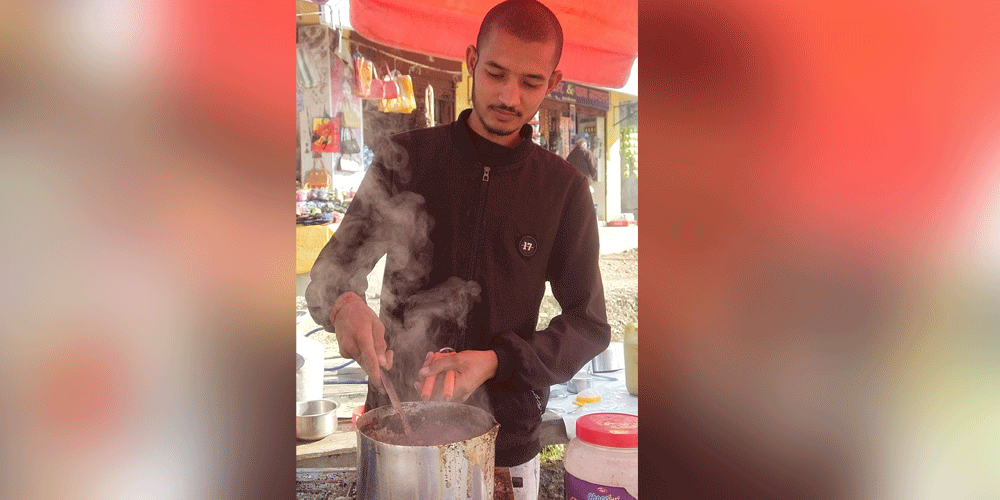
Without a citizenship, he could not get a passport to travel abroad nor could he enrol in a university to study in the country. Without a citizenship, he also could not apply for a job. So now, he is seeking a future at a tea stall.
“There are no doors open for me. I have nowhere to turn to,” Chaudhary expressed his sadness. “I started this tea stall three months ago because I can do nothing else, I am not allowed to.”
He compared his life to a tunnel of darkness, made darker after the process initiated to amend the Citizenship Act got stalled. The government, a few months ago, decided to issue a Citizenship Bill ordinance to address the problem facing by youth like Chandan. But that was not authenticated although both the Houses of the Federal Parliament had endorsed the Bill.
“When both the Houses of Parliament passed the Citizenship Bill, I felt it was on its way to becoming law and pulling me and others like me out of the swamp we are stuck in,” Chaudhary said. But this hope turned into despair again, he added.
As mentioned above, Chaudhary’s father Bhola Chaudhary is a citizen by birth. His mother Sarita Kumari Chaudhary is a citizen by descent. Similarly, his grandfather Bardi Chaudhary was a citizen by birth and grandmother Mina Devi was a citizen by descent.
Technically, as the child of a citizen (albeit by birth), Chaudhary’s father was entitled to a citizenship by descent. But neither him nor the government team that came to his village in 2006 seemed to know this and Bhola was also given a birth-based citizenship. “This one thing has ruined my and my siblings’ lives,” Chaudhary said with his hand on his head.
Had his father been recognised as a full citizen by descent, Chaudhary would have received his citizenship by now, would have been able to go to Japan, would have got a job … “These thoughts haunt me,” his voice choked as he held back tears.
Without a citizenship, Chaudhary cannot even purchase a SIM card. “I have to use my mother’s SIM,” he complained.
Needless to say, he has also not been able to apply for a driver’s license. That is why, despite knowing how to ride a motorcycle, he uses public vehicles, or, when that is not possible, he walks.
Chaudhary’s plight is not an isolated case. He said he knew many talented youths who were engaged in low-paying odd jobs or opening roadside stalls like him because they did not have citizenships. [The lack of] one card that most of the country takes for granted, he said, has ruined lives.
Jitendra Kumar Kushwaha, general secretary of the Citizenshipless Individuals Struggle Committee, said that denying recognition to the children of birth-based citizens had rendered hundreds of thousands stateless. He also hoped that the new government took the issue of citizenship seriously.
“Please consider this,” he said, drawing people’s attention to everything the lack of the official document deprived individuals of, “One cannot continue his or her education beyond high school without a citizenship. One cannot get a job, public or private, without a citizenship. One cannot get his or her rightful share of parental property without a citizenship. One cannot prove his or her own existence without a citizenship.”
We are not worth the land we stand on and the air we breathe without that vital piece of paper, he said. “We are humans but without statehood, we are not people.”