- Thursday, 28 May 2026

Indian Congress: Quest For Change

So the Indian National Congress (INC) has elected a president who does not come from the Nehru-Gandhi clan that commanded the 137-year-old organisation for a combined period of 75 years. Mallikarjun Kharge carries an overweight baggage of organisational decline recorded particularly during the past one and a half decades. He had no difficulty in defeating Shashi Tharoor, a noted writer, at 66, distinctly younger than the 80-year old veteran.
Although Kharge is seen by many as a close Gandhi loyalist, the Gandhi family has not officially endorsed either candidate. Will Kharge salvage the vastly lost ground that the INC steadily lost in the new century? Today, the party’s position with the voting public at its worst ever, coinciding with the Bharatiya Janata Party (BJP) leader Narendra Modi’s rise and rise. After independent India’s first Prime Minister Jawaharlal Nehru’s series of electoral victories that placed him in office for nearly 17 years, Modi has the distinction of leading his party to three consecutive victories at the general elections.
BJP has emerged as a formidable party whose organisational strength has consolidated so deeply that it is expected to emerge as either the party with the largest number of parliamentary seats for the fourth time in succession or, at the least, take the spot as the main opposition in the foreseeable future. That is, if it does not fritter away the tremendous hold it has on voters — so far. The next general elections will take place within 18 months. As things stand, INC’s steep decline has had demoralising effects on its rank and file. The 2019 general election proved to be simply pathetic. The past two decades saw the relentless erosion in its support base.
The Nehru-Gandhi clan’s name alone would not — and could not — work for ever. Even a relatively well-performing party in power for multiple terms tends to fatigue voters. But when a party has captained the government for many years, punctuated by some interruptions, its delivery capacity naturally comes into sharp question. Voters cannot be taken for granted, and hence the need for constant monitoring of public mood and expectations to be followed up by appropriate initiatives. Inner party democracy carries a tonic that rejuvenates the organisation.
Search for change
An organisation professing lofty ideals and tall promises that never get delivered even in half cannot expect the public to be in good humour and loyally endorse it to the helm of state affairs, as if people did not have any discerning power. The prevailing political landscape shows how INC has weakened in the last two decades. Sonia Gandhi, widow of the party’s ex-president Rajiv Gandhi who was assassinated in 1991, headed the party for a record number of years from 1998 to 2017. When she desired that her son Rahul take over, the latter took the reins in 2017, as the formality of electing him unanimously was quickly completed.
However, Rahul resigned when his organisation suffered its worst ever electoral defeat in the 2019 general elections. He brushed aside all persuasion to resume as party chief. At the request of the organisation’s presidium to become interim president, Sonia Gandhi stepped in. But the coronavirus pandemic caused an inordinate delay in the organisational election until the October schedule was made. Kharge and Tharoor attracted much attention outside the party, too, because the contest was to toss a non-Gandhi onto the seat of the organisational power.
Nehru, Indira Gandhi, Rajiv Gandhi, Sonia Gandhi and Rahul Gandhi have headed the party in all for three-fourths of century. Jaded, weak and lost for many years, the party with such a long history is, now, struggling to even hold on to a tenth of the seats in the 545-member Lok Sabha. Its pathetic position is stressed by the fact that it had obtained more than two-thirds majority in 1984, only to shrink to less than a third of the parliament’s strength five years later in 1989.
The 1984 success was primarily because of the mass sympathy wave generated in the aftermath of the assassination of Prime Minister Indira Gandhi on October 31 that year. That the Congress in November 1989 found more than half of the seats it held in the previous house underscored the leadership’s lack of vision in addressing the core issues that mattered the most to voters. Not only the INC but also other political parties were witness to the lessons on the consequences of taking voters for granted.
Change in institutional structures and governance does not come easily, unless existing outdated attitude and undemocratic decision making process are dispensed with. In order to boost party morale, genuinely free discussions for decisions should be the order of institutional functioning. High-handedness in the name of directives from “the high command” should be shed, as it demonstrates an authoritarian working style without responsibility. In this respect, what P. Chidambaram, a senior Congress leader, said the other week is interesting: “Congress president or not, Rahul will always have a pre-eminent place in the party.”
Basic approach
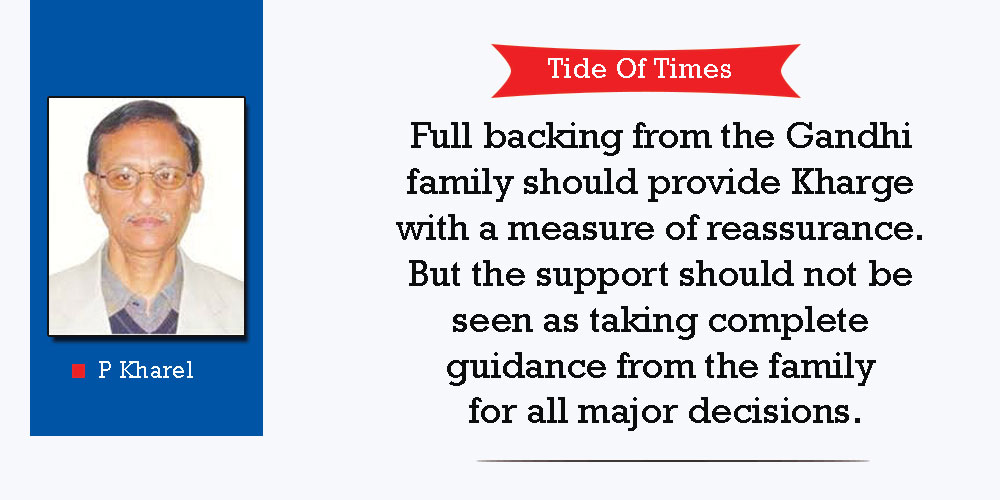
Presently, the Congress is opting for one-person-one-post, which leaves the road relatively clear for Rahul Gandhi to don the mantle of prime minister, that is, if and when the Congress gets an opportunity to head a coalition cabinet. Winning a clear cut majority on its own is an improbable prospect, of not impossible altogether at this stage. Full backing from the Gandhi family should provide Kharge with a measure of reassurance. But the support should not be seen as taking complete guidance from the family for all major decisions. INC should not be seen as the family fiefdom.
Cosmetic change won’t work. The Gandhi family should not be seen or sensed as pulling strings from behind the curtains in major party decisions. Interference would only portray the new president as the Gandhi family’s yes-man and nothing more. The creative, dynamic and energetic in the rank and file deserve to be roped in for key tasks, and be rewarded on the basis of their performance. This should encourage fresh ideas and propel hard work that would give a better shape to South Asia’s oldest party.
(Professor Kharel specialises in political communication.)