- Tuesday, 26 May 2026

Risk Of Taking Multiple Drugs

The proportion of older people is rapidly increasing in the world and by 2050, most of the older people live in developing countries. Older people or adults with multiple illnesses usually take several medicines every day, putting them at higher risk for threatening consequences. Aging is associated with the possibility of developing multiple chronic health conditions and owing to improved living standards and availability of high calorie ready to eat food, many adults also develop chronic diseases at earlier age.
While managing those conditions, daily intake of several medications becomes imperative. The increase in number of medicines grows the chances of adverse drug reactions. Older people as well as adults with multiple illnesses often have to consult several healthcare providers. In each of such consultations, new medications or changes in dosage often occur resulting in the complexity of already existing challenging situations owing to several medicines.
Dangerous consequences
The use of multiple medicines usually five or more on daily basis is often termed as polypharmacy. Those medicines may or may not be clinically necessary. The situation often results in dangerous consequences ranging from an unintentional overdose, clinically significant drug interactions such as that result decreased efficacy of one particular medicine, adverse drug reactions to death.
There are several risk factors for polypharmacy that include patient-related as well as inappropriately prescribed unnecessary medicines. It is obvious that older people or adults with multiple diseases consult multiple specialists and people with a chronic mental health problem often have difficulties in taking several medications appropriately. Medication management is a challenge for the older adult due to decreasing sight and dexterity, several diseases, declining metabolism, and often memory decline.
Moreover, inappropriately prescribed or excessive medications also may lead to grave consequences such as adverse drug interactions, and drug-disease interactions. Drug-disease interaction in which a medication prescribed for one ailment may worsen another condition or causes a new condition. Research has shown that the larger the number of medicines, the higher the chance of adverse drug reactions. Patients taking five to nine medications have a 50 per cent chance of adverse drug interaction, increasing to 100 per cent when they are taking 20 or more medications (US Pharmacist, 2017).
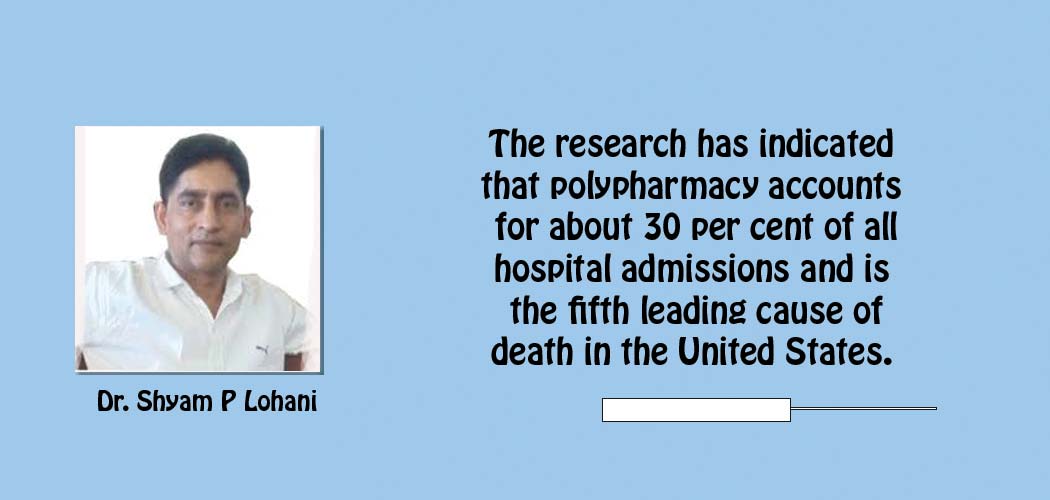
The research has indicated that polypharmacy accounts for about 30 per cent of all hospital admissions and is the fifth leading cause of death in the United States. The actual statistics in Nepalese scenario is not known yet. A disease can only be treated with medications if taken as prescribed. The rational use of medicine has value not only in appropriately managing a condition but also avoiding unnecessary adverse events. There are concerns of adherence when multiple drugs are taken. Polypharmacy is usually associated with increased medication adherence challenges. Increasing the number of medications naturally creates more adherence challenges for patients, thus increasing the likelihood of medication non-adherence.
Patients who are taking several different medications may forget to take all of them as prescribed, take them at the wrong time, or take them in the wrong amount. All of the situations may result in which the condition can worsen, treatment can fail, adverse drug reactions can occur, and patients can become hospitalized. Most of the above situations are potentially life-threatening and can cause death. The most frequently prescribed medications are nonsteroidal anti-inflammatory drugs, blood pressure medications, anti-diabetic, antibiotics, medications for depression, and several others.
The value of information on drug administration should never be overlooked and may become vital in situations of polypharmacy. Patients and caregivers should be aware of common symptoms of adverse reactions and drug interactions resulting from polypharmacy. The common signs can range from urinary incontinence, a loss of appetite, diarrhea/constipation, tiredness or reduced alertness, confusion and hallucinations, weakness and dizziness, falls, skin rashes, depression, and functional decline, to anxiety. However, these signs and symptoms can also be due to the disease itself or of a consequence of aging.
Approaches
The most important measure that patients and their caregivers can take to prevent polypharmacy is to make sure that all of their healthcare providers should get a complete and up-to-date list of medications that include dosages and time to take medicines. This list should include OTC medications, dietary supplements, as well as vitamins. It is recommended for patients bring a list of their medications when visiting their providers and update it whenever there is a change after each consultation. Another approach is known as deprescribing in which the dosage of medications is adjusted down to the minimum effective dosage.
Sometimes, it may involve stopping giving medications when the health status of the patient changes in a way that the potential for harm from a drug or drugs does not outweigh their health benefit.The role of a community pharmacist is vital when there is a concern about adverse drug reactions or adherence. Before purchasing any OTC product or dietary supplement, every patient or caregiver should ask the community pharmacist if it is safe to take with other medications or with the medical condition for which medicines are being taken. In case of potential adverse drug reactions, pharmacists can talk to physicians directly to better understand why a medication was prescribed and to discuss alternative therapies with a considerably lower risk of drug interactions.
(Dr. Lohani is the clinical director at the Nepal Drug and Poison Information Centre. lohanis@gmail.com)