- Thursday, 28 May 2026

Bhattarai’s Self-denial Of Polls A Political Ploy Or Sainthood?

Former prime minister Dr. Babu Ram Bhattarai has given up to contest the upcoming elections for the federal parliament scheduled to be held in November. He has surrendered his Gorkha constituency to his former comrade-in-arms Pushpa Kamal Dahal Prachanda and become fully active to campaign in favour of the latter. This may have come as the startling news for many but for those who have closely followed it up and scrutinised his remarks, observations and statements made public during the recent days, he appeared to be in a state of dilemma for some time before he took this crucial decision. In the first extended meeting of Nepal Samajbadi Party (NSP) that came into being following the split with Upendra Yadav-led Janata Samajbadi Party almost six months ago, Dr. Bhattarai had hinted at it clearly that he was in the mood to pass the leadership baton on to the upcoming generations.
While reaffirming the need for transformative politics in the country to face the impending challenges, he made exhortation to the youngsters to take up the mantle of leadership and lead the country into a new era of prosperity and development. In the same vein, Dr. Bhattarai’s speech given in an event organised by Policy Research Institute (PRI) last fortnight had given enough indications of his tilt to shift to a new role in the policy and intellectual domain. These were clear signals that Dr. Bhattarai would break the politics-for-power cycle, and carve a new canvas for his role.
Precedent
Dr. Bhattarai's exit from the cycle of electoral contest for power has won many admirers for him. Even his hardened detractors have appreciated him for this decision hailing it as an exemplary precedent and asked at least half a dozen elder septuagenarian politicians to follow Dr. Bhattarai's suit. But none of them has given any hearing to it. This is neither to single out and blame any elder politicians nor to discredit them. But their hold on the power politics for the last three decades has stagnated party democratisation and gridlocked the country’s march for development.
Dr. Bhattarai had contested the polls thrice in the past and won all of them with a thumping majority of votes. In both the Constituent Assembly elections held in 2008 and 2013, he had represented his home district Gorkha constituencies on behalf of the Nepal Communist Party- Maoist. The third election that was held following the promulgation of the new federal constitution in 2015 was the severest test for his electoral political career.
This was a crucial test for him because he had quit the Maoist party that he put in efforts to build and shape it up. He had created a new political outfit under the rubric of alternative politics lacking any stout organisational base and following. He was pitted against his own parent party – CPN –Maoist Centre -- in the elections but he was able to secure a victory with convincing margin. It was believed that his own dedication to the development of Gorkha that had won him a solid base of popularity accompanied by the support he mustered from the Nepali Congress had helped him to steer clear victory in the polls.
One can find in Dr. Bhattarai a proclivity of detachment and sacrifice as vindicated by his resignation from the Constituent Assembly almost seven years ago and his voluntary decision to abstain from contesting polls as a candidate to represent Gorkha constituency this time. In both the instances, he has demonstrated that he has no excessive lust for power. However, some people do attach personal reasons in regard to why Dr. Bhattarai decided not to contest the upcoming elections. Some say he decided to opt out because his popularity base has been eroded significantly with thin chances for his success in the upcoming polls.
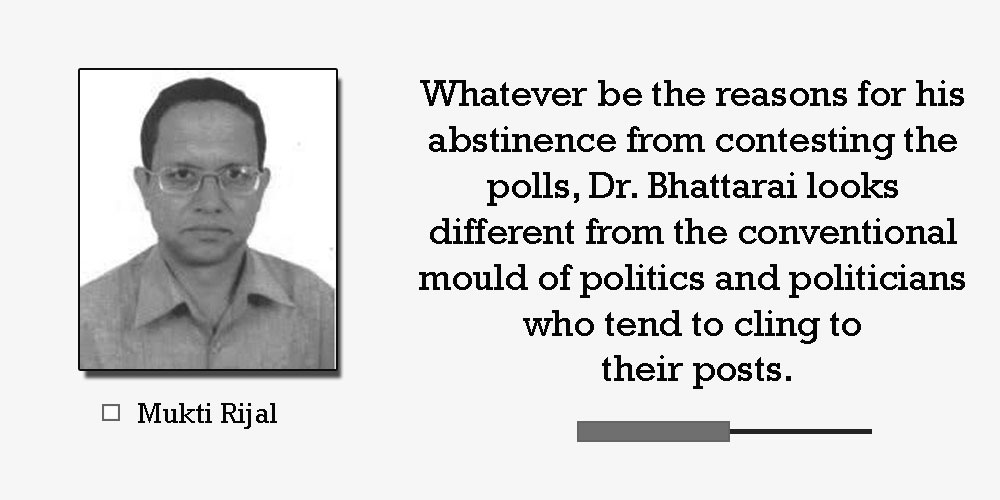
Others contend that Dr. Bhattarai has a deep interest to promote his daughter Manushi Yami Bhattarai in politics. According to his scheme, Manushi is contesting the upcoming elections from Kathmandu constituency. Whatever be the reasons for his abstinence from contesting the polls, Dr. Bhattarai looks different from the conventional mould of politics and politicians who tend to cling to their posts and use hooks or crooks to stay tied to the perks and privileges of the political office at the expense of their personal reputation too.
Matter of conjecture
What lies in store for Dr. Bhattarai in the days to come is a matter of conjecture for many political onlookers and analysts. Will he completely renounce the run of the mill type politics and engage in intellectual and policy pursuits befitting his interest and image or get involved into the task of building and shaping up socialist alliance comprising of various communist parties as he has argued time and again? Will the non-UML communist parties like CPN-Maoist Centre and the CPN- Unified Socialist will be prepared to shed their long-held communist tag with their bag and baggage and transform into a modern, progressive and democratic socialist alliance has been a matter of big question.
Similarly, the communist elders who are long imbued with centralised mindset and accustomed to vouch for communist demagogic verbosity will agree to disarm and democratise themselves in the scheme devised by Dr. Bhattarai does present another big question. When Dr. Bhattarai joined hands with Madhes-based party headed by Upendra Yadav, he had hoped that he would be able to transform the group into a national democratic political formation. But he admits he failed to accomplish the mission. Will Dr. Bhattarai succeed to accomplish the goal of his new narrative of building a socialist alliance bringing the communist groups together and transform them according to his democratic scheme or merge into the Maoist stream poses one of the big challenges for him?
(The author is presently associated with Policy Research Institute (PRI) as a senior research fellow. rijalmukti@gmail.com)