- Wednesday, 27 May 2026

Make Non-violence A Global Agenda


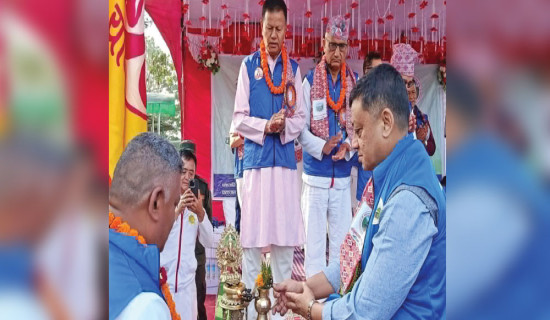
The events organised last week in Kathmandu to mark the birth anniversary of Mahatma Gandhi received wider coverage in Nepali mass media. The rich tributes showered upon Gandhi fit in with his worldly positive image and recognition. Undoubtedly, he is an enlightened figure whose thoughts, ideas and practices cut across the national boundaries and ideological divides. He is respected worldwide for his deep commitment to non-violence and peace. It is due to the reason that his birth day that falls on October 2 according to Gregorian calendar has been observed as the UN International Day of Peace and non-violence. The UN resolution adopted on June 15, 2004 pertaining to the observance of the international day of non-violence reaffirms the universal relevance of the principle of non-violence upheld by Gandhi and his desire ‘to secure a culture of peace, understanding and non-violence”.
Gandhi's global respect and admiration was so wide and all-pervading outside India that in January 2004 Iranian Noble Laureate Shirin Ebadi had reportedly proposed the idea for observing the Gandhi's birthday as international day of non-violence. Her idea was accepted by many Indian leaders, who later called upon the United Nations to adopt the proposal in 2007. Indian Congress leader and then Minister of State for External Affairs initiated the step to take the move forward and introduced the resolution in the General Assembly on behalf of 140 state co-sponsors which was unanimously agreed and adopted in a thumping manner.
UN resolution
The UN resolution avers that Mahatma Gandhi, who helped lead India to independence, has been a source of inspiration for non-violent movements for civil rights, human dignity and social change across the world. Throughout his life, Gandhi remained committed to his belief in non-violence even under oppressive and difficult circumstances. The day is indeed meant, according to UN, to spread the messages of non-violence through public awareness and education. The principle of non-violence upheld by Gandhi — also known as non-violent resistance — rejects the use of physical violence in order to achieve social or political change. Often described as “the politics of ordinary people”, this form of social struggle has been adopted by mass populations all over the world in campaigns for social justice and change.
Martin Luther King II, leader of the civil rights movement in the US, Nelson Mandela in South Africa, former US president Jimmy Carter are some of the champions who drew inspiration from Gandhi in their quest for right, peace and liberty. It is a fact that almost every ordinary person in most parts of the world is aware today that Gandhi was not only the leader of the Indian independence movement but also the pioneer of the philosophy and strategy of non-violence. The theory behind his actions was that “just means lead to just ends”. It means to say that it is irrational, inappropriate and highly objectionable to try to use violence to achieve a peaceful democratic society. Gandhi believed that seekers of social and political change and transformation should not use violence or hatred in their fight for freedom and dignity.
This author became much more aware of the significance and meaning of the teachings and practices of Gandhi on non-violence, peace and righteousness when I got initiated into the knowledge domain of conflict resolution and peace. Especially it was during the 10-year long Maoist led violent conflict that the studies and literatures had been produced and discourses on peace and conflict were conducted in an enormous scale in Nepal. John Paul Lederach, Edward Miller, Chris Spies and the like with whom this writer got into contact and attended the seminars facilitated by them understood how highly Gandhi was admired and how influential his percepts and practices were in shaping the ideology of peace and conflict transformation in the world mired in conflict and turbulence.
When Gandhi constructed and shaped up the philosophy of non-violence and peace and practised it in the social and political reality of India, the world was divided into blocs - Allies and Axis - indulging into hostile conflicts. Likewise, ideologically too, capitalism (liberalism) and communism were battling to assert and prove their supremacy and dominance in the world. But in that world mired in confusion, uncertainty and complexity, Gandhi was sensible and careful enough to take cognizance of the inherent flaws in the dominant ideologies and avoided to be drawn into the fold of this or that ideological straitjacket.
Common ground
Ram Chandra Pradhan – a prominent Gandhian scholar who delivered this year's Gandhi Jayanti lecture at a function organised by Gandhi Tulasi Smarak Mahaguthi at Kathmandu, dwelt at the way Gandhi steered clear of the flawed ideological divides. The Gandhian scholar articulates, "It is true that a number of scholars have tried to trace out the common ground between his thought and perspective of liberalism in their attempt to bring him within the ken of liberalism. His concern for the autonomy, freedom and integrity of the individual has been emphasised to put him in the category of a liberal thinker".
However, Pradhan states further: "Strangely enough, his concern for Daridranarayan (wretched and the indigent), his idea of the state of the enlightened anarchy and other similar ideas or poor and oppressed, had some commonality with Karl Marx". According him, several attempts have been to try out to prove Gandhi as a protagonist of either liberalism or Marxism depending on the orientations and proclivities of a particular scholar. But Gandhi did not fit into any faulty parochial framework and worldview. Gandhi had a vision of alternative civilisation framework built on the interrelationship between man and nature based on Gram Swaraj (village republic) dedicated to secure equity, justice and dignity. This is the need of the day.
(The author is presently associated with Policy Research Institute (PRI) as a senior research fellow. rijalmukti@gmail.com)