- Saturday, 4 April 2026

Minister Bhusal calls for collective efforts for unlocking climate finance for green grid investments
File
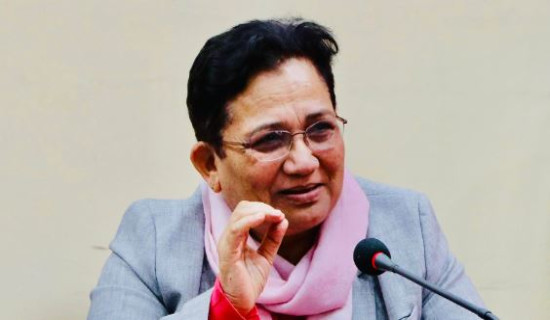
Kathmandu, Aug 25: Minister for Energy, Water Resources and Irrigation Pampha Bhusal has underscored the need for collective efforts to create more avenues for unlocking climate finance for green grid investments.
She said this
while addressing by virtual means the session 'Unlocking climate finance for
green grid investments' under the forum, “Towards COP 27: Regional Forums on
Climate Initiatives to Finance Climate Action and SDGs”, held in Bangkok, the
capital of Thailand, today.
The forum is organized by the United Nations Economic
Commission for Asia and the Pacific and the United Nations High-Level Climate
Champions for COP26 and COP27.
Minister for Energy Bhusal said that the set of
principles for unlocking climate finance for grids developed under the Green
Grids Initiative “One Sun, One World, One Grid”, launched at COP26, needs wider
dissemination and it is important to build the capacity of countries like Nepal in
the design and development of transmission and distribution infrastructures.
As the Minister shared on the occasion, in addition,
the financing gap needs to be fulfilled to ensure that the transmission
projects adhere to the principle of climate-compatible grid investments.
Hydropower in Nepal has the potential for nationwide electrification along with the possibility of cross-border electricity trade. Cross Border Energy Trade can have a massive impact on the clean energy transition in South Asia, she said.
"Nepal is among the most vulnerable nations to
climate change with the country’s delicate topography, climate-sensitive
livelihoods of the people and their limited adaptive capacity.
As a Least Developed Country (LDC) with an insignificant contribution to past and current global emissions, we recognize that to meet the 1.5°C temperature goal, all countries need to undertake ambitious mitigation actions," Minister Bhusal said.
Stating that as Nepal aim to move forward, it is
crucial to recognize the pathway that will ensure a sustainable transition and
Nepal’s Second Nationally Determined Contribution (NDC), 2020 has adopted
ambitious targets for the next decade to mitigate emissions and increase the resilience of vulnerable communities to adapt to the impacts of climate
change.
According to her, among various targets, the Second
NDC of Nepal aims to expand clean energy generation to 15,000 MW, of which 5-10
% will be generated from mini and micro-hydro power, solar, wind and
bio-energy, by 2030.
Similarly, by 2030, we aim to increase sales of electric vehicles to cover 90% of all private passenger vehicle sales and 60% of all four-wheeler public passenger vehicle sales.
"Residential cooking has been prioritized with a target set at 25% of households using electric stoves by 2030. It is to be
noted that the targets set by the second NDC of Nepal are mostly conditional
and dependent upon mobilization of external resources," the Energy
Minister said, adding that the cost of achieving Nepal's NDC conditional
mitigation targets is estimated to be USD 25 billion while the cost of achieving
unconditional targets outlined in the NDC is estimated to be USD 3.4 billion
and that covers 5,000 MW of electricity generation only.
"Furthermore, with our Long Term Strategy for
Net-zero Emissions, Nepal is committed to accelerating climate action with the
goal to achieve net zero emissions by 2045. Nepal would also like to gain
recognition for its mitigation contributions beyond its border through clean
energy trade.
Clean energy adoption has really taken off in Nepal.
We have made significant progress in increasing access to electricity in the
last decade. More than 95% of the households of the country have been
electrified through a grid and off-grid solutions and we aim to achieve universal
electricity access by 2024."
Stating that Nepal’s largest available renewable
energy resource is hydropower with a current installed capacity of around 2,300
MW, the Minister said with sufficient solar radiation and sunshine on an
average of 300 days in a year, there is great potential for utilizing solar energy
in Nepal.
She further said, "It is to be noted that, in
Nepal, the Power System is hydro-dominated where the demands are covered
primarily by run-of-river (ROR) and peaking run-of-river (PROR) hydropower
plants, with only around 100 MW of storage-based hydro.
The lack of storage-based hydropower also is one of the challenges we face. Our Fifteenth Plan aims to diversify the energy mix by developing reservoirs, semi reservoirs, pumped storage and other alternative energy projects. Given Nepal’s complex mountainous terrain and last-mile connectivity challenges, these approaches are needed to complement grid extensions."
Informing the forum that Nepal will be in the state
of net electricity surplus by 2025 from which Nepal will be a net exporter of
power on a Round-the-Year basis, Minister Bhusal said considering the current
trend of annual electricity consumption growth rate, a country cannot consume the
surplus power.
"Accordingly, Nepal has identified a good
prospect of producing and supplying green hydrogen by utilizing the surplus
power. Hence, we are actively working towards introducing suitable
interventions for the promotion of green hydrogen," she said. (RSS)