- Thursday, 28 May 2026

'Small industries vital for national economy'


By A Staff Reporter
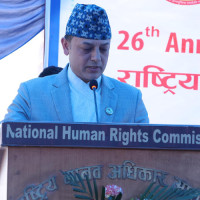
Kathmandu, Aug 19 : Minister for Industry, Commerce and Supplies of Bagmati Province Milan Babu Shrestha has said that micro, cottage and small-scale industries that make the country's economy self-reliant and create jobs are the priorities of the Bagmati Province government.
Addressing an interaction programme organised by the Federation of Nepal Cottage and Small Industries (FNCSI) in the capital on Wednesday, he said that the Bagmati government is always with such industries that help to boost the economy and make the country self-reliant through local production by substituting imports.
Stating that there is a lot of potentials to be self-sufficient through micro, cottage and small-scale industries which supply goods ranging from clothes to daily consumables, he said that he will provide support for this sector as he holds the Ministry.
He said that textiles in Lubhu and Thaiba in Lalitpur, carpentry in Bhaktapur, fine arts and metalwork in Patan have played a role in earning billions of rupees.
He said that in order to promote the products of domestic and small industries, a modern sales centre is being built in Hetauda, the capital of the Province, at a cost of around Rs. 50 million since last year.
Stating that the provincial government has a programme for the construction of modern exhibition centres in Chitwan, Makwanpur, Kathmandu, Bhaktapur, Lalitpur and other districts for the promotion of domestic goods, he urged the FNCSI to join hands with the programme.
FNCSI president Umesh Prasad Singh said that in Nepal, micro, cottage and small industries are the instruments of economic prosperity, but market access is the main problem of such industries.
He said that the Federation wants to move forward in cooperation with Bagmati Province in the direction of making the economy prosperous through the maximum utilisation and promotion of micro, cottage and small industries.
The outgoing president of the Federation Shyam Prasad Giri said that the provincial government is necessary for proportional development and proportional distribution of production.