- Sunday, 29 March 2026

Government issues Land Use Regulations: land classified into 10 zones


By Sharad Sharma, Kathmandu, June 1: The government has issued the Land Use Regulations, dividing land into 10 zones based on its features.
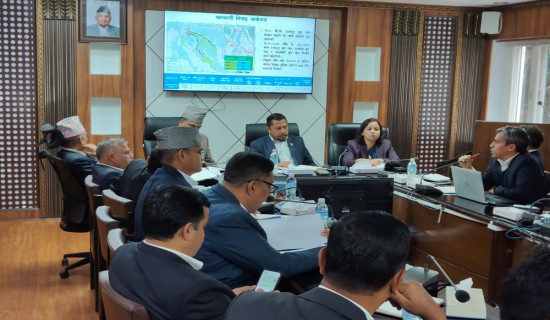
At a press meeting here today, Minister for Land Management, Cooperatives and Poverty Alleviation Shashi Shrestha issued the Regulations and informed about the classification of land.
The land has been categorized as an agricultural zone, residential zone, commercial zone, industrial zone, area of mines and minerals, forest zone, public use zone, area of cultural and archaeological importance, and others being based on topographic features, efficiency and utility of land, its existing use and necessity.
As the Minister said, the regulations prohibit commercial land plotting and its sale in areas except in classified areas for residential purposes. She was hopeful of the implementation of the regulations as it was issued in coordination with the stakeholders concerned.
The regulations have the provision that the federal level will deal with the land use mapping procedures across the country and hand it to the local level which can revise and update the mapping as per its needs and implement it.
Similar, one land zone may have sub-zones such as grains production sub-zone and fruits production sub-zone, according to the Minister.
The regulations grant the right to the landowner to go to a court if the party finds the classification unconvincing.
According to the Minister, federal, provincial and local levels will prepare land use plans and the province is required not to prepare a plan adverse to the federal plan and the local level not to contradict the province plan. The data achieving of the mapping shall be maintained.
Likewise, the regulations do not entertain the use of land classified into one category for another purpose and the land use classification is changeable through due process.
Likewise, the federal government can alter the land use if valuable minerals are found in the land use zone if priority projects were to be operated on it or for any other plausible reason like it falling in the international border security, development, tourism, world heritage sites etc.
The local level can change the land use for the purpose of disaster risk management, shifting the insecure settlements, prepare the basis and criteria required for regulating and checking the land plotting and demarcation. Provision has also been made for implementing the land pooling programme for the purpose of mechanization of agricultural land.
Rs 100 thousand fine if land left uncultivated
It is stated that it would be considered that an offence has been committed if the land is used in a way that the natural course of the river is diverted if programmes are run in contravention of the three tiers of land use maps and plans if the land classified as agricultural land is continuously left uncultivated for three years except in situations which are out of human control and if the specified land use zone classification is changed other than what is stated in the Act.
A fine of up to Rs 100 thousand would be charged in case of the aforementioned offences.
Minister Shrestha said that an action plan would be prepared for the implementation of the Land Use Regulations. A meeting of the Council of Ministers on May 23 approved the Regulations. (RSS)
-original-thumb.jpg)