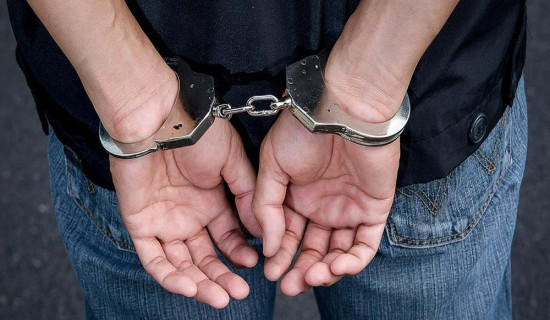
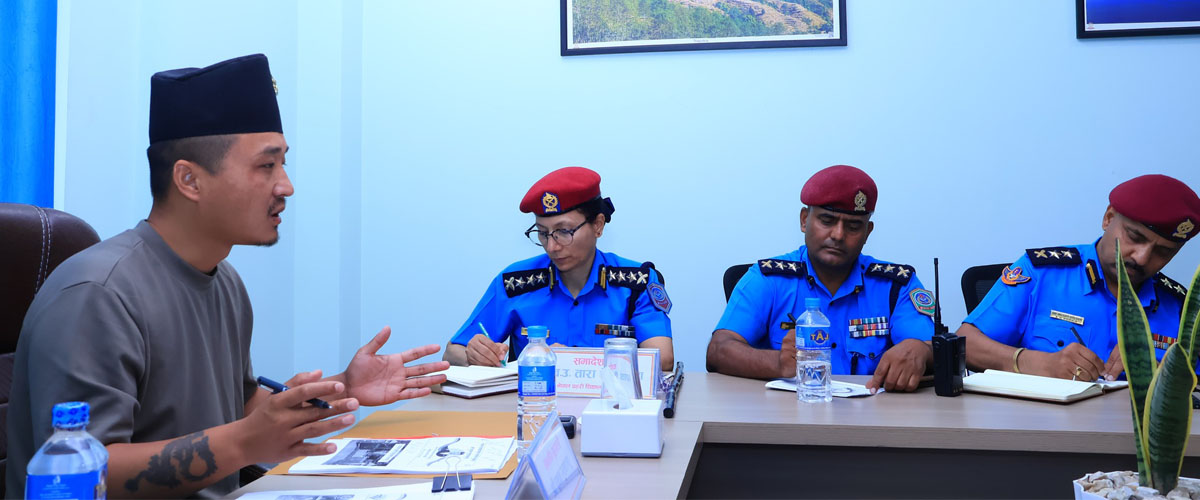
By Purushottam P. KhatriKathmandu, Apr 15 : A team of the Armed Police Force Nepal (APF) can be seen cordoning off the area near the premises of the Department of Forest and Soil Conservation at Babarmahal for the past 15 years just for two red sandalwood-loaded trucks. These sandalwoods seized while being smuggled from India to China via Nepal has become a matter of headache for the government. Chief of the Division of Participatory Forest Office and the Joint-Secretary of the Ministry of Forest and Environment, Dr. Sindhu Prasad Dhungana, said the seized red sandalwood has become almost a ‘headache’ for the government. “We have been providing security here to these seized goods for the last 15 years,” said Dhungana. “These illegal goods have really become a matter of worry for the government. We are not allowed to use it, nor can we earn revenue by auctioning it. But we have been providing security here,” Dhungana said.He said, “Despite repeated decisions of the Cabinet meetings asking India, the country of their origin, to take back the sandalwood, the country has shown no interest in taking it back.”In 2006, a temporary post of the Armed Police was set up on the premises of the Forest Department for their security. Three years later, the Forest Department Security Base Camp of APF was set up on September 23, 2009 with 30 Armed Police Force under the command of the Inspector of Police. The base camp is still there. But for the past two years, only 10 APF personnel have been guarding the area under the command of the Deputy Police Inspector.“We have been told to protect the sandalwood which were dumped in two containers,” the in-charge of the base camp told The Rising Nepal on condition of anonymity during the field visit this week. The two containers – one with a number plate “Na 2 Kha 4867” and the other with illegible number plate – have been kept covered by the tarpaulins since then. “We haven’t really opened the truck yet, we don’t even know the amount of wood there,” he said.Red sandalwood seized in six districts – Kathmandu, Lalitpur, Bhaktapur, Kavrepalanchowk, Sindhupalchowk and Rasuwa – has been kept on the premises of the Department. According to the data provided by Surendra Prasad Adhikari, Assistant Forest Officer of CITES (Convention on International Trade in Endangered Species of Wild Fauna and Flora) Branch of the Department, a total of 88,542 kg of sandalwood lie on the premises. Of that, 30,551.6 kg was recovered from Sindhupalchowk, 73,319.25 kg from Kathmandu, 619 kg from Lalitpur, 49 kg from Bhaktapur, 57 kg from Kavrepalanchowk and 13,946.8 kg from Rasuwa.211,054 kg of sandalwood across the countryAccording to the data provided by the Department, 211,054 kg of red sandalwood seized from 20 different districts has been kept in Nepal. According to Adhikari, all of them were seized while being smuggled from India to China via Nepal. “Nepal is just a transit hub to smuggle these goods to China from India,” he said. He said that still court cases are pending in various courts of the country regarding settlement of 16,487 kg of the wood. According to an employee of the Department, the price of red sandalwood in the international market is up to Rs. 8,000 per kg. On that basis, red sandalwood worth more than Rs. 1.68 billion is going down the drain. For the purpose of fixing the fine in the court, the assessment is done at the rate of Rs. 800 per kg, which is many times less than the actual price.The person concerned has not taken back their 8,459 kg of red sandalwood which should have been returned to the person who had won their court cases. “Reason for this is that it neither can be sold nor be auctioned now,” the officials said. Since no one can buy it even during the auction, it has been put on hold without any auction.Red sandalwood has also been seized in Chitwan, Sarlahi, Dolakha, Jhapa, Nawalparasi, Taplejung, Kapilvastu, Dhading, Terhathum, Rupandehi, Bajhang, Gorkha, Sankhuwasabha and Saptari, districts where the armed forest guards of the Division Forest Office haven been protecting it.
The government is fully committed to holding the upcoming local level elections in a free, fair and fearless manner. This is reflected on preparations being made for the polls slated for May 13. Elections can be conducted in a fearless environment only when a vigorous security system is put in place. Proper mobilisation of security personnel for polls could help prevent possible illegal activities like rigging and capturing of poll booths. To ensure that there will be no security lapses during the local polls, the government is preparing to deploy an adequate number of security personnel belonging to different security agencies. With its unified poll security plan, the government aims to mobilise a total of 165,000 police personnel. With an addition of 100,000 temporary police, the total number of security personnel to be deployed in all the 753 local levels is going to exceed 265,000. In view of possible security threats, a meeting of the National Security Council held on March 24 had endorsed the Local Level Election Integrated Security Plan-2078. Under this plan, Nepal Police, Armed Police Force (APF), Nepali Army (NA), National Investigation Department (NID) and temporary police are being mobilised for local elections. About two weeks ago, the National Security Council recommended to the government for deploying the NA personnel for the local polls. Recently, President Bidya Devi Bhandari, on the recommendation of the Council of Ministers, approved the proposal regarding the mobilisation of the army. This has paved the way for the NA to deploy its troops in all the local levels to help conduct the polls in a free and fair manner. According to the NA spokesperson, over 71,000 army personnel are going to be mobilised for poll security. They will work in close coordination with the concerned District Security Committees and the office of the District Chief Election Officer to ensure a full election security. The security plan with the deployment of the intelligence personnel associated with the NA, NID and APF is expected to contribute towards holding the elections in a dignified manner. Periodic local polls are the key to strengthening and institutionalising the grassroots democracy. It is the free polls that alone can create a congenial environment for voters to exercise their franchise freely. With such elections, there are higher chances for the honest, dedicated and visionary candidates being elected to lead the important local government. It works closely with the people. In the existing federal governance system, the local government enjoys executive, legislative and semi-judiciary powers. So, it can strengthen the service delivery system and carry out development activities as per the needs and aspirations of the people. Under the local poll security plan, the NA has more than a dozen roles to play. It has to ensure security of ballot paper printing and their transportation. Besides, it needs to coordinate with other security agencies for the security of prisons, airports and other crucial structures across the nation. The NA has been assigned to transport ballot papers, along with ballot boxes and other poll materials. The Election Commission of Nepal (ECN) has set altogether 10,756 polling booths and 21,955 polling centres for the local polls across the country. Of the total number of polling centres, 20,945 are regarded as highly sensitive, 4,420 sensitive and 3,391 general from the security perspective. So, the security agencies have a crucial role to play in conducting the polls in a trustworthy manner.
Barry Eichengreen Europe’s economy is finely poised between recession and growth. The knife edge is sharp because European policymakers have exactly zero control over the outcome. Before Russian President Vladimir Putin’s attack on Ukraine, Europe’s recovery from the damage wrought by the COVID-19 pandemic was solidifying. Industrial production rose in January, and retail trade rebounded. Economic sentiment improved in the first half of February, surpassing pre-pandemic levels. But then the war dented consumer confidence by heightening uncertainty and raising energy and commodity prices. In mid-March, the European Commission’s consumer confidence indicator fell to its lowest level since the start of the pandemic. So far, however, the data show only a mild softening of demand and limited disruptions to supply. They signal nothing remotely resembling the collapse in activity that accompanied 2020-21 pandemic lockdowns. The OECD’s weekly tracker of economic activity, which uses machine learning and Google Trends data to infer real-time changes, similarly points to only a mild slowdown. Box office receipts are stable. Restaurant receipts are stable. Data from the navigation service TomTom do not suggest much decline in mobility-related activity.Energy shockIn response to the war and energy shock, the European Central Bank, appropriately, has downgraded its forecast for eurozone growth in 2022 from 4.3 per cent to somewhere in the 2.3 per cent to 3.7 per cent range, depending on what happens to oil and gas prices. Nonetheless, even its “severe scenario” of sustained high energy prices still anticipates above-trend growth in 2022. More costly energy will no doubt be a drag on growth. But if Russian gas continues to flow, higher prices will not bake in a recession. Inevitably, profits will be squeezed by more expensive inputs. Even so, European producers can take steps to economise on energy use and keep the wheels turning.But using less gas is one thing; using none at all is quite another. In the latter scenario, gas-powered factories won’t be economising; they will be shutting down. Over time, US natural gas can be substituted. But Germany has no liquefied natural gas terminals and will need the rest of 2022 to install its first floating LNG terminal – a converted supertanker – even if all goes according to plan. In the meantime, German gas consumption will fall by 30-40 per cent. Even assuming that the monetary and fiscal authorities respond forcefully to prevent second-round business-cycle effects, this could drive German growth in 2022 from 1.8 per cent, the most recent forecast of the German Government Council of Economic Advisers, into negative, recessionary territory.And here Europe’s lack of control comes into play. Whether gas supplies are suspended depends entirely on Putin, who could decide to terminate shipments in retaliation against Western sanctions. He may need the revenues, but this would not be the first time that anger and pride trumped economic logic. If the West makes payments not to Gazprombank but into escrow accounts, Putin will lose his last remaining incentive to keep the gas flowing. He knows that those accounts will ultimately be used to finance Ukrainian reconstruction rather than topping up Russian government coffers.Above all, if Putin allows his army to continue committing atrocities against Ukrainian civilians, Western European publics and policymakers will unite against him. Given their country’s history, Germans will not be able to sit back comfortably, in homes heated by Russian gas, in the face of this monstrous behaviour. If Chancellor Olaf Scholz won’t lead, then other members of his coalition, such as Defence Minister Christine Lambrecht, almost certainly will step in. And at some point, the German people will drag Scholz along with them. Whether it comes to this depends on Putin’s next steps.It is easy for an American, heated by natural gas from Texas and the Dakotas, to say that Europe should endure a recession in order to ratchet up the pressure on Putin. But if President Joe Biden’s administration and the US Congress think it crucial to intensify the pressure on Russia, then they can make it worth Europe’s while.Post-war reconstructionEurope will take the lead in Ukraine’s postwar reconstruction. The logistics are easier. Ukraine is in Europe’s neighbourhood, as Ukrainian President Volodymyr Zelensky reminds us. The European Union can deploy its cohesion funds, trans-European transport and other infrastructure projects, and common energy policy even without – or preferably before – admitting Ukraine.But if Europe is the logical party to do the legwork and administer the aid, then the United States can provide the bulk of the finance, beyond that portion financed by escrow accounts and Russia’s other external assets. This will be an appropriate humanitarian gesture once the war is over. But a US commitment now to compensate Europe for the steps it must take, starting with a ban on imports of Russian oil and gas, is also a way to incentivise it to help bring the war to an early end.(Eichengreen is a Professor of Economics at the University of California, Berkeley.)
Dr. Kundan Aryal The government is all set to conduct the local elections on May 13 in a free, fair and fearless environment. Even the major thrust of New Year greetings of top public figures is about the holding of the polls and people’s participation in them. While extending her wishes to the citizens on the occasion, President Bidya Devi Bhandari stated that it was the common responsibility of all to conduct the local election in a free, impartial and fearless atmosphere. The role of media has been crucial during the polls. On one hand, they create a discourse to help the voters for better choices while they tend to infringe professional standards during the election campaigns, on the other. The media do not cover all the events and incidents of the day. But during the election time, the media seek to cover most of the events and incidents regarding the campaigns. It is wise to hope that the media outlets will abide by professional standards to a great extent and refrain from biased and partial reporting and unequal treatment to the different parties and candidates. Moreover, they are expected not to indulge in highlighting only the news that would be highly favourable to a certain party as happened in the yesteryears. Credibility In its ‘Analytical Report on Media Monitoring: Constituent Assembly Election 2013’, the Election Commission of Nepal has concluded that the newspapers, in general, showed their impartially or bias through the headlines of the news during the CA election. It said that most of the weeklies, despite their lesser influence in comparison to the broadsheet dailies, demonstrated their views through their headlines. It also has stressed that online journalists need to be responsible and accountable to their practice so as to gain credibility. After about a decade, it is visible that selected online news portals have started to gain credibility with their comparatively fair coverage. However, a huge number of fly-by-night online news portals might spread disinformation during the upcoming local election. There are different forms of media right from print, radio, television to online in the country in addition to various social networking sites. Only an empowered and aware citizenry would be able to utilise all these channels to make informed choices at the ballot box.The biased coverage and ignorance of fairness in presenting news and views during elections is a global problem. However, there is a visible trend across the world that there is the process of gatekeeping in the mass media outlets with the presence of critical intellectuals or pressure groups. Moreover, it has been proved in different countries, including Nepal, that media coverage alone cannot ensure the electoral success for a candidate of a party. The best way or the professional duty of a media outlet is to provide choices before voters. An underlying common argument derived from the opinions of Walter Lippmann, an US scholar, and Norwegian sociologist Johan Galtung’s is that exposure to the media or media person can make difference in terms of coverage. Lippmann argues that before a series of events become news, they have usually made themselves noticeable in some more or less overt act. According to him, the events which are not scored are reported either as personal or conventional opinion, or they are not news. They do not take shape until somebody publicly in the etymological meaning of the word makes an issue of them, he states.Therefore, Nepali media should give emphasis on the importance of free, fair and fearless elections for the comprehensive development of the nation. To protect multiple sources of information, the process of gatekeeping in any media outlet should be in line with the ethical standards. Shoemaker, a prominent professor of communication from the US, argues that gatekeeping is the process by which the vast array of potential news messages are winnowed, shaped, and prodded into those few that are transmitted by the media. Thus, the role of the pressure groups comprised of civil society and professional organisations in spreading awareness and sensitising the role of free and independent media are pertinent to influence journalists and media outlets. Constructive roleAs one of the functions of mass media is to educate the general public and facilitate them to improve their socio-political and economic lives, media could empower them more effectively during the election time. Thus, media can play a greater constructive role in voter education. It is worthy to repeat the findings from the earlier elections that partisan interests and party allegiance were identified as the major causes of unprofessional performance and ignorance of the ethical values by the different forms of media outlets. In this context, the unfair performance by media outlets is directly linked with the credibility and subsequently with the financial health of the media institutions. This requires that the media entrepreneurs should make their impartial role distinctly visible. The ECN and the media organisations, including the professional and training institutions, should work in tandem to address those issues. (Dr. Aryal is associated with the Central Department of Journalism and Mass Communication of Tribhuvan University.)
Bini DahalFor someone who enjoys an occasional treat of some Indian sweets, I frequent certain sweet shops a lot. But each time I visit, I get startled by the small portion I get for the price I pay. Not just sweets, even daily groceries have now become a luxury for us with their unexpected price rises. I remember studying inflation in the first year of my college. Concerned about having to remember long definitions, I would select the shortest ones. And the easiest definition of inflation went something like, ‘a rise in the general price level of key commodities’. Then, I could not grasp the issue of inflation well, but now I do.It seems that Nepal’s current economy has fallen into a deep slump. According to the Current Macroeconomic and Financial Situation Report unveiled by the Nepal Rastra Bank (NRB), the economy is suffering from rising inflation, deficits in the balance of payment (BOP), falling remittances, high level of dependency on imports and a very low foreign exchange reserve. The consumer price inflation now stands at 7.14 per cent as compared to just 3.03 per cent a year ago. Inflation is not something new for the country. We are so dependent on our neighbouring and other foreign countries that their problem becomes our own, thanks to the spillover effect. With post COVID-19 and the latest Ukraine-Russia conflict, we have come to acknowledge that our economy is dearly holding on to the rope. A rise in imported petroleum products such as petrol, diesel, aviation fuel and cooking gas alone means an increase in prices of every commodity. The repeated hike in transportation fares has led to a rise in prices of all goods and services.While an individual’s income will remain as it is, the prices of basic commodities will continue to soar up to a point that survival becomes the most difficult. This is especially an issue for low-income people who need to divide their expenses very carefully. With the pandemic receding, everything is now recovering slowly. The country has started seeing more foreign tourists. But the tourism sector has not reached a point where it can carry a huge portion of the nation’s economic burden. While talking about other productive sectors, they are completely undeveloped and novice.The economic crisis is demanding immediate attention on the part of the government authorities. Their role is vital in ensuring proper service delivery and monitoring the market. Not just the public sector, but the private sector should also play a key part in checking inflation. For the time being, their focus should shift from profitability towards carrying out social responsibilities. However, they are still scrambling for reviving their business. A time has emerged when survival is becoming continuously difficult for all. The year on the calendar might have changed but we cannot be excited or expectant of what lay in front of us. Right at this time, a pertinent question arises: are we really heading towards a newer and a better year? Or are we destined to continue with the current situation?
By Aashish MishraKathmandu, Apr. 15: Utsukta and her classmate have all the same answers in their exam, because the latter copied off her. Yet, the friend stands first and she stands second. Utsukta is hurt. Shouldn’t teachers be able to tell who copied from whom?Never mind. Second place is not bad either. But Utsukta cannot feel so looking at the face of her principal. She was visibly ecstatic while awarding Utskuta’s classmate but lost all her glee when Utsukta came on the stage for her prize.“Why the unfairness? Why the different behaviour?” Utsukta first asks herself and then her mother these questions albeit with different words. In answering them, her mother uses the phrase “those who are like us.” “That phrase ‘those who are like us’ leads the child to ponder who she is to get treated like that. The answer – she is a Dalit,” said Sarita Pariyar, author of the children’s book ‘Utsukta.’Through the book’s fictionalised main character of the same name, Pariyar provides a glimpse into the very real lived experiences of the Dalit community. “Whether overtly or covertly, consciously or subconsciously, our society ignores and undermines the equality of fellow human beings.”“The view is that Dalits are people who are only worth the tails of slain animals,” Pariyar said, referencing to a Nepali custom where when an animal is slaughtered in a locality, the tail, hooves and other parts that the supposed upper-castes do not want are “left” for the Dalits to have. “This is how the larger society views Dalit potential.”The notion that Utsukta could write better than her classmates was so unfathomable and inconceivable to her teachers that they flat out refused to accept it and chose to award the other student whose answers were no different from her.Through the book, illustrated by Rupak Raj Sunuwar and published by Srijanalaya in collaboration with The Asia Foundation’s Let’s Read initiative, Pariyar also lays bare the hypocrisies we, as a people, seem to have normalised. The character Pantheni Bajai gives off a nauseatingly strong stench of raw milk and cow dung. Still, she is the one who scolds neat and clean Utsukta to not come near and sprinkles gold-purified water on the clothes her mother sews for her.This is something we see all around us and yet choose not to engage with, said Pariyar. “We are fearful of conversations about caste and caste issues, we treat it as taboo.”“But children are innocent and curious (Utsukta means curiosity) and ask tough questions that demand candid answers.”‘Utsukta’ is such an answer. But it’s not an objective all-encompassing statement; far from it. This book was born out of a very personal need when her six-year-old daughter asked hard questions about caste-based violence in 2015. “She wanted to know what caste was and why people segregated people based on something as arbitrary as names and occupations,” Pariyar said. “And when I looked for reference materials to have that conversation with her, I found none.”The issue of caste and casteism is hardly covered by the school curriculum, Pariyar claimed, nor is there extra-curricular literature available in the market. She visited bookstores in search of relevant publications but they told her that they did not have such books“I felt that other children also would have the same queries my daughter had. That is what drove me to write this book,” she said.“‘Utsukta’ came from my daughter’s curiosity.”The target audience for this book is children, Dalit and non-Dalit alike, ranging in age from 10 to 15 years, according to Pariyar.But why? Why do children need to learn about caste at all? Is it an issue that requires formal literature? Yes, stressed Pariyar, because, “Caste is not past. It is very much present amid us, around us, affecting the lives of countless individuals, Dalits and non-Dalits alike.“So, it is crucial for kids to be engaged with the social realities and be allowed to develop an understanding of this issue for them to understand the society they inhabit and sense the lived experiences of their peers.”And the readers could not agree more. Reviews for the book published in various media outlets have been largely positive. Dalit children have themselves come forward to say that it brings to light the discrimination they face in their daily lives. Madhesi Dalit women that Pariyar is working with as part of an initiative directly related to the book have said that it provides an empathetic language to their plight. Also, they have been inspired to explore writing to articulate their own experiences.
By Our CorrespondentSiraha, Apr. 14: Siraha celebrates the amazing flower Salahesh, which blooms once a year in Nepal, just for a day by organising fairs and festivals. In remembrance of 14th century king Salahesh, a folk hero, fairs and festivals are held in various places of Siraha on first day of Nepali New Year 2079 BS.The fairs and festivals are held at Salahesh Fulbari and Pakadiyagadh of Lahan, Mahisothagadh of Siraha headquaters, Patari pokhari of Laxmipur on that day. The flower, which blooms only at the Salahesh Fulbari in Lahan Municipality-12, Madhes Province, is at the centre of attraction of these fairs and festivals.The flower, which blooms on the first day of the New Year on two trees at Salahesh Fulbari, is taken as a token of love between king Salahesh and his beloved Malini. The locals feel that the New Year has finally arrived once the flowers bloom on hundred-year-old two trees known as 'Haram' in local language in a forest spread over 5.5 acres.According to the folklore, king Sahalesh used to come to the Fulbari and wrestle with his friends every day. After that he used to take a walk with his beloved Malini, who used to offer flower garland to him. It is said that the Fulbari was named Salahesh after the love between the king and his beloved became strong in 1266 AD. And it is believed that the Malakar flowers that bloom on the tree near Malini's temple (Gahbar) on the first day of Nepali month of Baisakh each year symbolises their love.People from Siraha, Saptari, Udayapur, Sindhuli, Dhanusha, Mahottari, Sarlahi and nearby villages of India visit this place just to see these flowers.King Sahalesh is popular for climate, fields, villages and forests in Mithila. Salahesh is considered to be the second most influential person after king Janak. Due to his brave and miraculous leadership in Mithila in around 14th century, he is still talked about.As it is associated with the legend of the almighty King Salahesh, the fairs are being organised at the Fulbari and Mahisothagarh in Siraha district headquarters as well as Pakdiya Garh in Lahan Municipality-18, Brahman Gorchari in Ward No. 20, Manik Daha in Ward No. 24 and Patari Pokhari in Laxmipurpatari Rural Municipality.At the fair, some people even make vows to fulfill their desires. Childless couples worship the King for procreation, chronic patients for good health and fulfillment of desires. There is a tradition of offering a goat and a paper umbrella to Salahesh once their desires get fulfilled. It is believed that the marriage will be successful if it is solemnised with the help of Salahesh. It is believed that taking a vow in the temple of Salahesh will fulfill one's desires.
By Kokila Dhakal Ilam, Apr. 14: It has been 158 years since tea cultivation began in Nepal. Governor (Bada Hakim) Gajraj Singh Thapa planted the first saplings in Ilam in 1864 and since then, tea has grown to become arguably the most popular drink in the country. However in all this time, Nepal has not developed its native variety of tea – until now.The first tea plants planted in Nepal were brought from China some 160 years ago. These days though, farmers also cultivate Indian varieties. And now, after more than a century and a half of growing the cash crop, the Agriculture Research Centre (ARC) of Dhankuta and the National Tea and Coffee Development Board (NTCDB) have begun work to develop a Nepali variety of tea.Dr. Govinda Prasad Timsina, head of the ARC, Dhankuta, informed that the Nepal Agricultural Research Council (NARC) and NTCDB recently signed an agreement to develop a native type of tea plant. Under the agreement, Dr. Timsina along with Dr. Himal Timsina of the National Commercial Agriculture Research Programme (NCARP) and Indra Adhikari, chief of NTCDB’s Tea Expansion Project (TEP), Phikkal, studied and selected 12 of the oldest plants from the Ilam and Soktim tea estates.Why oldest? Because the older the plants, the greater they will differ from the varieties in other countries. “The buds that first sprout from the seed are similar to their parents which in our case are similar to the foreign kinds. However, as they grow, they adapt to the local climate and develop unique Nepali characteristics,” ARC head Timsina said.“We have requested the estates to conserve these 12 plants so we can begin developing a native variety from them,” Timsina said, explaining that these plants needed to be protected as parent plants even after Nepali type is developed. Preliminary work on developing a Nepali species of tea had been carried out five years ago at the TEP office in Phikkal under the leadership of Darjeeling tea expert SK Pradhan. However, everything stopped after Pradhan died three years ago. “Now, we will be taking Pradhan’s study forward,” Adhikari said. “We will build on Pradhan’s work,” he added. “We are in the process of research and will look into registering it soon.”The Nepali tea will be sent to the Seed Quality Control Centre for registration. “It will take around 10 years to prepare our own kind of tea but if everything goes according to plan, we can prepare our native tea in five years,” said Timsina.
Mukti RijalThe government has named the ambassadors to 20 different countries at one go, the other day, beating all the past records. A big tally of 12 ambassadors has been subscribed from the political quota whereas eight come from the career bureaucracy representing the Ministry of Foreign Affairs.The big contingent of the ambassadorial nominees who will be fanned out to different friendly nations in the near future have a seminal role to explain to the outside world Nepal's position, promote national interests and thus fully represent the country. The competence and experience of some of them as commented in the media may not support them to shoulder the sensitive and critical job that demands qualification, skills and expertise. Not only the corps of ambassadors named by the incumbent coalition government but the ambassadorial appointments executed by the previous governments have been always debated and subjected to harsh scrutiny.DebateSelection of ambassadors has not been free from controversies in the mature democracies like the UK, the USA and India, too. A Washington Post report published not very long back writes about the ambassador appointment process in the US: "Over the past few decades, about 30 per cent of all ambassadors have been “political” nominees. The other 70 per cent were career diplomats who worked their way up through the Foreign Service.Although many political appointees may be chosen because of their suitability for the job, there is also a questionable but longstanding tradition of awarding ambassadorships to campaign donors or bundlers, Former President Richard M. Nixon, says the same Washington post report, can be heard telling his White House chief of staff, in a 1971 recording released decades later as part of the Nixon Tapes, that “anybody who wants to be an ambassador must at least give $250,000.The incumbent US President Joe Biden had promised to appoint best people possible, not the campaign financiers, for the post of ambassadors. But he is alleged not to have been keeping his word. According to a news report, despite that campaign pledge, 25 of Biden’s ambassador picks are former “bundlers” (campaign financiers) constituting a third of the total, as per a Washington Post analysis.He named Jane Hartley, a businesswoman and Democratic Party fundraiser as the US ambassador to Britain, continuing a practice in recent decades of appointing wealthy donors to the prestigious job. Hartley, who served as ambassador to Paris in the Obama administration, is a business executive, and is married to an investment banker, with a record of large-scale fundraising for Democratic candidates in the UK, potential ambassadors, the vast majority of them career diplomats, are recommended by the Foreign Office and have to be approved by the Buckingham Palace, as they have a dual role of representing the government and the Crown. In India too, ambassadorial appointments are not free from disputes and controversies.Almost two decades now, there is an unwritten rule worked out between the Prime Minister's Office (PMO) and the Ministry of External Affairs (MEA) that the number of political appointees as ambassadors should be around six, the rest would be taken from the MEA bureaucracy. But now the rule has been reportedly breached and the PMO has the upper hand in selection and appointment of the ambassadors.Coming to the context of Nepal, it is interesting to mention the fact that ambassadorial appointments began in 1934 with the appointment of Nepal's first envoy, Bahadur Shumsher Rana, to the UK. Rana was the younger brother of the then ruling Rana Prime Minister Judhha Shumsher and he had helped in the management of the country's affairs of the governance before he was appointed as an envoy to the UK. Ambassadorial candidates in Nepal are seconded from two sources, namely career Foreign Service cadres and political appointees.Required qualitiesWhether an envoy comes from the foreign ministry bureaucracy or outside may not be a major issue. The thing is that the nominee must be in possession of required qualities expected from a diplomat like having adequate knowledge of foreign affairs and diplomacy, effective communication and negotiation skills and capability to interact with bilateral and multilateral counterparts on the agenda with diplomatic dexterity and finesse.The ambassadorial appointees should also be an able manager to lead the diplomatic mission abroad. They should possess a clear understanding of the political, social, cultural way of life of the people of the host country. Most importantly, they should be capable of enhancing national interest through interaction with the peoples of various walks of life especially civil societies, media, academicians and business communities. If the ambassadors are named and deployed to serve the vested political interests, their poor performance in the host country will not only ruin the image of the country but fail the nation on every diplomatic front. (The author is presently associated with Policy Research Institute as a senior research fellow. rijalmukti@gmail.com)
Kathmandu, Apr. 14: The government is all set to deploy 165,000 security forces except the temporary policemen for the upcoming local body elections slated for May 13.With the addition of 100,000 temporary policemen, the number will be more than 265,000, which will be deployed accordingly in all 753 local bodies.Besides the above numbers, the exact number of security personnel to be deployed from the National Investigation Department and other personal intelligence offices from the Nepali Army, Nepal Police and APF has been kept confidential due to security reason, the officials said on Wednesday.A meeting of the Central Security Committee held on March 24 passed the 'Local Level Election Integrated Security Plan-2078' to deploy the army, police, armed police, National Investigation Department and temporary police to conduct the election in a free, fair and fearless environment.According to the plan, the National Security Council had recommended the Council of Ministers to mobilise the army on March 31. A week later, Prime Minister Deuba approved the council's recommendation and sent it to the President for approval.With the approval to mobilise the army by the President on April 12, a way has been opened for the army to deploy troops at all 753 local levels.According to the Security Plan-2078 BS, manpower will be deployed in the election to carry out the responsibilities assigned by all the four security agencies with a temporary police numbering 100,000.Army Spokesperson and Brigadier General Narayan Silwal said that more than 71,000 manpower of Nepali Army alone would be deployed for election security soon. He said that the army would be deployed in the designated areas in coordination and cooperation with the District Security Committee and the office of the District Chief Election Officer."In the local level election security plan, we have been asked to assign more than a dozen roles including security of ballot paper printing, transportation, prisons, airports and other important structures," Silwal told The Rising Nepal.He said that the army was preparing to take responsibility as soon as possible by coordinating with other security agencies for the security of prisons, airports and other important structures.The army will also be deployed to transport ballot papers in the remote areas by air, along with ballot boxes and other election materials.The Armed Police Force has been given the responsibility of providing security outside the polling stations considered to be very sensitive. The Armed Force will also be deployed for the protection of the Chief Election Returning Officer and his office, the office of the District Election Officer, government, public structures, and foreign diplomatic missions in Nepal.In the past, the manpower of Nepal Police was deployed for the security of the Chief Election Returning Officer and the District Election Office. But this time, this responsibility is given to the APF as election is going to happen in single phase, Silwal said. The Election Commission Nepal (ECN) has fixed a total of 10,756 polling booths and 21,955 polling centres for the election.Out of which, 20,945 polling centres have been placed on highly sensitive, 4,420 on sensitive and 3,391 on general from security risk and sensitivity perspective. According to Joint Secretary and Spokesperson for the Ministry of Home Affairs Phadindra Mani Pokhrel, the areas of more than three dozen districts bordering China and India have been included in the highly sensitive list.Similarly, SSP and acting APF spokesperson Kamal Prasad Tiusina said that 32,000 forces of APF will be on the election regions across the country. APF has been mandated to provide security of election booths, carrying ballot boxes after election up to the vote counting centres, mobile and striking security, which is about giving security to the public by making environment for its candidates to cast votes, security of the chief election returning officers and election returning officers and district election offices, according to SSP Tiusina.Bishnu Kumar KC, SSP and spokesperson for Nepal Police Headquarters, said that 62,000 manpower will be deployed in the election this time. All security preparations have been made in coordination with the central security committee of the election, SSP KC said.
By A Staff ReporterKathmandu, Apr. 14: The Ministry of Foreign Affairs (MoFA) has said that Nepal is putting its efforts to further the process of the South Asian Association for Regional Cooperation (SAARC). "As the current chair of the regional association, Nepal wants to continue the SAARC process," Spokesperson for the MoFA Sewa Lamsal said at a press meet organised by the ministry on Wednesday. Nepal has been the chair of the SAARC since November 2014. Prolonged tensions between India and Pakistan have disturbed the SAARC process and the organisation has failed to organise regional summit since 2014. The last summit was held in Kathmandu.Likewise, Lamsal said that Nepal and Bangladesh are planning for the secretary-level meeting which would be held soon. The two countries are doing homework to finalise agenda for the meeting. "Agenda are yet to be set. However, trade, energy, investment, high-level exchange as well as exploiting trade and business opportunities will be priority agenda," said Lamsal. Similarly, Bangladesh and Nepal are strengthening climate change cooperation.We are also studying Bangladeshi model for LDC graduation, she said. Bangladesh is graduating from the Least Developed Countries (LDCs) in 2026. Since Bangladesh is faring better than Nepal in terms of business development, investment attraction and economic progress, the latter can learn from it. Meanwhile, Nepal and Bangladesh are celebrating golden jubilee of their diplomatic ties. Presidents and prime ministers of both countries have recently exchanged congratulatory notes.
Kathmandu, Apr. 13: Writers and critics have commented that the 'Naya Yugko Padachap ' (footprint of a new era) gan anthology of speeches by 'Prachanda', was meaningful and true to its name. The 61 speeches delivered by CPN (Maoist Centre) Chairperson and former Prime Minister Pushpa Kamal Dahal 'Prachanda' during his two stints as the Prime Minister are included in the anthology published by Pragya Smriti Pratisthan. Loosely translated as 'Footsteps of New Era' in English, the anthology encompasses contents that were true to its title, voiced by the writers and critics univocally at a discussion organized here on Wednesday by Nahasanskritik Federation Nepal and Pragya Memorial Foundation. Federation chairperson Matrika Pokharel said that the articles and contents included in the book had made it clear that many realities, issues and matters during Prachanda's leadership could not reach the public domain realistically at the time when false and misleading matters were cooked up and spread out. Commenting on the book, critic Tej Bilash Adhikari asserted that the articles and contents of the book had clearly established Prachanda as the person who would take forward the achievements. The collection of Prachanda's speeches shed light on the inter-conflict and achievements of the 10-year-long insurgency, federalism, secularism, republicanism and inclusiveness, the agendas strongly advocated and pushed forward by the Maoist party, shared Adhikari.According to him, the book has 15 speeches that Prachanda had delivered during this first tenure as the PM and 46 as the second.The speeches also highlight the efforts of erstwhile Maoist- led two governments to abolish Haliya system, the establishment of Madhyapaschim University, the establishment of agriculture support centers in all seven provinces and the development of agriculture and increase in revenue among others. Some of the achievements during Maoist leadership were presented in the bullet points in the book, informed Adhikari. Another critic Prof Dr Dhana Prasad Subedi added that the book illustrates matters of public concerns such as people's war, the peace process, and complexities seen during of constitution among others.He viewed that Prachanda's speeches in the initial phase as the Prime Minister were laden with aggression. Some speeches later tend to impart the message that foreign and domestic forces had tried to push for stagnation while taking strides in favour of the country. The book also presents Maoist's views on education, health, women, ingenious communities, and backward classes among others through Prachanda. "The book has come out as a blend of history, socialism and literature," he opined, adding the book was a reflection of political movements since the people's war.Going through the book, Subedi said that it came to fore that the Maoist party had raised at least 40 per cent of women in all State organs and within the party, while today there is 33 per cent women participation.Press Centre Nepal's president Bishnu Prasad Sapkota 'Jugal' recalled that he was working in Prachanda's secretariat while publishing the book. According to him, the book was a humble effort to document the speeches of Prachanda that would chronicle the big changes and achievements. He also shared the ordeals faced in parliament and governmental agencies while collecting the speeches and revealed that many of the speeches delivered by Prachanda were neither well documented nor protected. According to him, Prachanda himself had assisted the book publishing team in collecting many of his speeches
By TRN Online, Kathmandu, Apr. 13: CPN (UML) has forged an electoral alliance with the Rastriya Prajatantra Party, Nepal (RPP).The RPP candidates will use the election symbol of the UML, the sun, while contending for the local level election which is slated for May 13.Chief of the UML's local development department, Devendra Dahal and chief of the RPP's local level mobilization department Sushil Kumar Shrestha signed a five-point agreement to this effect at the UML's headquarters on Wednesday.The two parties will field their common candidate at local levels in mutual understanding.
Kathmandu, April 13: With 15 new cases of COVID-19 confirmed on Wednesday, the nation's novel coronavirus tally has reached 978,631.In 3,349 Real-Time Polymerase Chain Reaction (RT-PCR) tests done in the past 24 hours, a total of 15 persons were found infected with SARS-CoV-2, informed the Ministry of Health and Population (MoHP) in its regular update.Likewise, the virus infection was detected in four-person in 1366 antigen tests performed in the last 24 hours.Currently, there are 520 active cases of COVID-19 across the nation of which, 24 are admitted to various institutional isolation while 496 patients are placed in home isolation.Of the active patients, 12 are admitted to the ICU and one is under treatment with the ventilator facility.Meanwhile, 49 COVID-19 patients receiving treatment in institutional isolation or staying in home isolation recovered from the infection in the last 24 hours. Nepal has now recorded 966,160 cases of recovery, and the recovery rate is at 98.7 per cent. The MoHP on Wednesday added zero COVID-19 related fatalities to the nation's COVID-19 death toll, which has now reached 11,951.
April 13: Northern Ireland boss Kenny Shiels has apologised for saying "women are more emotional than men" when discussing his side's 5-0 defeat by England.Shiels' remarks drew criticism from former England players Siobhan Chamberlain and Ian Wright.He said on Wednesday that he was "sorry for the offence" caused."I am an advocate for the women's game and passionate about developing opportunities for women and girls to flourish," he said.Shiels' side conceded four second-half goals in a 5-0 defeat by England that left them unable to qualify for next year's Women's World Cup.He told a post-match news conference: "I felt [England] were struggling a wee bit at times to open us up until the psychology of going 2-0 up in the women's game."I'm sure you will have noticed if you go through the patterns - when a team concedes a goal, they concede the second one in a very, very short space of time."[It happens] right through the whole spectrum of the women's game, because girls and women are more emotional than men. So, they take a goal going in not very well."The match was attended by a crowd of 15,348 at Windsor Park in Belfast - a record for a women's match in the country."I wish to apologise for my comments made in the post-match press conference last night," Shiels said.'Last night was a special occasion for the women's game in Northern Ireland and I am proud to manage a group of players who are role models for so many girls, and boys, across the country."Former goalkeeper Chamberlain, who played 50 times for England, said Shiels had to take responsibility for "knowing the value that words can hold"."I think we all know that the five minutes after you concede a goal - not just in women's football, [also] in men's football - you're more likely to concede a goal," Chamberlain, speaking before Shiels' apology, told BBC Radio 5 Live."To just generalise that to women is a slightly bizarre comment."When you give post-match news conferences when you're feeling emotional after a big game, it's important to make sure that you are speaking sensibly and are aware of the message that your words can carry."Wright tweeted that Shiels was "talking foolishness".Yvonne Harrison, chief executive of Women in Football, said Shiels' remarks were "very unhelpful"."Hearing a man talking about women being too emotional in this day and age, I just felt like I'd gone back 30 years, to be perfectly honest with you," Harrison told PA news agency."It's something women have had to face for years and years right across society, not just sport."But I caveat that with his team had just been beaten 5-0 by a very strong Lionesses team and that's not easy to take, and you've got all the media on you."Shiels, 65, was appointed manager of the senior women's team in May 2019, having previously led Kilmarnock and Derry City's men's teams.He oversaw Northern Ireland's successful Euro 2022 play-off campaign, which saw them secure the country's first-ever qualification for a major women's tournament.Shiels described his side's qualification as the "UK's greatest sporting achievement".England went 1-0 up in the 26th minute but had to wait until the 52nd minute to add a second."When we went 1-0 down we tried to slow it down to give them time to get that emotional imbalance out of their heads. That's an issue we have," Shiels continued in his Tuesday news conference."Not just in Northern Ireland but all of the countries in the world."