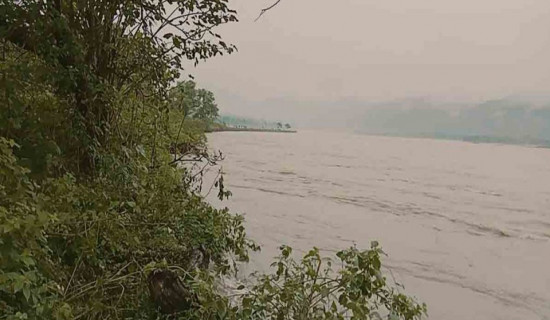
By Chandra PandakTaplejung, Apr 16 : Air services have resumed at Suketar Airport, in Taplejung district, from Friday after three weeks of obstruction.The obstruction was caused by the bad weather. “Dense fog had affected the air transportation to be operated from the airport. The weather got cleared on Friday and the services have resumed,” said Lokendra Limbu, station in charge of Nepal Airlines Corporation (NAC) in Taplejung.With the gradual improvement in the weather, three flights from Kathmandu-Taplejung took place on Friday from Suketar, informed Limbu.The obstruction had also affected tourists expecting to visit Mount Kanchenjunga. Passengers were also bound to return after waiting for hours for several days due to unfavorable weather.The NAC has been operating Kathmandu-Taplejung air services every Monday, Wednesday, and Friday from Suketar. The airport is at a height of 2,400 meters due to which the air transport service gets affected by fog.
By A Staff ReporterKathmandu, Apr 16 : Finance Minister Janardan Sharma said on Friday that the Nepali economy immediately needed transformation in agriculture and government mechanism to implement development programs. "The country is lagging in terms of development and growth and currently facing economic challenges because it has failed to manage available resources. There are challenges in utilization of the resources," he said in a meeting with the Nepal Association of Financial Journalists (NAFIJ) at his office. According to him, revolutionary changes are needed to transform the agriculture sector in order to make it able to substitute the imports that has reached Rs. 300 billion a year. The country is facing pressures on its foreign currency reserves as it is importing the goods that could be grown here. FM Sharma had initiated his budget-related discussions from agriculture. He believes that the national economy could be strengthened with the development in agriculture, reduction in the imports of petroleum fuel, increase in the generation and consumption of hydroelectricity, and attraction of tourists to Nepal. Similarly, the government mechanism to implement the development budget needs an overhaul. Although the country has been ushered to federalism, the mentality of bureaucracy and leadership is centralized which has created challenges in implementing the rights devolved to the subnational governments, he said, adding, "Reforms are needed to change this scenario. The country won’t gain much from the current structure."FM Sharma expressed worry over the high inflation rates which have severe repercussions on the foreign currency reserves, leading to economic challenges for the country. According to him, the country had paid about Rs. 100 billion for imports of petroleum products although the quantity of goods is more or less the same. Nepal imports petroleum fuel worth about Rs. 1 billion a day. Meanwhile, the government has planned to reduce the use of fossil fuel by 20 percent in its applications. Likewise, a hike in the price of goods like iron and steel, cooking oil, and vehicle spare parts had inflicted an additional burden on the balance of payment."We are also planning to shift the subsidy given to the LP gas to the electric cooking appliances in order to strengthen the national economy by reducing imports," said the finance minister. He said that his vision is to develop Nepal as a productive economy and the upcoming budget will have programs and projects to support this theme. Meanwhile, FM Sharma indicated that the claims of COVID-19 insurance would be paid in near future. However, he did not disclose the details.
Frank Doyle , Frank For generations, people have been fascinated by the links between mind and body. For example, do people really die of a broken heart? Does a healthy mind indicate a healthy body?Scientists have been studying the associations between mental and physical health for some time. One such association is between depression and heart disease. Research has shown that depression is more common among people with heart disease compared to the general population.Further, in people who are physically healthy, when followed over many years, those with elevated depressive symptoms are more likely to develop heart disease than those who don’t have depression. We also know that in people with acute heart disease (for example, they’ve had a heart attack), having depression is associated with increased risk of further heart attacks and death, not only from heart disease, but from any cause.However, fewer studies have investigated whether these trends exist in reverse – that is, whether cardiovascular risk factors are associated with a higher likelihood of developing depression. But now, a new study published in the journal PLOS ONE has sought to explore this.Sandra Martín-Peláez from the University of Granada in Spain and her colleagues focused on people with metabolic syndrome to explore the link between cardiovascular risk factors and depression in people aged between 55 and 75.Metabolic syndrome is a group of conditions that occur together – including high blood pressure, high blood sugar, excess body fat around the waist, and elevated cholesterol – and which increase a person’s risk of heart disease, stroke, and type 2 diabetes. The participants in this study were drawn from a broader trial analysing the effects of a Mediterranean diet on people who are overweight, and who have metabolic syndrome. More than 6,500 participants were included in the baseline analysis for the study, with over 4,500 followed up two years later. The researchers used the well-established Framingham risk score, which was developed by following healthy people over time to determine the major risk factors for heart disease. Participants were asked about their depressive symptoms using questionnaires at baseline (when they began following the diets and physical activity programmes) and then two years later. Surprisingly, no significant association was found between cardiovascular risk and depression at baseline or follow-up. So, overall, participants with a higher risk of heart disease were not more likely to have or develop depression.When the authors analysed the data by gender, they found that at baseline, women with higher cardiovascular risk were more likely to show symptoms of depression. On average, all participants’ depression scores reduced at two years. Depression scores dropped more for those who had low cardiovascular risk, and for those in the intervention group (participants who were following the restricted diet and the physical activity programme).It’s difficult to clearly interpret the findings of this study. The data has been analysed in several different ways, and there are some mixed results. For example, the authors analysed the data by different metabolic syndrome factors, finding that diabetes and certain cholesterol levels resulted in lower depression scores at follow-up.Although we can’t conclude from this study that heart disease risk is associated with a higher risk of developing depression, it does add to an already strong body of evidence suggesting heart disease and depression are linked.A number of factors, behavioural and biological, may explain this relationship. Some of the biological factors common to both depression and heart disease risk include increased inflammation, constriction of blood vessels in the heart, altered autonomic nervous system activity and blood platelet dysfunction (where blood platelets are more likely to stick together and form clots).Also, we know that healthy lifestyle factors, such as doing physical activity, not smoking and maintaining a healthy diet, are protective against both heart disease and depression. The opposite is also true – unhealthy lifestyle factors are associated with increased risk of heart disease and depression.Unfortunately, people with depression find it more difficult to change these sorts of habits, for example, to quit smoking. So probably the most interesting finding of this study is that depression scores were reduced in the group who were encouraged and supported to adopt a healthier lifestyle.While there’s good evidence to suggest that exercise is a very effective treatment for depression in people with heart disease, the role of diet as an intervention for depression is less clear. This study provides a promising impetus for more investigation of diet and lifestyle as potential depression treatments in those with and at risk of heart disease.(Frank is a Senior Lecturer, Department of Health Psychology, RCSI University of Medicine and Health Sciences.)
Aashish MishraIt is spring, the season of Jatras and celebrations here in Nepal. Beginning from Holi, this season hosts some of the biggest and best-known festivals of the country, including the Ghode Jatra, the Seto and the Rato Machhindranath Jatras, the new year’s Biska (Bisket) Jatra and more. Naturally, these are occasions of joy and relaxation. They also promote social cohesion and unity.The festivals mentioned above are not exclusive to one group or community. They bring people from all walks of life together and provide an opportunity for them to share lived experiences. The Rato Machhindranath Jatra can be a great example of this.This Jatra is executed and celebrated by everyone, regardless of class, caste and religion, of the ancient core city of Patan. God Karunamaya itself is a deity worshipped with equal fervour and dedication by both Hindus and Buddhists and no one from any ethnic and economic background is restricted in any way from pulling the chariot. Women are also allowed to participate in the fun on one special day and children, too, get in on the action by pulling the chariot of Minnath.The Rato Machhindranath Jatra even connects the people of Lalitpur with Dolakha. The Newas of Dolakha also worship the god and hold a chariot festival for it around a month before Lalitpur. This helps to establish a common link between the two districts and unites the multiple Newa communities residing here around one occasion. It is a similar case with Biska which is celebrated, in one way or the other, by all Bhaktapurians as well as those in parts of Kathmandu and Thimi. Holi, also called Phagu, also does the same thing as it is celebrated by most Hindus and even non-Hindus across the country.Of course, this unifying factor is not limited to the festivals of spring only. Take for instance Indra Jatra, a festival celebrated in Autumn, the nine oil-presser (Manandhar) wards are responsible for the selection, transport and erection of the 60 feel high sacred Yansi pole, the Jyapu farmers perform the Devi Pyakha (Goddess Dance) and are involved in conducting numerous processions throughout the Jatra period, a Putuwar from Balaju keeps watch over the Yansi for eight days, a Kusle musician comes and plays the oboe at its feet every day until it is felled, Hindu Rajopadhyayas and Buddhist Bajracharyas act as priests for the images of Indra put on display at Indrachowk, Maru, Kilagal and Nardevi and the mask of the Dagi is kept at the house of a Tuladhar family near Kasthamandap. Since the ascension of Prithvi Narayan Shah to Kathmandu’s throne, various non-Newa castes have also played important roles in the successful conduction and completion of the festival. Every caste plays a vital role for the completion of the Jatra and no task is judged big or small. All those engaged in the festivity are equally important.Nepal’s festivals have crossed geographical, racial and ethnic boundaries and bonded different groups and communities for centuries. However, in recent years, they have started to become exclusionary in the economic aspect. Excess and pomp have made festivals unaffordable for the poor. Too much emphasis on materialism has prevented economically disadvantaged families from participating in and enjoying the celebrations like they used to. This has started to create resentment and dismay which is particularly visible around Dashain and Tihar. It is a sad fact of our time that festivals are only festivals for those with money. For others, it is a reminder of their lack of resources and marginalisation.However, if we get rid of ostentation then festivals, at their core, are still unifying factors for our society.
By A Staff ReporterKathmandu, Apr 16 : For much of the past two years, COVID-19 ruled the world, creating unprecedented challenges to health system. As public health measures, hand washing, wearing masks and maintaining social distance remained part of the new normal. On 23 January 2020, the disease was first detected in Nepal. As mitigation measures the country adopted strict restrictions. During the first wave of the pandemic, the country faced shortage of personal protective equipment including masks and PPE.The second wave, severer than the first one, began to hit the country in April 2021, leaving many patients in dire need of medical oxygen and hospitalisations. On May 11, the country recorded highest single-day coronavirus-related deaths with 225 fatalities and 9,483 new cases within 24 hours. The fragile health care system was overwhelmed. And 8,000 cases were recorded on average on a daily basis. Again, Nepal faced the emergence of the third wave in January 2022. As the new variant of the virus, Omicron, was making a comeback, on January 20, 2022, Nepal recorded an all-time daily high of over 10,200 cases through RT-PCR tests. According to the health experts, the pandemic phase of COVID-19 seems to be ending in Nepal, unless significant and severe new variant emerges. If we see the trend in the world, however, COVID-19 may emerge again, but still we may not face the worst case scenario like that of the second wave, said Dr. Sher Bahadur Pun, chief of the Clinical Research Unit at Sukraraj Tropical and Infectious Disease Hospital, Teku. There are possibilities of new variants, muted or hybrid, gripping us anytime, so we need to be alert all the time, added Dr. Pun. According to Dr. Chuman Lal Das, director at the Epidemiology and Disease Control Division, though the cases are declining significantly, everyone should remain cautions. “Nobody is safe until everyone is safe from the virus,” said Dr. Das and added that as the cases have not been eradicated from the world, no one knows for sure how it is changing its face and will emerge again anywhere and anytime. As a precautionary measure, the government is still screening people coming from abroad at the Tribhuwan International Airport, said Dr. Das. The pandemic continues to recede for the last one month in Nepal as the cases are reported in two digits or even in a single digit, thanks to the robust vaccination campaign. The government so far has vaccinated 66.3 per cent of its population. The government has done a commendable job regarding vaccination, but still many are reluctant to get the jab, said Dr. Pun and added that it was essential to get vaccinated to fight against any variant of the virus.Dr. Sangita Kausal Mishra, spokesperson for the Ministry of Health and Population (MoHP), requested all to adopt safety health protocols and receive vaccines against COVID-19 to keep the virus at bay.
Ein Bahadur Malla, Deputy Inspector of Police (DSP) and chief at the Area Police Office in Kohalpur, said that the fire caught many houses as it was a time of windy weather and that there was no fire engine at Raptisonari.
BY A STAFF REPORTER, Kathmandu, Apr. 15 : Minister for Industry, Commerce and Supplies Dilendra Prasad Badu has said that micro, cottage and small scale industries are the backbone of the country's economy and the key to economic prosperity.He made this remark in an interaction with a delegation of the Federation of Nepal, Cottage and Small Industries (FNCSI) at the Ministry Wednesday.He said, "Micro, cottage and small industries are in priority of the government. This sector makes the country self-reliant and creates employment. We are ready to discuss what are the problems in this area, and what we should do for the solution.”"We felt that there are some problems in the promotion of this sector after the adoption of federalism in the country. We have to move forward by addressing the problem through the amendment to existing act and policy," he said.FNCCI President Umesh Prasad Singh said that effective implementation of the directive 2071 on the use of domestic goods in public entities should be made for the promotion of domestic goods and the development of local industries.He stressed the need to stop the import of agriculture and other industrial goods which can be produced inside the country.Stating that the state should provide structure and space for the promotion of locally produced goods and development of domestic industries at the federal and in the provinces for opening export houses, he said that arrangements should be made to keep only domestic goods produced by micro, cottage and small entrepreneurs across the country at the centre. "We request the government to keep the concessional loan programme given to women entrepreneurs, agro-industry and other entrepreneurs at 5 per cent," he said.
By Rekhi Ram Rana, Palpa, Apr. 15: At least two passengers have died when a bus skidded some 700 meters off the road at Juthapauwa in Rainadevi Chhahara-6 in the district.According to the police post at Juthapauwa, four passengers have been injured and they have been sent to the Mission Hospital in Tansen for treatment. The cause of the accident is yet to be known.
Kathmandu, April 15: Vice President Nanda Bahadur Pun asserted that the Nepali arts held a global identity for Nepal. He said Nepal is rich in natural and cultural arts. Inaugurating the National Fine Arts Exhibhition-2079 BS at Nepal Academy of Fine Arts (NAFA) in Kathmandu today, VP Pun recalled the national luminary Araniko who, according to the VP, held the head of Nepal high abroad through arts. Expressing his happiness over the wide reach of Nepali arts across the world, Pun recalled the pride he had taken to see Nepali folk and modern arts exhibited in Austrian capital-Vienna- some years ago. Stating that Nepali arts, which had over 2,000 years of history, were being created in various genres and techniques lately unlike in traditional form in the past, he underscored the State's support in preserving and conserving the arts. The VP shared that his interest spanned the field of fine arts. On the occasion, NAFA's chancellor Kancha Kumar Karmacharya said that the exhibition would run for a month. A total of 426 paintings by 365 artists from all over the country are on display in the exhibition. VP Pun, on the occasion, awarded senior fine artist duo Krishna Manandhar and Surya Bahadur Chitrakar with 'Araniko Pragya Samman' carrying a purse of Rs 100,000 for each. Similarly, journalist Devendra Thumkeli received 'National Fine Arts Writing Award' while Sushila Tamang was awarded 'Fine Arts Journalism Award'. Also, seven artists were awarded the 'National Fine Arts Award' in different categories and 17 with 'Fine Arts Special Award'. Seven artists from seven provinces received the 'Lalitkala Provincial Award'.
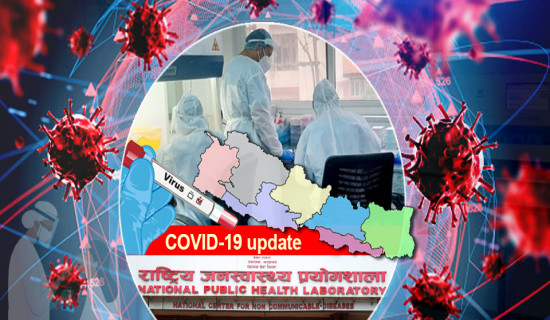
Kathmandu, April 15: With 14 new cases of COVID-19 confirmed on Friday, the nation's novel coronavirus tally has reached 978,648.In 3,030 Real-Time Polymerase Chain Reaction (RT-PCR) tests done in the past 24 hours, a total of 14 persons were found infected with SARS-CoV-2, informed the Ministry of Health and Population (MoHP) in its regular update.Likewise, the virus infection was detected in zero people in 873 antigen tests performed in the last 24 hours.Currently, there are 438 active cases of COVID-19 across the nation of which, 19 are admitted to various institutional isolation while 419 patients are placed in home isolation.Of the active patients, nine are admitted to the ICU and one is under treatment with the ventilator facility.Meanwhile, 55 COVID-19 patients receiving treatment in institutional isolation or staying in home isolation recovered from the infection in the last 24 hours. Nepal has now recorded 966,259 cases of recovery, and the recovery rate is at 98.7 per cent.The MoHP on Friday added zero COVID-19 related fatalities to the nation's COVID-19 death toll, which has now reached 11,951.
Provincial, district committees of ruling parties likely to be asked to forge consensus on electoral coalition by April 13 NBA decides not to issue LC for import of essentialsChief Minister Rai calls for opening export-oriented industriesCPN (Unified Socialist) forms Election Mobilization Committee Influx of devotees in Muktinath (Photo Feature) Former Finance Ministers draw government's attention to economy Chief Minister Rai calls for opening export-oriented industries Provincial, district committees of ruling parties likely to be asked to forge consensus on electoral coalition by April 13Issues of price increment of petroleum goods will be resolved: Minister Badu Chinese Ambassador Hou Yanqi sings Nepali song Resham Felili Chief Minister Rai calls for opening export-oriented industries Buddhakrishna piercing his tongue for the ninth time, says it'll be his last Issues of price increment of petroleum goods will be resolved: Minister Badu We are trying to have more Nepali workers in Japan: Deputy Assistant Minister Iwamoto Three new cases, 48 recoveries in 24 hours Buddhakrishna piercing his tongue for the ninth time, says it'll be his last IAEA Says Ukraine Has Requested Help Safeguarding Nuclear Plants Buddhakrishna piercing his tongue for the ninth time, says it'll be his last 2,593 foreign tourists arrived in Nepal yesterday Three new cases, 48 recoveries in 24 hours CPN (Unified Socialist) forms Election Mobilization Committee We are trying to have more Nepali workers in Japan: Deputy Assistant Minister Iwamoto Buddhakrishna piercing his tongue for the ninth time, says it'll be his last Former Finance Ministers draw government's attention to economy Chinese Ambassador Hou Yanqi sings Nepali song Resham Felili IAEA Says Ukraine Has Requested Help Safeguarding Nuclear Plants Three new cases, 48 recoveries in 24 hours Former Finance Ministers draw government's attention to economy Provincial, district committees of ruling parties likely to be asked to forge consensus on electoral coalition by April 13
Kathmandu, April 15: A meeting has been held between Home Minister Bal Krishna Khand and Netra Bikram Chand 'Biplav'-led CPN (Maoist) spokesperson Khadga Bahadur Vishwakarma 'Prakanda'.During a meeting at the Home Ministry on Friday, Prakanda said that they were positive to participate in the local elections.Home Minister's Press Coordinator Madhusudhan Bhattarai said that the party was demanding the release of party leaders and cadres jailed on various charges and the withdrawal of the charges against them.Both sides have stated that they have reached the final stage of agreement as the talks held repeatedly on this issue have been positive.After the government started the process of withdrawing the issue which can be withdrawn according to the law, the talks became governmental and came close to an agreement.During the meeting, Home Minister Khan said that the process of withdrawing the case has started.
Provincial, district committees of ruling parties likely to be asked to forge consensus on electoral coalition by April 13 NBA decides not to issue LC for import of essentials Provincial, district committees of ruling parties likely to be asked to forge consensus on electoral coalition by April 13 NBA decides not to issue LC for import of essentials
Kathmandu, April 15: The government has accepted USD 659 million in grant aid from the United States Agency for International Development (USAID).This information was given by the government spokesperson Gyanendra Bahadur Karki while announcing the decision of the cabinet meeting held on April 13.He said that the decision was made to accept 659 million dollars in grants from the United States Agency for International Development (USAID).The meeting also decided to accept a concessional loan of USD 150 million from the World Bank Group's International Development Association.Similarly, the meeting has decided to appoint Additional Inspector General of Armed Police Pushpa Ram KC as the Inspector General of the Armed Police Force and to accept the resignation of Ram Adhar Kapar, Chairman of National Housing Company Limited.
By Nancy Lapid, April 14 (Reuters) - The following is a summary of some recent studies on COVID-19. They include research that warrants further study to corroborate the findings and that has yet to be certified by peer review.The fourth vaccine dose protects against Omicron for at least a monthA fourth dose of the COVID-19 vaccine from Pfizer (PFE.N) and BioNTech (22UAy.DE) provided significant added protection against severe disease, hospitalization and death for at least a month in older individuals, according to a study from Israel conducted when the Omicron variant was dominant.The estimated effectiveness of the fourth dose during days 7 to 30 after it was administered compared with a third dose given at least fourth months earlier was 45% against infection, 55% for symptomatic disease, 68% for hospitalization, 62% for severe disease and 74% for death, the research team reported on Wednesday in The New England Journal of Medicine. The study compared 182,122 individuals aged 60 and older who received a fourth dose and 182,122 very similar people who had received a third dose but not a fourth."The results of our real-world study suggest that a fourth vaccine dose is, at least initially, effective against the Omicron variant," the researchers said. "Additional follow-up will allow further assessment of the protection provided by the fourth dose over time." A recently published larger Israeli study that looked only at rates of breakthrough infections and serious illness after the fourth dose found that efficacy waned quickly versus infection but held steady versus severe illness.COVID-19 may increase the risk for rare eye clotsPatients with COVID-19 may have an increased risk of rare vision-threatening blood clots in the eye for months afterwards, new findings suggest.Because SARS-CoV-2 infections increase the risk of blood vessel obstructions at other sites in the body, researchers studied nearly half a million COVID-19 patients to see whether they would develop clots in the veins or arteries of the retina, the nerve tissue at the back of the eye that receives images and sends them to the brain. Over the next six months, 65 patients had a retinal vein occlusion. While that number is low, it reflects a statistically significant 54% increase compared with pre-COVID infection rates, according to a report published on Thursday in JAMA Ophthalmology. Retinal artery clots were 35% more common after COVID-19 than before, but that difference might have been due to chance. The clots most often occurred in patients with other conditions that increased their risk of blood vessel problems, such as diabetes, high blood pressure, and high cholesterol.Clot risk did not appear to be associated with the severity of the coronavirus infection. The study cannot prove that COVID-19 caused the clots in these patients' eyes, the researchers noted, saying larger studies of the issue are needed.Risk of breakthrough infections tied to psychiatric problemsPeople with mental health problems are at higher risk for breakthrough infections after receiving COVID-19 vaccines, new data show.Researchers in California tracked more than a quarter of a million fully vaccinated patients in the U.S. Veterans Affairs health system. Nearly all were men, and roughly half had received at least one psychiatric diagnosis in the past five years. Overall, 14.8% developed COVID infections despite vaccination. Compared to study participants without a psychiatric diagnosis, those over age 65 with substance abuse, psychotic disorders, bipolar disorder, adjustment disorder or anxiety faced up to a 24% higher risk of breakthrough infections, the study found. For those under 65, risks were up to 11% higher than for those without a psychiatric history, the researchers reported on Thursday in JAMA Network Open."Our research suggests that increased breakthrough infections in people with psychiatric disorders cannot be entirely explained by socio-demographic factors or pre-existing conditions," said study leader Aoife O'Donovan of the San Francisco VA Health Care System. "It's possible that immunity following vaccination wanes more quickly or more strongly for people with psychiatric disorders and/or they could have less protection to newer variants."