AgenciesMumbai, Apr 20 : Huma Qureshi is all set to play the role of India’s first-ever home chef, Tarla Dalal, in her upcoming film. The actor announced the film, titled Tarla, on Tuesday. The poster shows Huma in a never-seen-before avatar. It also gives a glimpse of how the film will revolve around food and recipes.“I clearly remember how my mom used to try her recipes when we were kids. Looking forward to this very special character,” she said. Calling the role “awe-inspiring character”, Huma continued, “My mom had a copy of her book in the kitchen and would often try many of her recipes for my school tiffin. I also clearly remember the time when I helped mom make Tarla‘s homemade mango ice cream.” Produced by Ronnie Screwvala, Ashwiny Iyer Tiwari, and Nitesh Tiwari, the epic food filler will be directed by Piyush Gupta.Talking about the late chef and her decision to make a film on Tarla’s life, producer Ashwiny Iyer Tiwari said in a statement, “Tarla’s story is a lot more than her being an iconic chef. It’s a story about a working mother who singlehandedly changed the face of vegetarian cooking in India and paved way for many such home cooks and start-ups to aspire and achieve their dreams.”“Tarla Dalal transformed home cooking in India. Her story is a textbook example on entrepreneurship – how it is never too late to work towards your ambitions. Very excited and looking forward to collaborating again with Ashwiny and Nitesh,” Ronnie Screwvala said.The film will be directed by Piyush Gupta, who has been a writer on films like Dangal and Chhichhore. “I am delighted to have the opportunity to illustrate Tarla Dalal’s life on screen. Being a foodie myself, the intention is to make this film a treat for all food lovers to gorge on,” he said.Tarla Dalal was an Indian food writer, chef, cookbook author, and host of cooking shows. She was the first Indian to have been awarded a Padma Shri award in the culinary skills category in 2007.
By Vijay Kumar SahDhalkebar, Apr 20 : Political parties in Dhanusha are gearing up for the upcoming local level election. But their voters in villages are busy harvesting wheat.When meetings, gatherings and interaction programmes of the political parties have increased the farmers can be seen busy harvesting wheat.Some farmers are cutting wheat while others are threshing it and taking it to their houses. They are busy the whole day in their fields.Now the season of wind, rain and hailstorm has arrived. If they do not harvest wheat in time then they risk losing their hard-earned grain to the hailstorm. That's why the farmers are away from the election campaign, said farmer Manoj Mahato of Mithila Municipality-3.He added that all farmers are busy harvesting wheat so they were not concentrating in the election and the political programmes. They said they would join the political programmes after completing the wheat harvesting work."Election has just started. We can still think about whom to vote but if we can't take care of the wheat in time then we might have to go hungry,'' said a farmer, Ram Pukar Yadav, of Ganeshman Charnath Municipality, Barmajhiya. He added, “This time we will vote for the ones who understand the problems of the farmers. We will choose those who understand the real problems of the farmers instead of one who give only false assurances. In the previous election, many used the slogans of providing irrigation facilities, fertilisers and farming tools but they did all that only to get elected as the problems of farmers remain the same now."Last year, 108,000 metric tonnes of wheat was produced from 36,000 hectares of land. But this year the production was likely to decrease to 102,000 metric tonnes due to lack of chemical fertilisers and damage caused by the winter rain, stated Chairperson of Agriculture Knowledge Centre, Shankar Prasad Sah.
The adult franchise is a prerequisite in a democratic political system. The principle of the adult franchise adult franchise is a prerequisite in a democratic political system. The principles of the adult franchise are meant for ensuring the right to vote of eligible citizens without any discrimination irrespective of caste, class, religion, region, and so on. The election is a crucial democratic exercise that ensures people's participation in their decision-making process with direct or indirect representation. The government has only the right to impose tax when it ensures the representation of the people. So, all stakeholders including the political parties and the government are responsible to create an environment conducive to conducting free and fair polls. So, a peaceful and fearless environment is another prerequisite for the election under democratic governance. The election will fail to nurture the spirit of the constitution if the electorate cannot vote in a free and fearless manner. In this connection, Minister for Home Affairs Bal Krishna Khand the other day urged all political parties to participate in the local level elections scheduled for May 13. This is an occasion to strengthen the federal democratic republic system with the implementation of the new constitution through periodic elections. Minister Khand also called upon those political parties of the country which have not participated in elections so far. The government is regularly holding meetings with the political parties which have not participated in the elections till now, particularly the ones led by Netra Bikram Chand ‘Biplav’ and CK Raut. The Home Minister said that both the political parties are positive regarding their participation in the local polls. This is a very positive sign because people are in no mood to see any forces going against the present democratic setup achieved through hard struggle and sacrifices of the people. As negotiations are the key to including all stakeholders in the elections, the government's efforts are commendable. The legitimacy of elections will be established when all political parties participate in the elections. They represent people through ballots. The government has an onerous responsibility to arrange sound security and a peaceful environment for polls. Holding talks with the disgruntled political parties, and providing security to the people and the electoral staff is important in this respect. Definitely, local-level elections strengthen grassroots democracy where representatives who are truly familiar with the grievances and needs of the people are given a mandate. This is a time when people make a comprehensive evaluation of the outgoing representatives and seek fresh pledges from the aspiring candidates. These polls act as an acid test for local leaders to sift between false promises and true commitments. As reported in this daily, the Election Commission is carrying out poll preparations on a war footing and has already printed ballot papers for 46 districts. The commission says that out of 19.4 ballot papers required for upcoming local polls, a total of 9.5 million ballot papers have been printed so far. The ballot papers are being printed at the state-run Janak Education Materials Centre and about 800,000 ballot papers are being printed daily on average. The EC has says that it has not received any financial aid from foreign donors for election purposes. It is a good signal toward the self-sufficient position of the country in holding the elections. There are various tasks that have to be carried out in pre-election, during the election and post-election time. The government's efforts to bring all parties in the elections and assure a proper environment will win the trust of the people and provide an important impetus to a vital democratic exercise.
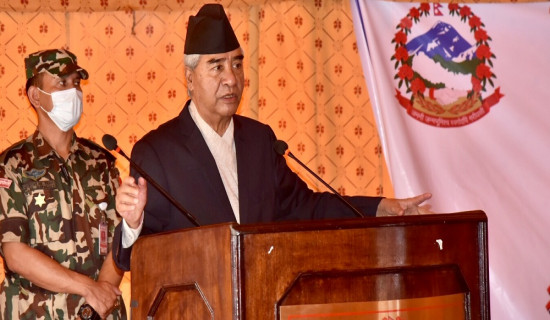
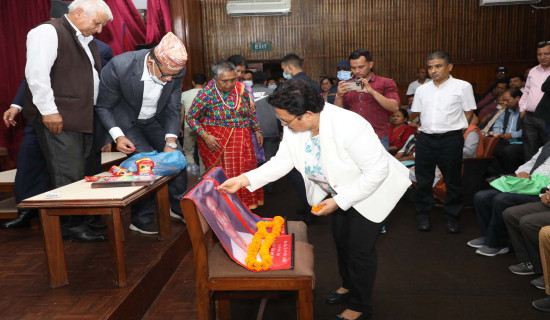
BY A STAFF REPORTERKathmandu, Apr 20 : Prime Minister and President of Nepali Congress Sher Bahadur Deuba has said that a conspiracy is being hatched to break the alliance made by the ruling government. Addressing a program organized on the occasion of the establishment day of the Nepal Students’ Union (NSU) here on Tuesday, Prime Minister Deuba said that the coalition with other parties would not break. Alliance has benefited the Nepali Congress, as most of the provinces have got chief ministers from our own party, said Prime Minister Deuba. The existing political alliance should not be broken. As per the constitution, there is no condition that a single party gets a majority in the election, added Prime Minister Deuba.Speaking at the function organized on the occasion of the 53rd anniversary of the NSU, Prime Minister Deuba pointed out that NSU should reach at village level and engage students of the school level to increase its importance. In order to win the free student union, consolidating its foundations from the school level is essential, added PM Deuba. Prime Minister Deuba urged students to achieve excellence in an academic career and also asked them to dream of the posts of Prime Minister and President including other prominent posts in future. “This is a competitive age, so education should be in priority.”NSU also launched its calendar and NSU app. On the occasion, Deuba honored NSU founding president Bipin Koirala, vice-president Sanad Regmi, general secretary Tika Pokhrel, Chiranjivi Wagle, members Ramchandra Poudel, Surendra Bahadur Bist, Kedar Neupane, Damodar Gautam, Chakraraj Pant, Basant Gurung and Rajendra Bahadur Shah among others. Meanwhile, the ruling NC has established a 'province desk' under the coordination of General Secretary Bishwa Prakash Sharma for the upcoming election. Party President Sher Bahadur Deuba established the province desk at the party’s central office on the recommendation of the meeting of the local level central election mobilization committee coordinated by Vice President Purna Bahadur Khadka.The Joint General Secretaries will look after each province's affairs relating to the election.
Yuba Nath Lamsal, The war in Ukraine will leave a deeper mark in the geopolitical landscape of Europe. History is a witness to the fact that invasion in a sovereign country has always been costly no matter how powerful the invading country might be. World history is filled with the rise and fall of empires. The empires that once boasted as invincible did not last forever and were eventually dumped in the trash of history. Let us go back to recent history. Saddam Hussein of Iraq invaded its small neighbor Kuwait in 1990. The Kuwait invasion brought his downfall. The Soviet Union, which was a superpower of that time, invaded Afghanistan in 1979 which proved costly for Moscow and the Soviet Union disintegrated in 1992 and lost its superpower status. The United States got into military conflict in Vietnam in 1975 to contain the spread of communism but Washington had to return in humiliation losing more than it gained as the same Vietcong communists against which America fought 20 years came to power after the US withdrawal. Washington met with a Vietnam-like fiasco in Afghanistan very recently. The United States attacked Afghanistan in 2001 in a furious response to the terrorist strikes in Washington and New York, the responsibility of which was claimed by Al Qaeda. America entered into the Afghanistan war to wipe out Al Qaeda terrorists and teach the Taliban a lesson for giving shelter for Al Qaeda terrorists. America got badly stuck in the Afghanistan war and it had to come out in utter disgrace even after its military engagement for two decades. America somehow came out of the Afghanistan quagmire but the sole superpower is facing a challenge to maintain its position as the mightiest and richest country.Fall of hawkish powersHawkish powers may apparently emerge winners but ultimately they lose. Only pacifist ones could gain in the long run. Empires like Roman, Byzantine, Mongol, Japanese, British, French, German, Russian, and several others rose and fell. Hawkish Germany and imperial Japan were badly crushed in World War II. Germany and Japan emerged as economic powers only after they gave up military adventure and embraced the pacific policies. The newer developments in Ukraine will certainly have repercussions in Europe and more particularly in Europe’s eastern flank and Nordic Region. The security architecture of Europe is likely to take a paradigm shift. Russian adventure in Ukraine has made countries in Europe particularly Eastern Europe and the Nordic Region more susceptible. Nordic countries like Finland and Sweden are now contemplating joining the North Atlantic Treaty Organization (NATO), the transatlantic defense architecture under US leadership. According to the opinion polls in Finland, 62 percent of Finns want to join the NATO, Swedish public opinion to seems to be inclined toward NATO membership.If Finland and Sweden join NATO, other European countries may be tempted to become part of the Western security umbrella further isolating Russia. Ukraine has already initiated the process and Georgia, Moldova, and Kosovo may follow suit. Currently, NATO has 30 members of which 27 are European countries. The United States, Canada, and Turkey are non-European NATO members. Similarly, six other countries namely Finland, Sweden, Ukraine, Georgia, Australia and Jordan have the status of enhanced opportunities partnership for dialogue and cooperation (EOP) of NATO.Finland maintained its neutral position even during the height of the Cold War, which used to be taken by some countries as a role model. In the aftermath of Russian action in Ukraine, these Nordic countries seem to be shaking off the luxury of neutrality and embracing the European collective defense alliance. Russia’s action in Chechnya in 2014 led Ukraine and two Nordic countries to become EOPs of NATO. The Ukraine war pushed them further towards the West.Even if these countries want to join NATO, it may take months to acquire membership due to long membership procedures. The first step requires a country to write to NATO headquarters expressing its intent to become a member. Then all members need to unanimously decide in the North Atlantic Council, the executive body of NATO and extend an invitation for necessary talks relating to new membership. In the accession talks, the aspirant country has to convince the NATO experts that it meets all the criteria and obligations that NATO requires. Then the aspirant country has to write a letter to the NATO secretary-general clearly expressing commitment to abide by the obligations of the Alliance. There are specific criteria to become a NATO member which include: democracy, diversity, a free-market economy, and a military under civilian control. This has to be ratified unanimously by all member countries in the North Atlantic Council. Once it is ratified by all members, the aspirant country is notified about the approval for the new membership. Normally it would take more than a year to complete the procedures. ‘Obsolete’ NATO However, there are question marks even about the relevance of NATO and its capability to defend Europe. NATO is the relic of the Cold War and some even demand it be disbanded. Former US President Donald Trump called NATO ‘obsolete’ while British politician Jeremy Corbyn, who was once chief of the British Labour Party and leader of the Opposition in parliament, said ‘NATO as a Cold War product should have shut up shop along with the Warsaw Pact’. French President Emanuel Macron and former German Chancellor Angela Markel floated the idea of creating a separate European Army under the EU. But the creation of EU Army may not be plausible at the moment. After the Brexit, Europe is a divided house as major powers of Europe are not unanimous on many issues. Given the new scenario and developments, NATO expansion to the Nordic region seems to be likely. But it remains to be seen what consequences and ramifications the newer developments in Europe will have in the future security and geopolitical landscape of Europe and the world. (The author is a former ambassador and former chief editor of this daily. lamsalyubanath@gmail.com)
Namrata Sharma, The people all over Nepal have now started storing grains and pulses as the prices of daily necessities are skyrocketing. The fuel prices have been increasing steadily since the Ukraine war. Because of the financial crisis in Sri Lanka which is similar to that of Nepal, the people in Nepal are perhaps more alarmed than necessary. But is there a need to fear that Nepal will face an economic and financial crisis soon? According to Nepal Rastra Bank, the foreign currency reserves in the country have fallen by more than 16 percent to Rs 1,17 trillion, which amounts to US $9.59 billion in the seven months till mid-February 2022. NRB also states that over the same period, the amount of money sent to Nepal by people working abroad fell by almost 5 percent. The fact that Sri Lanka saw a drop of 70 percent in foreign reserves since January 2020, could be an alarm bell for Nepal as the above-mentioned drop of 16 percent mentioned by NRB is data for 7 months. Import restriction The NRB has accepted that the country’s foreign currency reserves were under pressure. Keeping this in mind, the government has recently restricted imports of non-essential goods like cars, cosmetics, and gold. The government is now restricting the purchase of non-essential goods without affecting the supply of essential goods. By discouraging the import of non-essential goods at a time when the overall economic activities have seen a slump due to the coronavirus pandemic, the government has made a smart move. The Nepali people should now prioritize their needs and should adopt the habit of purchasing locally manufactured goods and consuming local foods. This will help them to save their individual savings and the country’s reserves. There are various comparisons between Nepal and Sri Lanka with regard to large foreign debts and reliance on foreign goods. Also, both the countries’ revenue generation is the tourism industry, which has been hit hard by the ongoing pandemic. However, Finance Minister Janardan Sharma has said that there is no need to compare the two countries as Nepal is not in the same condition as Sri Lanka.According to a statement from Finance Ministry, which is uploaded on its website, the government had to increase spending in order to manage the economic impact of the pandemic. As a result, Nepal’s debt has risen to more than 43 percent of its gross domestic product. However, the Finance Ministry’s statement emphasizes the fact that the economic indicators are normal. The statement mentions the fact that due to the stress on the foreign reserve, it has taken steps to manage imports and increase the foreign exchange reserves. The Finance Minister also has mentioned that Nepal’s debt is lower than other countries in the region. Minister Sharma’s stand seems to be validated by the British economist Alex Holmes. According to a report by Annabelle Liang and Sanjaya Dhakal in BBC News, Alex Holmes, an emerging markets economist at the research firm Capital Economics at the UK, said that the situation in Nepal appears “much better than in Sri Lanka”. According to Holmes, as mentioned in the BBC report, Nepal’s foreign currency reserves are double, which is considered “a comfortable minimum” and government debt “is not particularly high”. He also said that if the current account deficit is not narrowed things could regress “but the crisis does not appear imminent”.The government seems to have taken the right steps in decreasing the import of non-essential luxury goods to prevent the depletion of foreign reserves. The people in countries like Nepal and other South Asian countries need to revisit the consumerism habits that they have gotten into. Most South Asian countries had a savings-oriented behavior till the late 80s. With the advent of the global market-led economy, they resorted to aggressive consumerism and switched to the Western lifestyles of the affluent countries. Buying in credit from the banks with credit cards encouraged the middle class and rich families to have more than one house, several cars, motorcycles and other extra goods. Rather than spreading misinformation the media and experts need to do a better economic and financial analysis and spread factual information to help the country to increase foreign reserves.Awareness campaign It’s now better for the government and people, in general, to work together to cushion the impact of a possible financial crisis here. For this, using goods produced within the country and consumption of foods produced here could be the first step. The government should reduce significantly or waive off taxes levied on electric vehicles and set up charging stations to decrease our dependence on petrol and diesel. The experts should study the facts and give accurate information on the economic and financial situation of the country and suggest ways to mitigate their adverse effects on the economy. In this digital age, because of misinformation and disinformation, people are more prone to undue stress which can hamper their well-being. Therefore, it is wise to reduce buying non-essential luxury goods and focus on creating local-based industries. It is also important to start an awareness campaign on how to increase the use of local items. The political leaders and their parties should make this issue the main agenda in the upcoming elections.(Namrata Sharma is journalist and women's rights advocate namrata1964@yahoo.com Twitter handle: @NamrataSharmaP )
Dixya PoudelBooks after books, a reader earns not just knowledge but also a feeling of elation. Reading is an activity that is important for excelling in education and in most professions. At the same time, it is a leisure activity - one that is a favorite for many. April 23rd is World Book Day. Out of the 365 days on the calendar, this is a day dedicated to books but as readers may realize, each day can be the day to pick up a new book and delve in, one page at a time. Words are the building blocks of a text and readers come up with their preexisting schema when reading. They compare, take in, comprehend and build their vocabulary and grammar syntax as they read. Reading thus involves an understanding of the meanings behind the text. Further, it is important to the human world as it helps one find a way in life. Through reading, one learns about the world, oneself and about one’s place in the world. It opens up new horizons, opportunities, and possibilities to the readers. World Book Day was founded on April 23, 1995, by United Nations Educational, Scientific and Cultural Organisation (UNESCO). If one is to go back in the world history, writing systems were invented thousands of years ago in ancient civilizations in the form of clay tablets. Next, civilizations went on to use papyrus. Then in the 3rd century, Chinese societies became the first to make books through sewn bamboo pages. It was finally in the mid-15th century that Johannes Gutenberg invented the printing press which hallmarked the beginning of an era of printed books. People were thus able to read printed books in the industrial age and as a citizen of the twenty-first century, readers can now read varied books on electronic devices, a far cry from the industrial era. Now there are Kindles, tablets and iPads as well as mobile phones in which readers can read books. World Book Day was first observed in April 23, 1923, by booksellers in Spain as the commemoration of the death of beloved Spanish writer, Miguel de Cervantes. The event was celebrated through a book exchange ceremony. However, it was only in 1995, that an official inaugural celebration of World Book Day took place. Since then, the world has been observing April 23rd with book readings, book exchanges, signings, and publications. Further, April 23rd is also the anniversary of the death of the world renowned English playwright William Shakespeare.From poetry, dramas, novels, textbooks or biographies, books play an indelible part in human world. We read and we learn, we understand and then we act. Thus, books have an outreach to illuminate minds with knowledge and wisdom. It is also a form of escape as readers lose themselves in complex fictional worlds or those built on real life events. There is no refuting the significance of books in the lives of people.A child reads children’s literature with a curious, eager, and inquisitive mind. Consequently, the child grows up to be a well-educated, informed and aware citizen. Thus, the evolution of the consciousness, intelligence, and wisdom is ultimately cultivated in a growing mind through books which is why it is important to promote World Book Day globally and locally.
By A Staff ReporterKathmandu, Apr 20 : The National Examination Board (NEB) has said that preparations for the Secondary Education Examination (SEE) of the academic session 2078 BS have reached the final stage.The board that concluded the SEEs through internal evaluation in the two academic years -2077 and 2076 - because of the COVID-19 pandemic is conducting the exams as in the normal period. The NEB has scheduled to conduct SEE from April 22. The NEB has been preparing to conduct the SEE in coordination with the Province Ministry of Social Development and the District Examination Coordination Committee this time.Arjun Rayamajhi, Examination Controller of SEE, said that the examination materials including question papers and answer sheets have reached all 77 districts. Now, the NEB has been conducting training for superintendents across the country.The Board has fixed 2,007 examination centers and one sub-center for 514,760 examinees across the country. The board informed that 488,742 candidates will take the regular examinations and 11,454 candidates will participate in grade upgrading examinations. Similarly, 14,564 students from 299 technical schools across the country are also attending the SEE.Although the Ministry of Education, Science, and Technology (MST) had prepared to conduct SEE from the province level this year, it was unable to conduct the examinations that way in a lack of required law.Rayamajhi said that the NEB will initiate conducting the examinations from the province level once the required action is in place.
By Month DhakalKathmandu, Apr 20 : The Kathmandu Upatyaka Khanepani Limited (KUKL) is making preparations to send water from the Melamchi Water supply Project (MWSP) to the households in the Kathmandu Valley from coming Sunday. "If things went as planned and projected, we will be able to supply water to our consumers in the next five days," said Prakash Kumar Rai, Deputy Manager of KUKL. Earlier, the Ministry of Water Supply had announced that the water from the Melamchi in Sindhupalchok would be brought to the valley on the first day of the Nepali New Year, 2079. Tuesday is the 6th day of the year. KUKL's supply pipeline network is ready to pump water but in the first phase, water would be transmitted through the old network. However, households connected with the new supply network could get the water depending on the amount of water arriving in the Kathmandu valley. Rai said that the water utility had designed the supply plan in a way it would benefit maximum consumers. The MWSP had sent water to the tunnel last week and the water reached the Sundarijal side in the valley on Tuesday. The water will be held in the tunnel for about five days to get it filled and clean up. According to Bashu Dev Paudyal, Executive Director of the Melamchi Water Supply Development Board, it will take maximum of five days to fill up the 26.5 km long tunnel of the project. He said that after filling the tunnel, the water would be flown to the treatment plant in Sundarijal and within 5-6 hours it would be sent to the distribution networks. Meanwhile, the work to clean the debris deposited by the floods and landslide upstream of the Melamchi River in Sindhupalchowk on July 15 last year. Headworks and a part of the tunnel of the national pride project was damaged in the disasters caused by torrential rains. The structures were buried about 15 meters down in the debris. The work to restore the project had begun by the end of January this year. "About 75 percent debris is removed from the site and top of headworks is visible now. The site would be cleared and assessment would be conducted before the coming monsoon," said Paudyal. When the floods hit the headworks, the project had completed the construction of civil works of the headworks and only a small amount of hydro-mechanical and electrical work was remaining. Earlier, on 2 April 2021, President Bidya Devi Bhandari inaugurated the distribution of Melamchi water by letting a tap flow at the Bhrikutimandap, Kathmandu. The project was conceptualized about five decades ago and construction was started about two decades ago. It witnessed multiple deadline extensions and cost overruns, which have almost doubled by now. In the first phase, the project is supposed to bring about 170 million liters of water a day in Kathmandu. In the second phase, 340 million liters of water from the Yangri and Larke rivers would be added to the system.
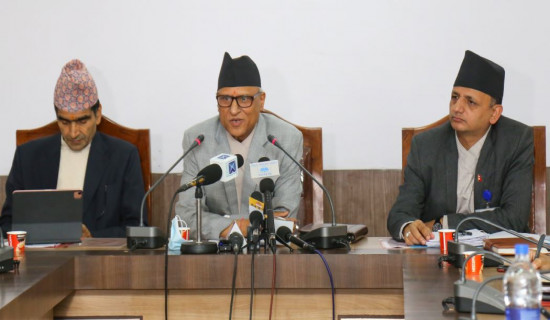
"The meeting was held under the chairmanship of the Prime Minister and it went on for some hours. Views have been put forth from different angles and all the views have moved forward positively,"
China will adhere to its dynamic zero-COVID approach as local infections are surging, a spokesperson for the National Health Commission (NHC) said Tuesday.
In 3,058 Real-Time Polymerase Chain Reaction (RT-PCR) tests done in the past 24 hours, a total of ten people were found infected with SARS-CoV-2, informed the Ministry of Health and Population (MoHP) in its regular update.
A joint bench of the Supreme Court (SC) justices Tej Bahadur KC and Tilak Prasad Shrestha issued a verdict to this effect scrapping a case filed at the SC against the election code of conduct.
Initiatives have been taken in creating an environment conducive to hold the May 13 local election in a fair, free and disciplined way and such efforts should not be doubted, he said at an event organised today here by the Election Commission.
Stressing that the legislature should pay attention to making laws, he said that they are seriously involved in finding out structural loopholes in the federal parliament and province legislature and resolving the problems.